January 10, 2012

American Monsters: Images of Brazilian Nature from Early Modern Europe

"The most disgusting and nauseating thing which man ever saw." 
-Spanish chronicler Andres Bernaldez on Christopher Columbus' first impression of Caribbean iguanas, 1513.

IN HIS BOOK Marvelous Possessions: The Wonder of the New World, Harvard literature professor Stephen Greenblatt argues that "the production of a sense of the marvelous in the New World is at the very center of virtually all of Columbus's writings about his discoveries, though the meaning of that sense shifts over the years." Greenblatt thinks that Columbus emphasized wonders and marvels "because marvels are inseparably bound up in rhetorical and pictorial tradition with voyages to the Indies. To affirm the 'marvelous' nature of the discoveries is, even without the lucrative shipments yet on board, to make good on the claim to have reached the fabled realms of gold and spices." Yet Greenblatt doesn't devote much space in his book to the flip side of the "marvelous": the monstrous.

As Iberian voyages of "discovery" segued into expeditions of conquest and settlement over the course of the sixteenth century, Europeans increasingly visualized the New World as a land of bizarre torments, freakish monsters and outlandish civilizations in thrall to the devil.
Map of Brasil, Dieppe School, 1547. Click to see
much larger version.
Spanish interpretations of the religious practices they encountered in the lands of the Aztec Triple Alliance have attracted the majority of historians interested in how Europeans expressed fear, apprehension and disgust -- as well as wonder -- toward the Americas (see below for some recommendations). The pictures below show that monsters and the monstrous were also depicted in the context of Portuguese Brazil. I'm particularly interested in how the incredible biodiversity of Amazonia was initially interpreted by European observers who had seen nothing to rival it in their temperate homelands. Although comparisons to the Garden of Eden were frequent, these images also reveal a profound anxiety about the abundance of nature in the Neotropics. 
The Flemish engraver Theodor de Bry's vision of Brazil mingles outlandish sea creatures with
flying devils who torment the Tupí Indian villagers at lower right. Theodor de Bry, Americae 
tertia pars (Frankfurt, 1592)
Birds of paradise feature in this detail from the 1547 Dieppe map of Brazil linked above.
Tupí Indians hunt leonine creatures, probably reflecting early accounts of jaguars. Another detail.
In the same pictorial field, villagers lounge while two tortoises amble by.
During the Dutch occupation of parts of Brazil in the 1640-60 period, a number of highly
skilled painters visited the new colony to record their impressions of its flora and fauna.
In this 1665 painting by Albert Eckhout, two dueling tortoises recall the pair in the detail
from the Dieppe map above.
Despite their skill in visual representation, however, Dutch artists were often at least as fanciful in their depictions of South American monsters as their French and Iberian peers. The engravings below, selected from the Dutch author Arnoldus Montanus' 1671 De Nieuwe en Onbekende Weereld (The New and Unknown World), offer a positively bizarre take on American animals and peoples. 
The "draco" (dragon) in this one bears a passing resemblance to the "Jenny Hanivers" and
"Sea Monks" of early modern sailors' lore.
Europeans were also fascinated and fearful of the "monstrous" forms of indigenous Brazilians themselves. Although most accounts remarked upon the good health, longevity and physique of Tupí Indians and other indigenous societies in Brazil (probably a reflection more of the poor health and diet of the European mariners than anything else), others focused on their tendency toward body-modification. The most entertaining and strange European take on piercing and tattooing I have been able to find is John Bulwer's fantastically titled Anthropometamorphosis: Man Transform’d, or the Artificial Changeling. Historically presented, in the mad and cruel Gallantry, foolish Bravery, ridiculous Beauty, filthy Fineness, and loathesome Loveliness of most Nations, fashioning & altering their Bodies from the Mould intended by Nature. With a Vindication of the Regular Beauty and Honesty of Nature, and an Appendix of the Pedigree of the English Gallant. (London: J. Hardesty, 1650). (I wrote about this a bit in an earlier post). Below he describes how "the Brasileans... are pricked within the flesh" with paint.
Bulwer's title page takes this a step further, showing an Amerindian figure sporting some truly remarkable tattoos! The European woman with facial tattoos to the figure's left highlights Bulwer's concern that this "barbarous" custom would become fashionable with his own countrymen (he was right, but it would take another three hundred years or so to really catch on, and the whole "face on a butt" tattoo fad seems to still lie in the future).

Readers wanting to learn more about the role of the devil and the monstrous in European interpretations of Amerindian societies might want to start with Fernando Cervantes' The Devil in the New World and Jorge Canizares-Esguerra's Puritan Conquistadors. Greenblatt's Marvelous Possessions, quoted above, is a great study of how the fantastical and marvelous figured into colonization, while Joyce Chaplin's Subject Matter: Technology, the Body and Science on the Anglo-American Frontier, revises and critiques his claims in various interesting ways. Those interested in New World nature and particularly animals should check out A New World of Animals: Early Modern Europeans on the Creatures of Iberian America Miguel de Asua and Roger French, a fun, learned and highly-entertaining book (from which I stole the quote on iguanas that opens this post). 

October 19, 2011

The Art of Fooling the Eye

PARRHASIUS, it is said, entered into a pictorial contest with Zeuxis, who represented some grapes, painted so naturally that the birds flew towards the spot where the picture was exhibited. Parrhasius, on the other hand, exhibited a curtain, drawn with such singular truthfulness, that Zeuxis, elated with the judgment which had been passed upon his work by the birds, haughtily demanded that the curtain should be drawn aside to let the picture be seen. Upon finding his mistake, with a great degree of ingenuous candour he admitted that he had been surpassed, for that whereas he himself had only deceived the birds, Parrhasius had deceived him, an artist. - Pliny the Elder, The Natural History (circa 77 CE), Book 35, Chapter 36.

Bronzino's Venus, Cupid, Folly, and Time detail, (c. 1545).
THE ability to trompe-l'œil ("deceive the eye" in French) was among the most highly prized artistic skills of Pliny's day, as evidenced by the many tales of Greek and Roman painters who boasted that their works were capable of fooling both man and beast. Although most figurative paintings offer an illusionistic "window" into a false reality to some degree, trompe-l'œil works take such verisimilitude to the level of optical illusion. The technique has been called a "triumph of the gaze over the eye."

My favorite examples of trompe-l'œil come from the Renaissance and Baroque periods (roughly speaking c. 1500 to c. 1700). European culture of this era displayed a strong fascination with the interplay between the beautiful and the hideous, the secret and the visible, and the concept of truth. In the arts, these preoccupations were expressed through masks, stage plays (whose actors often functioned as a metaphor for life in seventeenth-century poetry), and the mask-like, mysterious figures of Mannerist painters, most famously exemplified in the brilliant and vaguely creepy works of Agnolo Bronzino.

It is not surprising, then, that paintings which expressly sought to fool the eye (and the mind) by experimenting with the boundaries between the artificial and the real enjoyed a high level of popularity throughout the 1500 through 1700 period -- nor that these works could function as profound reflections on the nature of visible reality rather than as clever but gimmicky visual tricks, which is how we tend to approach trompe-l'œil today. Below are some of my favorite examples.
Domenico Remps, A Cabinet of Curiosity, 1690s.
I included this painting in an earlier post on curiosity cabinets, but wanted to revisit it here to show Remps' incredible ability to evoke illusionistic details. Notice, for instance, the reflection of the mirror in the upper left part of the cabinet, which, much like Jan van Eyck's famous Arnolfini Wedding, reveals the room in which it was painted:


Even as Remps points out the artificial nature of the painting by revealing the site of its creation, however, he also creates the illusion that an actual curiosity cabinet (rather than its mere representation on canvas) stands before us. This photo-realistic effect is achieved by clever touches such as the broken glass on the right hand cabinet window.


Portraying paintings within a painting, as Remps does here, was an extremely popular approach -- I suppose because it highlighted the painter's skill in multiple genres while also maximizing the visual delight of the viewer by offering several vistas and scenes at once (modern tastes tend to be more minimalist, but the seventeenth century was all about maximalism). The ultimate example of this that I have seen is David Tenier's incredibly over-the-top depiction of Archduke Leopold Wilhem's gallery:
David Teniers the Younger, ca. 1650, Archduke Leopold Wilhelm in his Gallery in Brussels, Kunsthistorisches Museum, Vienna.
Another typical approach of the period which I find to be in many ways more interesting was that of including written texts in paintings. This technique is actually visible in a surprisingly large number of famous works (for instance, in Hans Holbein's famous portrait of a German merchant). It reached an extreme form, however, in paintings such as the following:
Jean-François de Le Motte, c. 1670, Still Life, Musée des Beaux-Arts de Dijon.
A detail of the texts, which include a letter to the artist, a printed pamphlet and what appears to be an accounting
 notebook.
Cornelius Gijsbrechts (c.1630 - 1675), Trompe l'oeil, Museum voor Schone Kunsten, Gent, Belgium.
 Edward (or Edvart) Collier, Trompe l'Oeil of Newspapers, Letters and Writing Implements
on a Wooden Board
(1699)
Incidentally, this last work offers a fascinating glimpse into the origins of the modern newspaper. One of the early "intelligencers" depicted here, the Apollo Anglicanus, can be previewed on Google Books. (Check out the blog Merciurius Politicus for more along these lines).
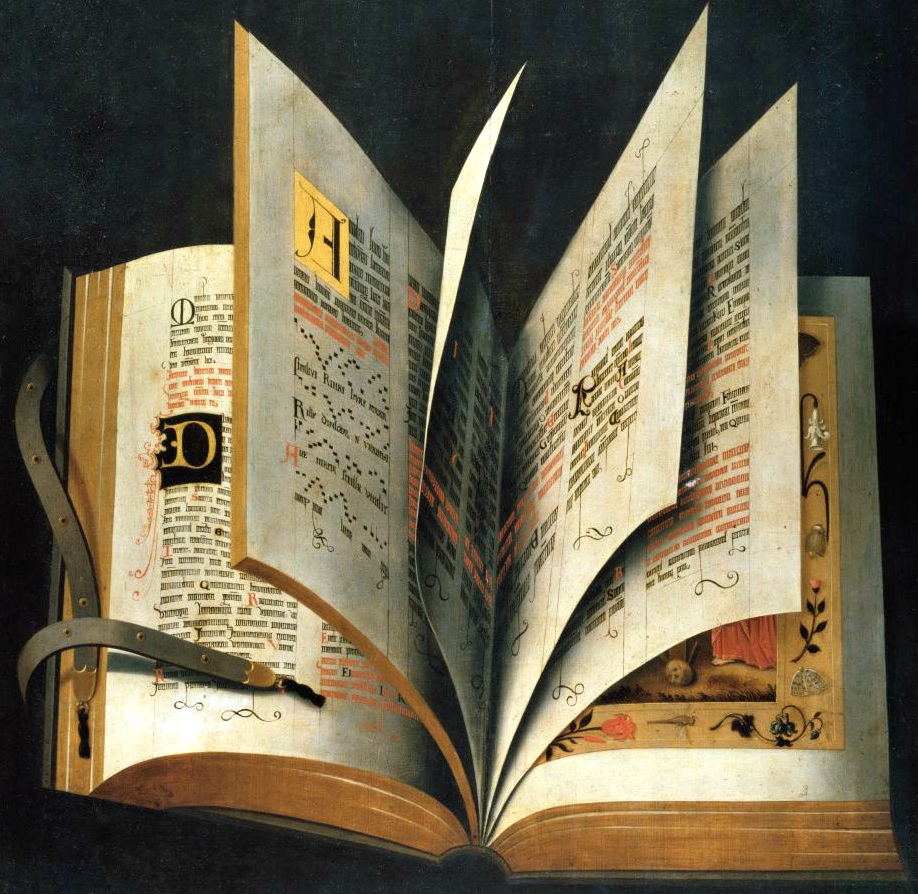
One interesting example of a painting of an illuminated manuscript can be found on Palazo Strozzi's online exhibit of trompe l'œil works:

Detail showing early sheet music of a psalm.
Finally, there is the related style of "quadratura," or painting architectural objects in an illusionistic manner. Perhaps the most famous example of this is Andrea Mantegna's playful and highly original ceiling fresco for the the Ducal Palace in Mantua, Italy, a detail from which heads this post:
Andrea Mantegna, fresco, Camera degli Sposi, Ducal Palace, Mantua, c. 1470.
An even more interesting off-shoot is anamorphosis, which employs distorted perspective to create coded images that only become understandable when viewed from the right angle. The most famous example of anamorphosis is to be found in Hans Holbein's The Ambassadors (one of my favorite paintings), where a strange blur at the bottom of the painting...
...revolves into a skull when viewed from the right angle, designed to remind the viewer of the ever-presence of death:

I'll stop there. For those interested in learning more, the Palazzo Strozzi museum in Florence has an online exhibit on trompe l'œil with many beautiful images and some interesting thoughts on the subject.