Showing posts with label Africa. Show all posts

November 12, 2017

What Did 17th Century Food Taste Like?

Diego Velázquez, Old Woman Frying Eggs, c. 1618, National Gallery of Scotland.
As the official portraitist for the Spanish monarchy at the height of its glory, Diego Velázquez painted queens, emperors, and gods. But one of his most famous paintings is a window into a much humbler world. A woman is frying eggs in hot oil, ready to scoop them out with a simple wooden spoon. Behind her, a servant boy carries a half-full jug of wine and a melon tied up in a loop of twine.

This painting is the type of thing historians love. A profoundly talented artist with a knack for realism, choosing the type of subject matter that is so normal that it rarely gets preserved (the same is true today—how many contemporary painters choose to depict taquerias or bagel shops?) Scholars suspect that Velazquez's own family members may have served as models in his early paintings. It's possible that the woman in this painting numbered among them, since she also appears in a religious painting he produced in the same year.

Diego Velázquez,  Christ in the House of Martha and Mary, 1618, National Gallery, UK.
But this post is not about Velazquez. It's not even about art history. It's about food.

What can we learn about how people ate in the seventeenth century? And even if we can piece together historical recipes, can we ever really know what their food tasted like?

This might seem like a relatively unimportant question. For one thing, the senses of other people are always going to be, at some level, unknowable, because they are so deeply subjective. Not only can I not know what Velázquez's fried eggs tasted like three hundred years ago, I arguably can't know what my neighbor's taste like. And why does the question matter, anyway? A very clear case can be made for the importance of the history of medicine and disease, or the histories of slavery, global commerce, warfare, and social change.

By comparison, the taste of food doesn't seem to have the same stature. Fried eggs don't change the course of history.

But taste does change history.

One example, chosen at random: the Mexican chili peppers hiding in the bottom edges of both paintings.


The pepper family (genus Capsicum) is native to the Americas, and it was still a relatively new arrival in the cuisines of Asia, Africa, and Europe when Velazquez was alive. As a non-elite person born in 1599, we can guess that his grandparents would not have been familiar with the taste of peppers and that his parents still thought of them as an exotic plant from across the seas. Even the name he, and we, apply to the plant was a foreign import: the word 'chili' is from Nahuatl, the language of the Aztecs. So is 'avocado' (Nahuatl ahuacatl), 'tomato' (tomatl) and chocolate (chocolatl).

The taste for these foods was a significant factor in the series of global ecological movements between the Old and New Worlds that historians call the Columbian Exchange. Any time we eat kimchi, or kung pao chicken, or pasta with red sauce, we are eating foods that are direct results of the Columbian Exchange.

Someone really needs to make a better map of the Columbian Exchange. This one, from a public-domain resource for teachers from UT Austin, is one of the best I could find, but it doesn't come close to capturing the full range of exchanges.

But we're also eating modern foods. That's not to say that there aren't older correlates to these dishes—there undoubtedly are. But food has changed since the early modern period. Globalization of food crops has transformed the flavors of regional cuisines. Meanwhile, factory farming has led to a homogenization of some of the varietals available to us, while also creating a huge variety of new strains and hybrids.

One example: I didn't realize until recently that broccoli, Brussels sprouts, cauliflower, kale, cabbage, and collard greens are all technically the same species, Brassica oleracea. The substantial differences between these sub-species are all due to patient intervention by human farmers over millennia. Many of these changes are surprisingly recent. Early versions of cauliflower may have been mentioned by Pliny and medieval Muslim botanists, but as late as 1600, a French author was writing that cauli-fiori "as the Italians call it" was "still rather rare in France." Likewise, Brussels sprouts don't appear to have become widely cultivated until the Renaissance.

A woman with Brassica oleracea in Pieter Aertsen, Market Scene, 1569.
One example of the substantial changes produced by the artificial selection of premodern farmers actually made the news a couple years back. In 2015, there was a wave of reporting about early modern watermelons. The watermelon is native to Africa and has a substantial amount of range in terms of color and taste. Seventeenth-century still life paintings record a substantially different phase in the artificial selection of watermelons toward the bright red, seedless varietal familiar in Western grocery stores.

Giovanni Stanchi, Watermelons and other fruits in a landscape, c. 1645, Christie's.
But focusing on unusual varietals and exotic imports can be misleading. Most people in the early modern world—not just in Europe, but everywhere—were illiterate farmers and pastoralists whose diet was hyper-minimalist by contemporary standards.

This is not to say that their food tasted bad, necessarily. But it was clearly very simple, and very starch-heavy. From China to Europe to sub-Saharan Africa, gruels and stews made out of staple grains or legumes were the daily fare. Italian farmers weren't eating eggplant parmesan or spaghetti with meatballs. They were typically eating either boiled beans or grains, day after day after day.

The Beaneater by Annibale Carracci, 1580-90.

The acute eyes of Bruegel the Elder captured one example of this universal food of the premodern peasantry. In Bruegel's The Harvesters, a team of peasants is taking a break for a mid-day meal which seems to consist entirely of bread and bowls of what I am guessing is a wheat-based gruel, something akin to Cream of Wheat. The jugs they're drinking out of probably contain small beer.

Pieter Bruegel the Elder, The Harvesters (detail), Antwerp, 1525-1530.

But paintings like these can only get us so far. A more promising approach, perhaps, would be to go directly to the textual sources and take a close look at early modern recipes. I spend a lot of time recording 'receipts' (an archaic form of the word recipe, but also a broader one, since it included drug prescriptions). Several actually look pretty tasty (like eighteenth-century "Maccarony cheese"), and I hope to cook a few one day, taking a page from my friend Marissa Nicosia's reconstructions of early modern food at Cooking the Archives.

But there are many others that I have no desire to make anytime soon. One example that stands out in my mind is this recipe for snail water from a circa 1700 English manuscript at Penn.
To make Snaill water, for a consumption, or anny weakness in old or young persons, and for the ricketts
take a quart of snails, wash them twince in stronge-stale-beere and dry them well in a cloth, then bruse them shels and all, put to them 3 quarts of red cows-milk 4 ounces, red rose leaves, Rosemary, sweet-marjoram, Ivery, of each a good handfull, distill altogether and sweeten your water with surrop of violets, and sugar candy lickerish sorrop, put in 6 penny-worth of naturall-ballsom, drink a quarter of a pint of this every night and morning. 
Snails, stale beer and ivory shavings certainly sounds like a challenging flavor combo to me, despite the addition of the fragrant herbs and sugar. But this is a medicine, not a food, and it wasn't intended to taste good. Another early modern manuscript owned by Penn (this one from 1655, and more inclined toward food recipes than drug recipes) contains a far more relatable dish:

To fricasie a chicken or rabbitt.
Take a chicking and scald it or Case it, and put it into a frying pan with halfe a pint of strong broth, a peace of buter with a little whole pepper and mace, and boyle them well upon the fire till yr  Chickin be tender then make a [illegible: looks like 'leare' or 'leane of uiriayce'?] and minced peaches* and ye yolkes of 2 eggs and a little drawne butter then put it into the frying pan keeping yr pan with shaking over the fyre till it bee thick, then dish it up strewing thereon a little minced parsley. 
* 11/19/17 update: a reader named Dev Gualtieri wrote to offer the suggestion that this word might be 'parsley' instead of 'peaches.' I think 'parsley' is a reasonable reading of the word, but hesitate to change it from 'peaches' because you can see at the bottom of the recipe that the author writes 'parsley' very differently there. I've added a link to the original manuscript page so the reader can judge.

Even this relatively simple recipe for pan-fried chicken has some surprises, however. One is the addition of mace, a fairly obscure spice that comes from the same plant as nutmeg (nutmeg's the actual seed, and mace is the covering). It's a highly potent spice that numbs the tastebuds and imparts a strong aroma to food. And it's combined here with stewed peaches and egg yolks—not a flavor combination that has survived into the cuisines of the modern era, so far as I know.

Guessing the true flavors of these ingredients—the taste of premodern chicken, or mace carried in a ship's hold from Indonesia to Europe, or butter that was churned by hand—is at some level impossible. Certainly, we can make some educated guesses. In the case of late medieval cooking, one scholar has looked at the transformations of recipes as they crossed cultural zones (such as the medieval Arabic sweet porridge called ma'muniya, which evolved into Anglo-Norman maumenee) and concluded that "as time went by, a dish tended to become sweeter, spicer, and more complicated." But so much has changed between the worlds of the past and the present when it comes to cultivars, modes of preparation and preservation, and, perhaps, an overall sense of what tastes good and bad. I often wonder what someone from the thirteenth or seventeenth century might make of a Snickers bar, for instance. I suspect they'd find it disgustingly cloying. But then again, maybe not.

Thinking about historical tastes reminds me of the French expression for words that seem to be analogous across two languages, but actually have totally different meanings: faux amis. (For instance, English-speakers in Spanish-speaking countries often say that they are embarazada—they intend to say they're 'embarrassed,' but they're actually saying they're 'pregnant.')

These early modern foods are culinary false friends. They seem like they'd be the same as our familiar correlates. But we can't be sure that they tasted the same.

Like so much in history, they're so close, yet just out of reach.


Further reading online:

The Recipes Project
Cooking the Archives
What did Byzantine food taste like?

Further reading in print:


 (Note: These are Amazon affiliate links, so if you buy one, a small percentage of the purchase goes to support this blog).  .


June 15, 2011

Le Monde Aquatique


The images below are hand-colored details from two lavishly illustrated atlases of the world's oceans produced by the workshops of Pieter Goos (d. 1670) and Johannes van Keulen (1654-1715).  Goos' L'Atlas de la Mer, ou Monde Aquaticque ("Atlas of the Sea, or the Watery World") the title page of which is visible at left, was published in Amsterdam in 1670. It would appear that van Keulen capitalized on the success of this work by reprinting the maps of Goos in slightly revised versions after his death in his Grand Nouvel Atlas de la Mer, ou Monde Aquatique (Amsterdam, 1696). Both Goos and Van Keulen shrewdly commercialized their knowledge of important commercial shipping lanes (which had once been proprietary to the Dutch trading companies) by publishing marine atlases in multiple languages, contributing to the hybridizations of knowledge and peoples that were a defining feature of the cosmopolitan late seventeenth-century.

What I find most interesting about these maps are the decorative, scroll-like 'cartouches' that ornament their corners, displaying a remarkable wealth of ethnographic and natural detail. These details, of course, were frequently wildly inaccurate, being based on second-hand information and long-held iconographies of the exotic and foreign (parasols, for instance, had a complex history in European depictions of Asians and Africans). Yet even these misperceptions are of interest, since, like the bizarre fabricated ethnographic sketches of Taiwan produced by the impostor George Psalmanazar, they offer insights into a vanished mental universe in which the boundaries of the known world were still shifting, uncertain and hazy, and when maps still contained huge swathes of blank space filled only by sea monsters and speculation.

All images are screenshots from hi-def scans of the works of Van Keullen and Goos that are accessible via a new online archive created by the French government relating to the Compagnie des Indes.

Detail from the title page of Goos' Atlas de la Mer evidently depicting Urania, the muse of astronomy.
Another detail featuring beautiful depictions of an armillary sphere and various mapping devices.
Title page of Van Keulen's atlas apparently depicting Europe (the woman with the torch) illuminating
the continents and oceans of the earth. Note the parasol, a popular iconographic marker of the exotic.
Cartouche for a map of Gabon in West Africa featuring an African writing and, oddly, what would appear to be a
Tupí Indian from coastal Brazil with a parrot-like bird.
A detailed painting of Fort Nassau near Moree, Ghana, a center of slave-trading.
A figure reckons the altitude of the sun using a cross-staff.
Another cartouche mingling African and South American iconographies.
The cartouche for a map of the River Gambia in West Africa apparently depicts a monkey preventing
a man from killing serpents with an axe -- I'd be curious if anyone reading this could explain this image. 
Several excellent recent works of history have also considered the political, economic and scientific implications of seventeenth-century world maps, and the larger world of cosmopolitanism, travel and early modern globalization in which they were embedded. I would especially recommend Alison Games'Web of Empire: English Cosmopolitans in an Age of Expansion (Oxford, 2008), Benjamin Schmidt's Innocence Abroad: the Dutch Imagination and the New World, 1570-1670 (Cambridge, 2001) and Harold Cook's Matters of Exchange: Commerce, Medicine and Science in the Dutch Golden Age (Yale, 2008).

February 20, 2011

Strange Creatures Intermixt with a Spaniard's Voyage to the Moone, 1700

Nathaniel Crouch (c. 1632 - after 1700) was an obscure but most interesting man: a London bookseller, he took the unusual step of authoring his own books on many subjects and publishing them under pseudonyms. Crouch's nom de plume of choice was "R.B." or "Richard Burton." As revealed by the research of Robert Mayer, Crouch attended meetings of the Royal Society and was regarded by contemporaries as an "ingenious man" despite his craftsman's trade and lowly birth as the son of a tailor. Although he has gone largely unstudied by modern scholars, the works of Crouch/Burton were prized by both Samuel Johnson and a young Benjamin Franklin, whose autobiography records his high regard for "Burton's books" (Mayer 393). Today I present some images I came across in a work that Crouch published under the name of R.B. entitled The English Acquisitions in Guinea and East-India (London, 1700). As the full title reveals, this was an expansive work which not only described the new colonial possessions of an expanding British Empire but also offered accounts of "Religion, Government, Trade, Marriages, Funerals, strange Customs, &c., Also the Birds, Beasts Serpents, Monsters and other strange Creatures found there. Intermixt with divers Accidents..."
The woodcut illustrations of English Acquisitions are quite compelling, as they center almost exclusively on depictions of "Monsters and other strange Creatures" that were reported by travelers in the Indian Ocean region and coastal Africa. I suspect that most or all were plagiarized from earlier accounts, a common practice of the era. Here are the images, intermixed with extracts from Crouch's accompanying text:
Creatures of "Guinea," or west Africa.
More beasts of Africa, accompanied in true early modern fashion by an extract from the Roman poet Lucan.
Crouch did not shy away from gory descriptions, and indeed these may have contributed to the popularity of his works. Here he is on the execution techniques of the "Great Mogul" of India:
 And the rather frightening accompanying illustration:
As I read this book I was surprised to find that the middle section was devoted to a description of a voyage to the moon via swans! After reading a bit I realized that this was a reprint from a remarkable work of early science fiction written in manuscript by the Elizabethan bishop Francis Godwin: the Man in the Moone, or a Discourse of a Voyage thither, by Domingo Gonsales (c. 1600). Here's the amazing illustration of the bird-powered contraption created by the ingenious Spaniard Gonsales:

This work is remarkable for the way in which it conflates the voyages of Columbus and otehr New World explorers with space travel. Godwin (and Crouch as well, it seems) reasoned that if 'Moderns' had been able to discover vast and previously unknown new lands across seas, then it stood to reason that similar wonders awaited those who traveled into the sky:
Here  'Gonsales' offers a bizarre description of outer space as imagined in early modern times. This land was apparently haunted by demons and "Wicked Spirits" who spoke Spanish, Dutch and Italian, as well as creatures that his Gansas (swans), could consume as food:
Strange stuff, and all the more interesting because Crouch chose to include it in a book lauding the expansion of the British empire. Was the moon next?

For more on the early modern astronaut Domingo Gonsales, read the original work: The Strange Voyage and Adventures of Domingo Gonsales, to the world in the Moone. For more on Nathaniel Crouch see Robert Mayer, "Nathaniel Crouch, Bookseller and Historian: Popular Historiography and Cultural Power in Late Seventeenth-Century England," in Eighteenth-Century Studies Vol. 27, No. 3 (Spring, 1994), pp. 391-419.

January 23, 2011

Daily Life as a Slave

Below are some vivid paintings and engravings of enslaved peoples in the colonial Americas compiled by Professor Jerome S. Handler (his personal site) and Michael L. Tuite, Jr. in a joint project funded by the University of Virginia and the Virginia Foundation for the Humanities. Contextual details for these images are scarce, but the pictures themselves speak eloquently of the manner in which the institution of slavery was embedded into the fabric of life in colonial societies stretching from Boston to Buenos Aires. I've added occasional captions to the images, but where the text is in quotes it comes direct from the online database assembled by Handler and Tuite, entitled The Atlantic Slave Trade and Slave Life in the Americas. Many thanks for this fantastic resource.
Extracting a jigger, scene in the Brazils. Watercolor by Augustus Earle (1793-1838). Original in National Library of Australia, Canberra.  "Shows a black woman extracting a chigger from the foot of a white man in what appears to be some sort of tavern; note pottery jug in left-hand corner. A tropical flea native to the Americas, the chigger (jigger, chigoe) was extremely troublesome to Europeans and Africans in many areas of the New World." William Dampier, the famed pirate and natural observer, recorded a similar removal of a chigger from his foot by an African slave in the 1690s, which he noted was accompanied by the sprinkling of tobacco leaves and the slave "mumbling some words to himself." See Dampier, A Voyage to New Holland, Vol. II, 93.
West India Washer Women, a painting by Agustino Brunias, 1760s. Courtesy of the National Library of Jamaica, Kingston. Brunias, "a painter born in Italy in 1730, came to England in 1758 where he became acquainted with William Young. Young had been appointed to a high governmental post in West Indian territories acquired by Britain from France, and in late 1764 Brunias accompanied Young to the Caribbean as his personal artist."
"Ile de France: Palanquin." Engraving from Louis de Freycinet, Voyage Autour du Monde... Atlas Historique. Plate 10. The Atlas Historique, a book of lavishly colored engravings documenting a French geographical expedition in the 1810s, offers a goldmine of information about enslaved peoples to historians. This image differs a bit from others I've seen from the Atlas in that it depicts daily life in Mauritius, an island near Madagascar in the Indian Ocean, as opposed to the Americas. Note the barber-surgeon at right, an important medical practitioner among enslaved and free black populations throughout the colonial era.
An archival image of a mulatto house slave of Peru, 1780s. "This and hundreds of other drawings were done by unidentifed Indians during the 1780s and were commissioned by the Spanish Bishop Baltazar Jaime Martinez Companon during his pastoral visit to the region of Trujillo in northern Peru. The drawings, spread over nine volumes, are of Spaniards, Indians, plants and animals, as well plans and maps of the region." Source: Biblioteca del Palacio Real de Madrid.
A companion image from the same series, depicting a mulatta woman.
Painting by an unknown artist; from post card issued by the Virginia Museum of Fine
Arts, Richmond. "Unidentified black nurse with grandchildren of Virginia's Governor Spotswood, 1790-1800."
Collectible cards were often issued by British tobacconists - many featured depictions of African slaves smoking. This one was issued in Devon, England, and is courtesy of the Abby Aldrich Rockefeller Folk Art Museum, Colonial Williamsburg Foundation, Williamsburg, Virginia; image C1980-866.
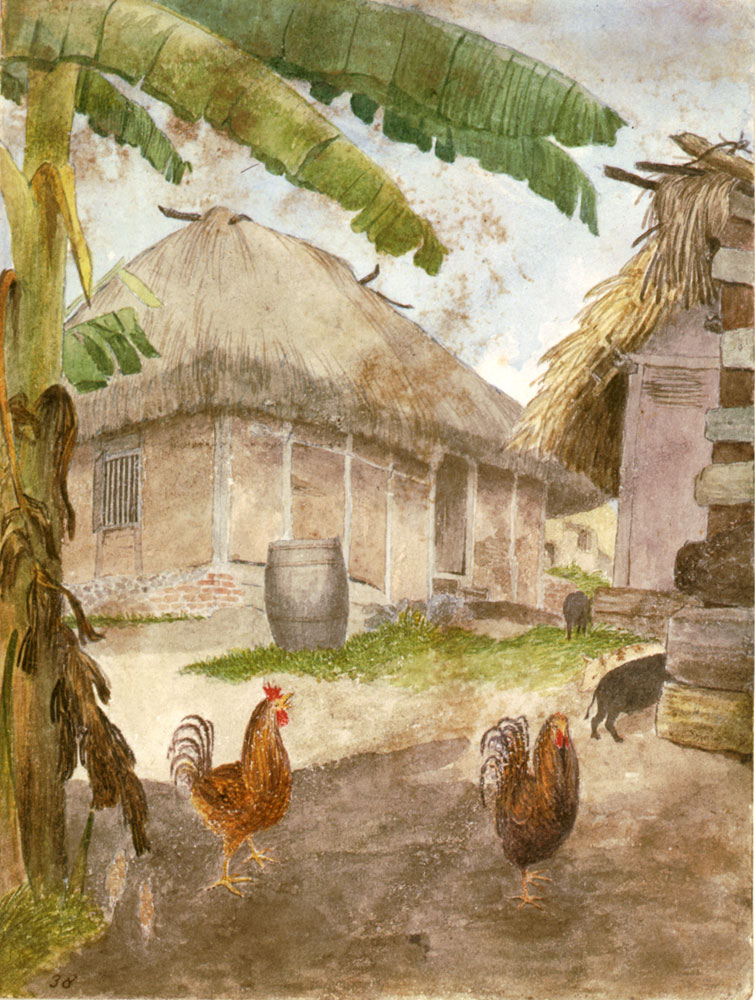
 And finally, an evocative scene devoid of people, but with some vivid details of daily life in a colonial Jamaican village: "Watercolor, showing rural house yard. Drawn from life by William Berryman, an English artist who lived in Jamaica for eight years in the early 19th century. He produced over 300 pencil and watercolor drawings of the island's people, landscape, settlements, and flora, with the intention of producing a series of engravings--never realized because of his death." Source: Library of Congress, Prints and Photographs.
Taken together, the images from this site can tell you things that books never can. I recommend that interested readers peruse it themselves. Below are links to some subject areas: