Showing posts with label Eighteenth century. Show all posts

October 30, 2019

Enlightenment-era Ghosts and the History of Technology


A detail of one of Etienne Gaspard Robertson's "phantasmagoria."
Ghosts were in the air in eighteenth-century London. Few knew this better than James Boswell, the friend and biographer of Samuel Johnson. On a gloomy Saturday in March of 1762, feeling “cold and spiritless” and having “lost all relish of London,” Boswell sought out the company of some friends. Unfortunately for Boswell, after dinner had ended, the group began to “talk of death, of theft, robbery, murder, and ghosts.”

Boswell's diary continues:

Lady Betty and Lady Anne declared seriously that at Allanbank they were disturbed two nights by something walking and groaning in the room, which they afterwards learned was haunted. This was very strong. My mind was now filled with a real horror instead of an imaginary one. I shuddered with apprehension. I was frightened to go home. 

Luckily, Boswell had a good friend in his companion Erskine, who “made me go home with him, and kindly gave him half of his bed, in which, though a very little one, we passed the silent watches in tranquility.” (Later, Boswell admitted that his lifelong fear of ghosts had made it impossible for him to sleep alone until he was eighteen.)

Perhaps ghosts had become a topic of conversation for Boswell's friends that evening due to the infamous case of the Cock Lane ghost. One of the most celebrated news stories of 1762, the Cock Lane affair had all the usual trappings of newspaper drama, including illicit sex, a controversial expert commission (which included Samuel Johnson), and spectacular allegations of murder – supposedly made by the ghost of the victim herself, one Fanny Lynes. All throughout the dreary winter and early spring of 1762, crowds of Londoners gathered outside the scene of the crime, regularly attempting to make contact with the spirit of the victim.

That same year, a play called The Orators had been staged in London which featured an incompetent attorney defending a client who happened to be a ghost. “What is a ghost? A spirit,” the grandstanding lawyer declaims:

What is a spirit? A Spirit is a thing that exists indepentently of, and is superior to, flesh and blood. And can any man go for to think, that I can advise my client to submit to be tried by people of an inferior rank to herself?... I therefore, humbly move to squash this indictment, unless a jury of ghosts be first had. 

The works of Shakespeare, especially his ghost-haunted plays Hamlet and Macbeth, began to enjoy a new level of renown in the same period, inspiring an entire sub-genre of spectral paintings and prints.

Detail from Benjamin Wilson's William Powell as Hamlet Encountering the Ghost (circa 1768).

In her book The Ghost: A Cultural History, Susan Owens argues (rightly, I think) that ghosts are “mirrors” of the cultures they haunt: “They reflect our preoccupations, moving with the tide of cultural trends and matching the mood of each age.” But I would go a bit further than this: ghost sightings seem to me to reflect, most of all, the technological preoccupations of an age. Thus it's little surprise that Enlightenment-era debates about ghosts fixated on whether the use of experimental tools, allied with reason, could banish these pesky supernatural entities altogether.

For the Scottish Enlightenment philosopher David Hume, ghosts and apparitions helped inspire what is perhaps the most famous passage in Hume's Enquiry Concerning Human Understanding: Section X, “Of Miracles.” By Hume's definition (“a transgression of a law of nature” enacted by "the Diety, or by the interposition of some invisible agent”) ghosts and haunting fell under the heading of “miracles,” just as the resurrection of Christ did. Hume was having none of it: the laws of nature are products of “a firm and unalterable experience,” he argued, that can only be changed by the testimony of many people from different times and places – a variation on the practices of collective observation and “virtual witnesses” that historians of science identify as one of the key aspects of the Scientific Revolution. According to Hume, ghosts and other miracles fail this test, because they are single, unique events. It is more sensible, he argued, to attribute claims of miracles to unreliable observers (motivated, for instance, by the desire to promote religious beliefs) than to assume a true violation of the laws of nature.

Given this, it's tempting to tie eighteenth-century ghosts to a larger narrative about what Keith Thomas called the “decline of magic” during the Enlightenment era. The witchcraft trials which had convulsed Europe in the seventeenth century began to peter out in the early decades of the eighteenth. Although Jane Wenham, an alleged witch who was condemned to death by a jury in 1712, was not the very last witch to be executed in England (as sometimes claimed), her case was deeply emblematic. In response to witnessing Jane's trial, a clergyman named Francis Hutchinson wrote an impassioned, skeptical essay on witchcraft that debunked many of the famous persecutions of the past few decades, including the Salem trials. Perhaps the decline in popular belief in the existence of living, human wielders of supernatural powers displaced that belief in the supernatural into non-living magical entities: ghosts, spirits, apparitions, and the like.

Francis Hutchinson's Historical Essay Concerning Witchcraft (London, 1718) and Richard Boulton's attempt to "vindicate" the concept of magic in response (London, 1722). Boulton's book is discussed below.

Eighteenth-century ghosts were not quite the same as the ones familiar from present-day horror literature and films. They were not even the same as the ghosts of the Victorian era, which haunted seances with their disembodied rappings and knockings. The difference shows how technological change maps onto the ways that people think about magic. Victorian seances were inspired by what was, at the time, cutting-edge research into such things as X-rays, radio waves, and the aether. The spirits of the dead appeared in these late nineteenth-century accounts as something akin to telegraph operators, sending out long-distance communications by means of cryptic, coded communication. As Hilary Grimes points out in her book The Late Victorian Gothic, spiritualist seances mapped directly onto the technological changes of the nineteenth century. Early in the Victorian period, ghosts regularly communicated in Morse code; when the telephone was invented, however, disembodied voices began to be picked up from the aether.

In the earlier context of Enlightenment-era Europe, natural philosophers were intensely concerned with the question of how the limits of perception and reason could be experimentally determined. This was not just a philosophical debate, but one that related to specific technological changes.  Devices like the microscope and telescope, though invented in the seventeenth century, emerged as widely-available consumer items in the early decades of the eighteenth. The promise these new tools offered of being able to see what had previously been invisible prompted new questions about what else might be revealed by future technological advances, lurking beneath the surface of ordinary human perception.

George Cruikshank's "The Gin Shop," 1829. Notice the dancing ghosts in the "Spirit Vault" behind the bar. Admittedly, this is an early nineteenth-century image, but the link between distilled spirits and ghosts was older.

In the same period, another esoteric technology of seventeenth-century alchemists and natural philosophers became truly accessible to common folk: distilled spirits. The gin craze of 1720s and 1730s London is the most famous manifestation of this trend, but the vogue for drinking all manner of distilled spirits never really went away. (Here I can't avoid making a plug for my forthcoming book, The Age of Intoxication: Origins of the Global Drug Trade, which charts how eighteenth century Europe and its colonies became suffused with new forms of intoxication). The revelation of the power of this more prosaic form of “spirits” shaped how eighteenth century thinkers imagined the spirits within human beings. Robert Pitt, in his 1705 attack on “the Frauds and Villanies” of apothecaries, argued that distilled alcoholic spirits “evaporate" the spirits within the human body itself, creating a sort of feedback loop whereby “the Spirits and Blood are made more Spiritual, til the Senses are decay'd.”

In a 1722 book, written in response to Hutchinson's, which purported to “demonstrate" the “reality of magick, sorcery, and witchcraft,” Richard Boulton wrote that "human... Spirits” could be “altered, and preternaturally indisposed” by “evil Spirits.” This was a prosaic claim. But Boulton framed his beliefs in the worldview of an Enlightenment-era natural philosopher, arguing that the existence of evil spirits could be deduced from the principles of a Cartesian universe in which "new Forms, which were in Motion" continually bounced up against one another. This constantly-changing world of violent motion, invisible to the naked eye but experimentally detectable by means of tools like the microscope, was a domain in which not only physical bodies, but “Impressions of the Mind” could also make themselves felt: Boulton claims that this is evident due to the fact that “Grief and Sorrow” are well-known causes of the death and decay of the human body. “If the Body be afflicted,” he explained, “the Soul suffers, and the Spirits are depressed, and consequently the whole languishes and decays.” And if, following scripture, we take it as a given that “all spiritual Bodies are immaterial substances,” then Boulton believed this provided a space of possibility for immaterial “spirits” to impact the physical universe – including, yes, ghosts.

An engraving of one of Robertson's "phantasmagoria" performed in 1797, from Etienne Gaspard Robertson, Mémoires récréatifs, scientifiques et anecdotiques du physicien-aéronaute E. G. Robertson (Paris, 1831).

By the final decades of the eighteenth century, the concept of ghosts with a form that could manifest in the material world was falling into decline. Ghosts didn't go away, of course: as always, they simply adapted to new technologies. Susan Owens documents how ghosts gradually became transparent in this period due to the influence of a new breed of stage shows which relied on the use of magic lanterns to project images of spirits. Performers like Etienne Gaspard Robertson began advertising their ability to summon “apparitions of Spectres, Phantoms and Ghosts” on demand by using vaguely-described new techniques (Robertson wrote, perplexingly, of “experiments with the new fluid known by the name of Galvanism”). Given the enormous popularity of magic lanterns in the decades bookending 1800, one suspects that Robertson's audiences knew perfectly well that he was not, in fact, a practitioner of the dark arts. Instead, he was something closer to what would come to be known as a stage magician, a performer whose audiences were aware that what they were watching was a clever trick, not real magic.

Ultimately, the newly-transparent ghosts of the Romantic era dwindled further still, disappearing entirely from view to become the “telegraph ghosts” of the Victorian seance. Unlike Victorian children, these ghosts were to be heard, but not seen.

As for today? “Cursed images” haunt social media, and ad hoc collections of ghost stories like r/nosleep proliferate featuring a new breed of digital ghosts. From the corporeal ghost of the Enlightenment, to the transparent ones of the Romantic era, to the etheric specters of the Victorians, we have reached something that, once again, holds a mirror to our own technological preoccupations: the ghost in the networked machine.


Further reading:

• Allison Meier, "Robertson’s Fantastic Phantasmagoria, An 18th Century Spectacle of Horror," Atlas Obscura (2013)
• Fabio Camilletti, "Phantasmagoria: creating the ‘ghosts’ of the Enlightenment," BBC History Extra (2017)
• Mary Luckhurst and Emile Morin, eds. Theatre and Ghosts: Materiality, Performance, and Modernity (Palgrave Macmillan, 2014).
• Susan Owens, The Ghost: A Cultural History (Tate Publishing, 2017).
• Hilary Grimes, The Late Victorian Gothic: Mental Science, the Uncanny, and Scenes of Writing (Routledge, 2016).
James Boswell's London Journal.

May 9, 2011

The Key of Hell: an Eighteenth-Century Sorcery Manual [Updated]

Astrological talisman from an 1801 grimoire.
I found these amazing illustrations on Wellcome Images, a useful online database devoted to images related to the history of medicine from ancient times to the present. It is a small part of the larger Wellcome Trust archives. According to the image captions supplied by the Wellcome, all of the images below come from an eighteenth century German magical text known as the Clavis Inferni sive magia alba et nigra approbata Metatrona -- which translates as "The Key of Hell with white and black magic proven [or approved] by Metatron."

Cyprien et le démon, French, 14th century.
According to its catalogue entry, this mysterious manuscript was purchased from Sotheby's on March 29, 1912. Although the title-page inscription seems to date it to 1717, the catalogue notes that "the script seems to be of the late 18th century." As for the text's origins, the Wellcome's caption writes that it
is also known as the Black Book, and is the textbook of the Black School at Wittenburg, the book from which a witch or sorcerer gets his spells. The Black School at Wittenburg was purportedly a place in Germany where one went to learn the black arts.
I was somewhat dubious of this Harry Potter-esque claim so I researched the title a bit more and found that the attributed author, one Cyprianus, probably refers to St. Cyprian of Antioch (d. 304 CE): a very common apocryphal attribution for medieval magical texts, since Cyprian was reputed to have been a powerful magician and demon-summoner before converting to Christianity (see also the Iberian grimoire The Great Book of Saint Cyprian).

The martyrdom of Cyprian and Justina, medieval
Portuguese, oil on panel.
I also found that this very manuscript has actually been published by something called the Avalonia Press, which appears to be one of several such boutique presses devoted to occultism and attempts to revive 'black magic' as a religion or way of life. (I find that these folks usually do more harm than good by spreading poorly-researched information which hinders actual historical research into the history of magic and alchemy, but I am glad that they put texts like this into print).

An interesting-seeming book by a professor of Norwegian literature named Kathleen Stokker (Remedies and Rituals: Folk Medicine in Norway and the New Land) offers a different take on the reputed identity of Cyprianus (pp. 100-101). Stokker writes:
The identity of the mysterious figure Cyprianus varied wildly. People in Holstein, Denmark, imagined Cyprianus to be a fellow Dane so evil during his lifetime that when he died the devil threw him out of Hell. This act so enraged Cyprianus that he dedicated himself to writing the nine Books of Black Arts that underlie all subsequent Scandinavian black books.
Next comes a surprising twist:
In stark contrast, the Cyprianus of Oldtidens Sortebog [a Norwegian grimoire] is a ravishingly beautiful, irrestistibly seductive, prodigiously knowledgeable, pious Mexican nun. The nun's gory story, dated 1351, details her mistreatment by a debauched cleric whose advances she steadfastly refused.
It goes unexplained how a Mexican nun could have even existed in 1351! Perhaps the identity of Cyprianus, and of the Wellcome manuscript attributed to him, will never be known with much certainty owing to the profusion of misinformation that seems to surround all things related to black magic. The images, however, are incredibly evocative and mysterious, and tell a fascinating story in themselves.


The work's title page. Note the date, provided in curly Roman numerals toward the bottom of the page, and the cipher script above it. "Metratona" refers to the angel mentioned as God's courier and scribe in the Talmud and Judaic lore. [Update 5/11] Also note the two lines at the bottom made up of Greek, Latin and a few symbols. The anonymous poster in the Comments section below has kindly translated these lines to something like "You hang it above the pentacle, you bring together the earth from a known thread." With 'thread' (filo) having connotations of the thread measured out by the Fates. Still fairly opaque.


Cyprianus, Clavis Inferni sive magia alba et nigra approbata Metratona. German, 18th century, ink and watercolor. The script is a cipher. According to the Wellcome's caption, this image depicts "Maymon - a black bird - as King of the South; and Egyn - a black bear-like animal with a short tail - as King of the North."


Cyprianus, Clavis Inferni sive magia alba et nigra approbata Metratona. German, 18th century, ink and watercolor. "Uricus - a red-crowned and winged serpent - as King of the East" and "Paymon - a black cat-like animal with horns, long whiskers and tail - as King of the West."


Cyprianus, Clavis Inferni sive magia alba et nigra approbata Metratona. German, 18th century, ink and watercolor. A crowned dragon consumes a lizard, arching over a snake-wrapped cross with skull and cross-bones. The sword and branch probably refer to the common iconography of God's twinned powers to create destruction or peace. The Latin text reads Qui facis mirabilia magna solus finis coronat opus. I translate this to something like "You who act alone with great miracles [or miraculous things], the end shall crown the work." But my Latin is quite rusty.


Cyprianus, Clavis Inferni sive magia alba et nigra approbata Metratona. German, 18th century, ink and watercolor. The archangel Metatron with allegorical objects. I have no idea what to make of this one. The text is in Kabbalistic Hebrew and cipher, with Greek alpha and omega symbols.

The final page. Note the symbol, which looks strangely like the emblem of the Society of Jesus to me. [Update 5/11] The same Anonymous in the comments section has also contributed a rough translation of this passage: "I truly, from the law of that Majesty, do receive and take the treasure requested by you in the sent proclamation. Go away now most calmly to your place, without murmor [assuming rumore instead of umore] and commotion, and without harm to us and to the circle of other men. In the name of the Father, the Son and the Holy Ghost, AMEN." Sounds like a spell or prayer to return a summoned being to its place of origin, perhaps.

These magical texts can make you feel a bit crazy if you spend too much time researching them (I was recently told as a bit of historian gossip that a prominent early researcher of John Dee went mad from precisely this cause, and I wasn't surprised). So I'll stop there.

As a side note, I'm hosting this month's early modern Carnivalesque (a round-up of recent blog posts on early modern history) so please send submissions to resobscura@gmail.com!

December 13, 2010

Lisbon before the Great Earthquake

"Come, ye philosophers, who cry, 'All’s well,'
And contemplate this ruin of a world.
Behold these shreds and cinders of your race...
...Did fallen Lisbon deeper drink of vice
Than London, Paris, or sunlit Madrid?"
- Voltaire, On the Lisbon Disaster (1755)
The Great Lisbon Earthquake and Tsunami of 1755 sent reverberations throughout European society. Leveling around 85% of the city's infastructure, it essentially destroyed the medieval and Renaissance architecture of one of Europe's greatest capitols and claimed up to 30,000 lives. The great French philosophe Voltaire not only wrote a mournful poem on the subject, of which an extract is quoted above -- he also took the tragedy as inspiration for his darkly comic masterpiece Candide (1759), a picaresque fable that mocks the notion, championed by Leibniz among others, that we disaster-plagued mortals inhabit 'the best of all possible worlds.'
I love early modern urban spaces and study 17th century Portuguese history, so I regret the fact that the Lisbon earthquake occurred on an almost weekly basis -- so many ancient buildings, forgotten paintings, and priceless manuscripts consumed by fire and the Atlantic. So I was very happy to find these snippets of Lisbon's urban life from the atlas Civitatis Orbis Terrarum, "The Cities of the World" (ed. Georg Braun, Cologne: 1572-1617), which show a bustling urban center of late-medieval type that bears little resemblance to the post-Pombaline Lisbon of today.
This detail centers on Ribeira Palace, the ancient Royal seat of the Portuguese monarchs destroyed in the earthquake (the long building with tower running perpendicular to the river). This building played a key role in Portuguese and, indeed, global history, since it was the meeting place of the Casa da Índia: the organization that directed Portuguese trade and empire in the Indian Ocean during the Iberian golden age of the sixteenth century. In a very real sense, this building was one of the hubs of the early modern global economy. Fittingly, a shipyard and a pillory for punishing criminals can be spotted adjoining it.
Here a group of the merchants who sustained Lisbon's power can be seen paddling to port from their ship, docked in the River Tagus.
And here's one of the wide-bodied trading vessels that routinely made the hazardous, month's-long voyage to Portugal's colonies and feitorias (trading posts) in Brazil, Africa's slave coast and India.

The full map (click for a much more detailed version):
Georg Bauer and Hogenberg (engraver), Civitates Orbis Terrarum, Vol. 5 (Cologne: 1598). An accompanying Latin note calls Lisbon "the most noted center of trade for the entire Orient... and for Africa and America," adding "in historical times there where two cities we might call 'Ruler of the oceans and the high seas,' from whence ships could set sail for the East and the West: one is Seville, the other Lisbon."

For those interested in learning more, Michael Swift's Cities of the Renaissance World is a nicely illustrated volume that looks at more of the remarkably detailed urban maps from the Civitates Orbis Terrarum. There's also a book on the Lisbon earthquake that's just come out called Wrath of God, but I have yet to read it. Finally, Voltaire's Candide is one of my favorite short books. Read it for free online here.

July 26, 2010

Scurvy, Shipwreck and Spaniards in the West Indies

Today I read an interesting manuscript held by the British Library entitled "A Voyage to Guinea,  1714-15" (shelfmark: Add Ms. 39946). The work is anonymous, but some clues on the final page and a mailing address tell us that the author probably wrote it in Jamaica around 1726 and then sent it to his sister in Leicester, England. What follows is a short synopsis of its contents and some extracts from the author's detailed descriptions of daily life in early eighteenth century Cuba.

The manuscript's author appears to have been reasonably well-educated since he writes with a good cursive hand and speaks Latin, but his memoirs begin with him serving as a common crew-member on a slave ship off the Calabar Coast of West Africa. After an appalling description of the horrors of the Middle Passage (including some gruesome passages involving feeding dead slaves to sharks, discussed in this essay), we next find the author penniless in the West Indies, where he enlists on a merchant vessel to harvest logwood along the Gulf of Mexico. Here he promptly falls deathly ill with scurvy and seeks aid from a frontier doctor who treats the local loggers (quasi-piratical outlaws known as “Baymen”). This doctor convinces the author to journey with him to Jamaica to get medicine and provisions, but their ship soon runs out of food and water and begins to sink. The small crew of six men jump ship and wash up on a nearby desert island where they are sustained by raccoon meat obtained thanks to the hunting prowess of a “Spaniel Bitch, which one of the men brought of the Bay of Compeachy with him." After ten days the crew decides to attempt the passage to Cuba. While floating off the coast of the island they are boarded by some local sea ruffians who seize their belongings but give them food and portage to a local village, where they’re taken to “one Don Diego Ruez, who was Secretary of the Town."

Van der Aa's map of the Caribbean (Leiden, 1707)
Detail showing shipwreck.


It is at this point that the author's tone changes from a rather matter-of-fact catalogue of his travels to a richly detailed account of daily life in early eighteenth century Cuba, with particular attention paid to religious matters. Here the author describes a boisterous Christmas celebration, December, 1715:
On Christmas day in the morning I went to Church, but could hardly hear any thing of the Mass for the noise of Drums, Trumpets and other Musick, at the end of every prayer, there was a Volley of Muskets, and Chambers fir’d in the Church-Yard. At night I went again, when the Devotion for the day was over, and found the great Altar-table all set with little Images of clay, representing some people of the Town, some were deform’d, others in obscene postures, and every one had a piece of paper tied to it, to distinguish his Character; this was a great diversion to the Mob. After this there was a kind of farce acted, representing a Battle betwixt St Michael and the Devil; the two Champions began with verbal expostulations, and afterwards came to a furious attack with their Swords, till the Victory seem’d doubtful for a good while, till Michael with a bit of fire at the end of his flaiming Sword, touch’d a parcel of Crackers that were tied to the Devil’s back-side, and made him glad to run out of the Church under the cover of fire and smoke. I my self once bore a part in one of their Drolleries by the perswasion of the Secretary.
Based on his experiences in this small town and a later stay in Havana, the author offers an account of "the Character of the Spanyard" with many interesting details mingled with the national steretypes:
The Spaniards as to their temper are generally Proud, and Reserv’d, valuing themselves much on the reputation of their country. They represent the Kingdom of Spain as a large Cow, and all other nations as so many calves sucking her; this alludes to the Silver, and gold of the West Indies, which furnishes a great part of the World…
The Women seem to be little akin to the Men, for as the men are stiff and Reserv’d, the women are Gay, and Pleasant and much more free and communicative in their conversation…
They drink Chocolate four or five times a day, of which they have two sorts, the best is call’d Regalo, which is pure Chocolate; the other is call’d Chocolata de Maiz, which is mix’d up with Indian Corn, and is us’d by the ordinary people...
Musick is in great vogue among them, and singing in Consort with it; their chief Instruments are the Harp and Guitar, which one may hear in most houses about Sun-set.
The work of the historian Marcus Rediker offers a fuller account of both this particular text and of the world it describes than I can offer here -- see especially his The Slave Ship: A Human History and Between the Devil and the Deep Blue Sea: Merchant Seamen, Pirates and the Anglo-American Maritime World, 1700 - 1750.

More extracts from my recent archival research to follow in the next few days!

June 11, 2010

Uniforms of the Brazilian Army

Greetings from Brazil! More to follow on the fascinating city of São Paulo. For now, I present some images of eighteenth century Brazilian army uniforms, courtesy of the excellent Portuguese-language blog Arquivo Histórico, :


Note the 'auxilaries' in the bottom left of this last image -- apparently mestizo and African-descended soldiers, sporting uniforms with much brighter colors than their rather drab colleagues!

These officers look almost exactly like Revolutionary War era British redcoats to my untutored eye. Here's the full book on archive.org.

June 7, 2010

Image of the Week 2: the Court of the Ottoman Grand Vizier

Click to enlarge.

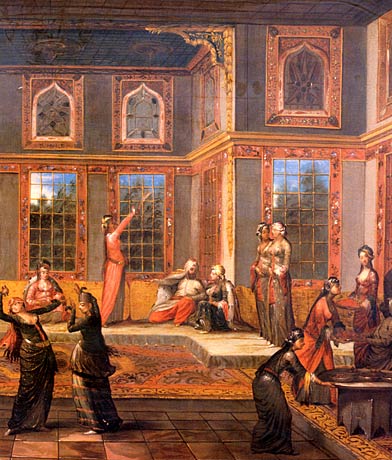
Today's image of the week depicts a formal audience between Ahmed III's powerful Grand Vizier, Ibrahim Pasha, and the  Vicomte d'Andrezel, the French Ambassador to the 'Sublime Porte' (as the Ottoman court was called in diplomatic circles.) The date is given as October, 1724. This puts the work squarely in the middle of the so-called 'Tulip Era' of the Ottoman Empire, a time of relative peace and prosperity, and one in which what John Brewer called the 'world of goods' opened up by global trade and consumer culture was beginning to transform Ottoman society. These changes are evident from the French fashions which dominate the painting, as well as the craze for exotic tulips which gives the period its evocative name.

The artist is Jean-Baptiste van Mour (1671-1737) a Flemish-French painter who became celebrated as a painter of the Ottoman court. His specialty was audience scenes such as the one above, but he was also allowed to paint the harem.

June 5, 2010

The Drawings of George Psalmanazar

The brilliant eighteenth century impostor George Psalmanazar (1679?-1763) is one of my favorite historical figures and someone I'll return to at a later date to write about in more depth. Today I'm just going to post some of his drawings, which were discovered by the historian Frederick Folely, S.J., in a sheaf of Church documents held by the Lambeth Palace Library (in 1968 Folely reprinted the images below in his rare and out of print  Great Formosan Impostor).

Put very briefly, Psalmanazar was a mysterious young man who convinced a wide array of early eighteenth century British luminaries, such as Henry Compton, the Bishop of London, that he was a native of the island of Formosa, now known as Taiwan. In reality, he was most likely from southern France, and his claims about Formosa were almost completely fictional -- which makes them very interesting.

The rather crude drawings below were apparently drawn by Psalmanazar himself (in his posthumously published Memoirs he modestly admits to "some ability" in the visual arts, not evident here). They depict various Formosan stock types, from a rustic fellow labeled 'a Country Bumpkin' to a 'Vice-Rey' and 'King.' Below the drawings, I've included the actual engravings from Psalmanazar's published work on Formosa, the Historical and Geographical Description.

'Tabernacle in which God appears.'

Comparison of Psalmanazar's original drawing (left) with the published British (center, 1704) and French (right, 1705) editions.
The printed English versions of 'Rusticus' (Country Bumpkin) and 'Civis' (Burger) shown above.

For more on these drawings see Peter Mason's excellent article on them, "Ethnographic Portraiture in the Eighteenth Century: George Psalmanazar's Drawings" in Eighteenth Century Life. The best book on Psalmanazar's life and influence is The Pretended Asian: George Psalmanazar's Eighteenth-Century Formosan Hoax by Michael Keevak.