Showing posts with label Classical World. Show all posts

October 5, 2010

Vanished Civilizations III: Trebizond

This is the third in an occasional series of posts about my favorite 'vanished' civilizations (the first was on Carthage and the second was on the mysterious Tocharians). I put the word 'vanish' in scare quotes because in fact few if any civilizations truly disappear: they simply transmute. Ancient Carthage was destroyed as a state by the Roman empire, but the people who composed the Carthaginian empire never really went away. (St. Augustine, for instance, is usually thought of as a Roman, but he was born in the Carthaginian heartlands and was of Berber ancestry.) But there is something essential about a culture that can be lost to time or conquest, and that's what I want to get at with this series.

Both of these points are certainly true of this week's civilization: the culture that grew up around the ancient city of Trebizond (currently known as Trabzond), on the southern shores of the Black Sea. I had always wondered about the place named Trebizond since I was a kid looking through my father's Penguin Atlas of History (a really wonderful series of books by Colin McEvedy). But what sparked my attention again was stumbling across Pisanello's remarkable depiction of Trebizond at the height of its wealth in a fifteenth century fresco complete with sailing ships, saints, dogs and hanged men:
A detail of the city itself (how realistic, I don't know):

Trebizond reached its cultural and political peak in the twelfth century, when it was an important breakaway state from the Byzantine empire and one of the principle termini of the Silk Road (see below map), but its historical roots are ancient.
The city began as a Miletian Greek colony whose citizens made their living by trading with the 'barbarous' peoples of the northern Black Sea coast -- called by the Greeks mossynoikoi ("those who dwell in wooden towers"). According to the historian Xenophon, the mossynoikoi were "fair-complexioned and white-skinned, with their backs variegated and their breasts tattooed with patterns of all sorts of flowers."

Coin of Mithridates VI of Pontus.
In the first century BCE, Trapezius/Trebizond became a center of the little-known Pontic Kingdom of Mithridates VI (143-63 BCE), a Greco-Iranian military genius who claimed descent from both Alexander of Macedon and the Persian Emperor Darius. Trapezius gained reknown as the home port for the Pontic Fleet of Mithridates, who successfully evaded Roman conquest for decades and became legendary in the ancient world for his supposed resistance to poisons, a feat made possible by his continual ingestion of small amounts of poison provided by a group of Scythian shamans called the Agari. This practice eventually allowed him to build up a tolerance and, hence, immunity. (For more on Mithridates, poison and the Agari, see this interview with Adrienne Mayor, the author of a well-received recent biography of the monarch called The Poison King.)
A bust of Mithridates.
In the end, of course, the Romans won, and Trebizond became incorporated into the empire as a key port city and an important buffer between the Roman world and the Armenian empire and the states of the Caucasus. Its important regional role continued under a period of Muslim rule in the vast Umayyad Caliphate of the 8th century CE, and through to its reconquest by a resurgent Byzantine Empire in the early Middle Ages.

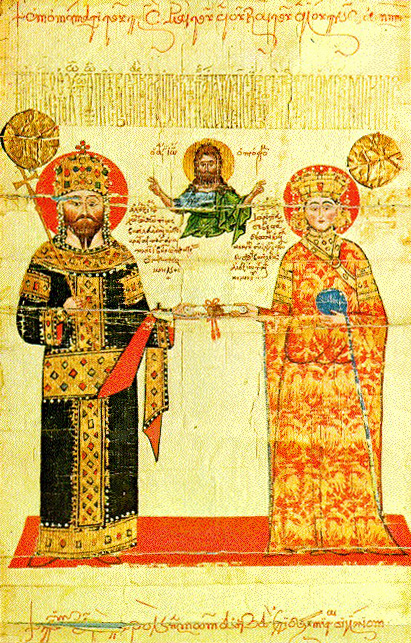
However it was not until the sack of Constantinople by Christian crusaders in 1204 that Trebizond reached its cultural and political zenith, when it became the capitol of a new breakaway Empire of Trebizond declared by the Georgian prince Alexios Komnenos.
Alexios and his queen.
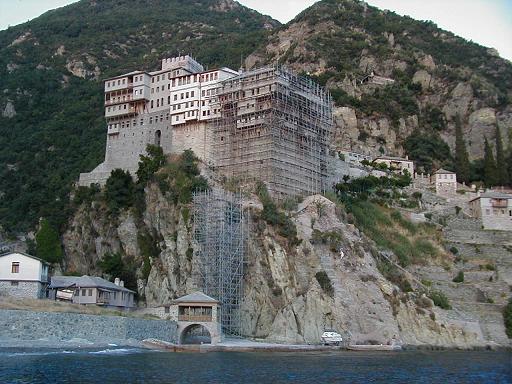
Under Alexios Trebizond developed quite a distinctive regional culture which mingled influences from the Muslim and Byzantine worlds with those from the ancient societies of the Caucasus Mountains. The monasteries built at this time are architectural standouts for their gravity-defying mountaintop construction, and are to me the most distinctive legacy of the empire:
The beautifully-situated Sumela monastery in winter.

A view from a courtyard at Sumela. A frescoed chapel wall is visible to the left.
The castle-like monastery of Dionysiou, greatly enlarged by Alexios.
The Trebizondian Empire actually managed to outlast the Byzantine Empire itself, holding off the Ottomans until 1461, some eight years after the fall of Constantinople. However, it too ultimately fell to the Turks, and the modern day Republic of Turkey, successor to the Ottoman Empire, is where the city lies to this day. The city endures, as it has always done, but the Empire of Trebizond (and the Pontic Kingdom that established its greatness) have faded away.

Some Trebizondian ruins:
A Byzantine hilltop fortress, at left, and at right a Roman-era tomb carved into a cliffside.
A Trebizondian castle and the secret tunnel that connected it to the world.
As an aside, the legends surrounding Mithridates and his poison-resistance gave rise to the substance known as Mithridatium or Mithridate, believed in the early modern period to be one of the most powerful medicines known to man, a universal antidote for all poisons. Interestingly, Mithridatium never had any one common recipe: it was more like a melange of all the most expensive and rare materia medica, from opium and ground pearls to the bones of salamanders and even the ashes of mummies! (On mummy as medicine see my earlier post touching on the subject).

September 1, 2010

The True Colors of Classical Sculpture

Lawrence Alma-Tadema, Phidias Showing the Frieze of the Parthenon to his Friends, 1868, (72 x 110.5 cm) Birmingham Museum and Art Gallery, Birmingham, UK.
 Continuing the theme of the previous entry a bit, here are some fascinating images created by the German archeologist Vinzenz Brinkmann and his research team. (For more on Brinkmann and his techniques see this 2008 article in the Smithsonian Magazine and a recent piece in the Wall Street Journal.) Brinkmann, the former director of the Gylptothek Museum in Munich, carefully analyzes the surface residue of pigments on classical sculptures and then uses this evidence to extrapolate how these works may have originally appeared. The results are, to say the least, surprising:

The Alexander Sarcophagus, 320 BC, as it appears today.
Brinkmann's reconstruction of how it originally appeared.
Detail.
Trojan archer (490-480 B.C.), from the Temple of Aphaia on the Greek island Aegina.
Brinkmann's reconstruction.
Another example from the Temple of Aphaia.
Now, as the painting that leads off this entry shows, people had known since at least the nineteenth century that pieces such as the Parthenon frieze once bore heavy pigmentation. But these images are the most complete reconstruction of this painting I've seen so far, and their garishness is almost shocking to a modern eye. As Brinkmann argues in the WSJ article linked above, twentieth century modernism has taught us to glorify the purity, simplicity and blankness of unadorned surfaces -- to which I would add that (in this respect, at least) modernism was taking a cue from the stark Neoclassicism of the Napoleonic era. What's more, Brinkmann notes, the substance of marble itself has an innate appeal:
"In modern times," he explains, "marble has been prized for its surface effect. Sculptors in antiquity knew it as the material that would allow them to do exactly what they wanted. They thought about it as filmmakers today think about their cameras. You got what you paid for. You ordered a block of Parian marble -- the best there is -- and you paid a fortune. But once it was delivered, you could relax. Because in those 12 cubic meters there would never be a fault or a flaw. If the sculptor wanted to make a fold a meter long, he could do it. In limestone, he'd run into a shell or a bump or a hole. The crystal structure of marble is absolutely pure and even. It's the most homogeneous natural material in the world. It's a gift from God. It's perfection."
How strange, one might interject, that ancient sculptors thought it fitting to smother this crystalline perfection in flashy orange, yellow and periwinkle hues! But this is a fabulous example of how easy it is to interpose contemporary intentions, values and aesthetics onto the past. Raised in a society that equates the simple, unadorned beauty of pure white marble with both high art and the edifices that represent both the state and the sacred, we find it hard to grapple with the garish Technicolor of classical sculpture. To me, though, the playful aesthetic sensibility that the work of Brinkmann has revealed actually jibes far better with what we know of ancient Greek culture than the dreary and bland white marble edifices that we find reproduced throughout the cultural centers of the Western world.

June 2, 2010

Vanished Civilization 1: Carthage

My people shall, by my command, explore
The ports and creeks of ev'ry winding shore...

- Queen Dido in John Dryden's translation of The Aeneid, Bk. I

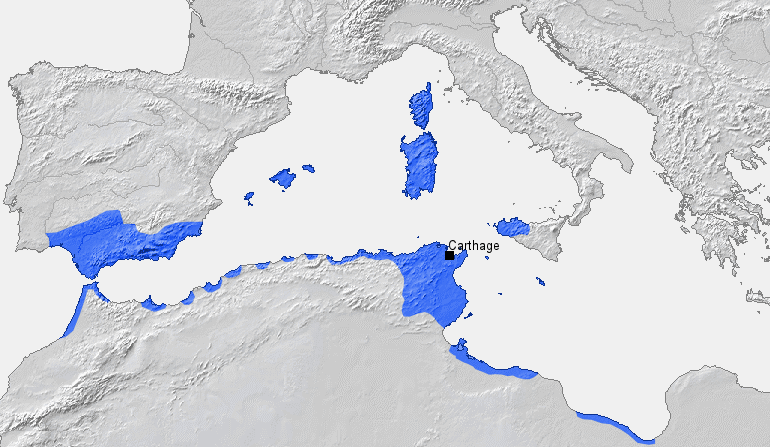
First in a series of once-weekly posts on my favorite vanished civilizations, I present THE CARTHAGINIAN EMPIRE. To understand Carthage, one has first to understand the Phoenicians, who were originally located in what is now Lebanon. The preeminent trading power of the ancient Near East and Mediterranean, the Phoenician city-states of Tyre, Sidon and Biblos (origin of the word 'Bible') sheltered a dynamic merchant community who regularly traveled from Mesopotamia in the East to Cadiz and Cornwall in the West. A Phoenician mariner, Hanno, even sailed as far as Senegal in West Africa, and Herodotus claims that Phoenicians in the employ of an eighth century Egyptian pharaoh successfully circumnavigated Africa, a feat that would not be repeated until the time of Vasco de Gama.

A Phoenician coin featuring a sea monster. c. 600 BC?

Cyrus the Great, Emperor of Persia, ultimately subdued the Phoenician city-states in 539 BC, with the final insult occurring when the supposedly unconquerable island city of Tyre was sacked by Alexander the Great in 332 BC. (Alexander achieved this feat by creating an artificial causeway linking Tyre to the mainland, creating an isthmus that lasts to this day).

 A beautiful Phoenician/Carthaginian sculpture, c. 5th century BC.

The city of Carthage was founded by a mythical ruler known as Pygmalion in the 9th century BC, but it wasn't until these defeats that large numbers of Phoenicians appear to have emigrated to North Africa. The result was a rapid expansion of Carthaginian/Phoenician power into what was effectively a political vacuum in the coastal lands of the Western Mediterranean. Recent genetic testing has shown that one in seventeen inhabitants of southern Europe and North Africa may be directly descended from Phoenician forebears, including up to one half of the population of the island of Malta and a large percentage of Sardinians.

By the third century BC, Carthaginian dominance in the Western Mediterranean was being challenged by an aggressive new power, the Roman Republic. This is by far the best-known period of Carthaginian history, so I'll skip over it here. (For a good overview of the subject see Nigel Bagnall's The Punic Wars.)


Suffice to say, the Carthaginians ultimately lost, and their cities and provinces were devastated by the Romans. Few civilizations have been more thoroughly eradicated. The Roman conquest was so effective that almost everything we know about the Carthaginians today derives from (heavily biased) Roman sources. For instance, it was (and to a degree still is) commonly believed that Carthaginians practiced child sacrifice to the god Ba'al and the goddess Tanit -- a legacy of Roman propaganda that has continued to circulate for over two thousand years.

Fourth century BC Carthaginian coin featuring the goddess Tanit.

As an historian I'm doubtful about these claims because I'm familiar with the degree to which the victor rewrites history, but some archeologists do take them seriously. According to the archeologist Shelby Brown, Carthaginian parents were expected to place their child into the arms of 
“ the lady Tanit... The hands of the statue extended over a brazier into which the child fell once the flames had caused the limbs to contract and its mouth to open... The child was alive and conscious when burned... Philo specified that the sacrificed child was best-loved.
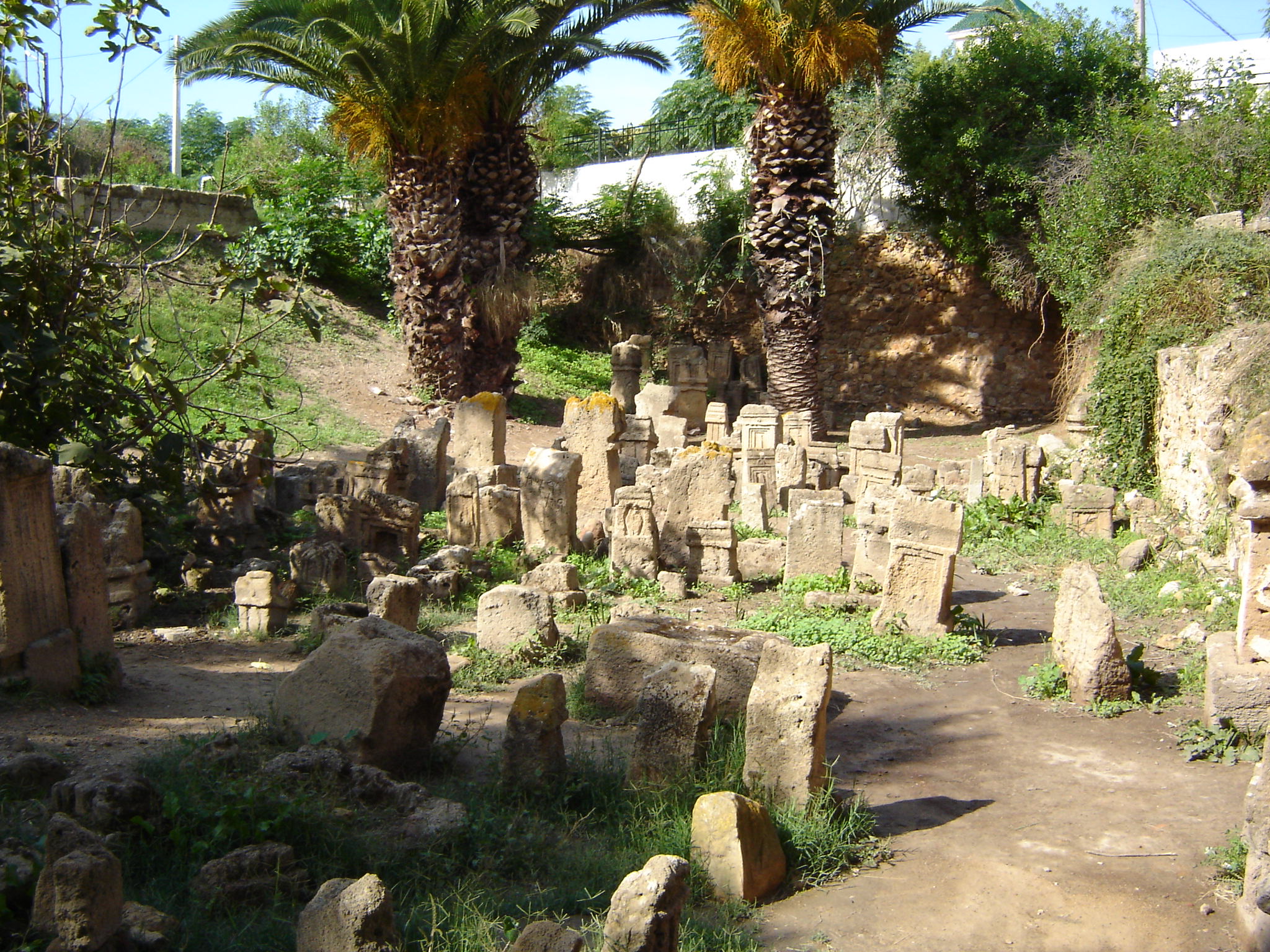
 A Carthaginian Tophet, or 'burning place,' the reputed site of human sacrifices.

The fact that we need to appeal to conflicting archeological evidence to reconstruct Carthaginian society points to the degree to which the Romans eradicated Carthaginian literary sources, of which only a handful survive. The survival of even a single Carthaginian library would immeasurably enrich our understanding of ancient history.


Tanit was the preeminent Carthaginian deity, the goddess of motherhood and the moon. Her symbol, above, is probably the most common surviving visual legacy from ancient Carthage, a testimony to a vanished religion and civilization which will probably never be fully understood.


Owing to the paucity of sources, books on Carthage are scarce. Adrian Goldsworthy's  The Fall of Carthage: The Punic Wars, deals mainly with military matters. The best bet for a general overview may be Serge Lancel's Carthage: A History.