Showing posts with label Medicine. Show all posts

December 17, 2015

The Alchemy of Madness: Understanding a Seventeenth-Century "Brain Scan"


The image above is a detail from a remarkable 1620 engraving I first came across this past summer. It shows a man sliding another figure into what looks like an old-fashioned oven - but instead of smoke, images of the man's thoughts billow out of the oven's top. The "baker" is in fact an apothecary, the "oven" is a distillation apparatus, and the man whose thoughts are boiling out of his head is someone being treated (metaphorically) for madness.

The full image is even stranger. Two well-dressed figures stand before a wall of shelves stocked with drug jarsbearing labels like ModestieRaison, and Memoire. One is pouring a potion marked Sagesse (wisdom) into the opened mouth of a seated figure who grips the pourer’s arm uneasily. Below, court jesters wearing fool’s caps tumble into a bedpan. 

"Le Médecin guérissant Phantasie," Mattheus Greuter, 1620 (Bibliothèque nationale de France).


To the right of these two— leaning in front of a distillation apparatus, a mortar and pestle, and a lengthy medical receipt pinned to the shelf—is an apothecary pushing a man on a long board into a distillation furnace. Above, the fantasies that had filled this man’s head emerge as the rarified quintessences of distillation: horses, backgammon boards, armor, pantaloons, women, swords, theater masks, flowers, hunting dogs, and, unaccountably, a monkey brandishing a walking stick. 


 I think that it's one of the most memorable and mysterious depictions of early modern science and medicine I've ever seen, and I thought I'd try to figure out a bit more about it here. 

The most obvious place to start is with the French caption which accompanies the image. Here's the original French:

Aprochez vous qu'avez la teste pleine
de phantasie, qui vous met en grande peine
assurez vous de ce Maistre sçavant,
quil voz humeurs seicherat tellemant,
dedans ce four, qu'aurez en peu de temps,
grand allegeance de beaucoup de torments,
aussi serez purge per ses brevages
qu'incontinant deviendrez du tout sages.

And here's my attempt to render it in something resembling the couplet rhyme scheme of the original:

You, come here! Your head is filled
With fantasies, that make you ill
Of this learned Master, be assured
That he will have your humours cured
In no time at all, within this furnace—
Great allegiance of many torments—
So too, he’ll purge with healing potions
That can make the foolish cogent. 
Even after the cursory research that I did when I first encountered the image, it became clear that this was a pretty popular motif. The basic imagery of a cloud of "phantasies" being distilled from a fool's head by a physician-alchemist appears in at least seven variants that I've been able to find: the French-language version shown above, apparently created by a printer named Mattheus Greuter in 1620; a German-language original from 1596 along with several later copies; a much-altered English versions; and, fascinatingly, a full-color French painting that was seemingly based on the engraving rather than the other way around. 

The earliest iteration of the image would seem to be from a book of emblems created by the Belgian engraver and printer Theodor de Bry (1528-1598) which was published two years before his death. This included a picture of a "Narrendoktor" (Fool Doctor) distilling the madness or folly out of a man's head using an alchemical still, while his associate opens a spigot in a man's stomach to purge him of his foolish humors. Interestingly, this version shows a closer attention to the actual technology of distillation, as it also shows a solid distillate falling to the ground in the form of mice. The Latin caption can be translated to something like "My art can be all knowledge--except wisdom." 

Engraving of the "De Narrendoktor" from Theodor de Bry's Emblemata Secularia (Frankfurt, 1596). 
an accompanying Latin epigram pokes fun at the boasts of Paracelsan physicians, who achieve
Quod non Hippocrates,
no noverat ante Galenas,
Arte mea cerebri
fatuos incido meatus.
What neither Hippocrates
nor Galen ever attained:
with my art I retrain
the paths of fools’ brains. 

Another German version, from 1648, offered an expanded caption in the voice of one Doctor Wurmbrandt (Wormburner), who implores, “trust me to bring you back to your right mind” when you suffer from “wild imaginings as when... having become quite drunk... you are conscious of nothing, whether you are a man or woman.” His cure is effected by the new chemical arts: a still worn over the head produces a kind of cognitive vapor—bat, dagger, backgammon set, a woman, dueling pistols—that sublimates into the air and leaves the patient freed from psychological distress.

It’s an image that would have had an obvious metaphorical resonance for early modern Europeans who saw the human body as a microcosm. If illnesses are indeed caused by fermentations of the blood, poisonsous corpuscles, or malignant humors, then why not move from distilling drugs to practicing medical chemistry directly on the human body itself?

The English version of this print veered into political territory, presenting the "Fool Doctor" in the midst of a far more elaborate allegorical scene referencing the political upheavals that preceded the English Civil War:


According to the British Printed Images to 1700 project, this version was refigured as "a satire of universal folly in which a tripartite division of the realm into Cuntry, Citty & the Court is symbolised, respectively, by rude 'Rusticall' being purged by the doctor on the close-stool, 'spruce master Cittyzsinne' standing behind the Doctor, and the Gallant (i.e courtier) whose head is just entering the subliming furnace." The print also appears to be demonstrating a new wariness about female sexuality and the perceived masculinity of women in positions of power, as the caption adjoining the female figure in the print  reads:
Once (faire) I knew the tongues Phlebotomie
Had powre to Cure your Sexes Maladie
But now youre manly humors boile so high
That you must in the Gallants Furnace lye.

It reminds me a lot of the metaphysical poetry of John Donne, with its complex medical and alchemical references ("the tongues Phlebotomie" is a reference to the common practice of medical blood-letting or phlebotomy, but seems to be suggesting that previous generations of women could be cured by speech, whereas now, because of their "manly humors," they required new alchemical technologies like "the Gallants Furnace").

In short, variants on this image seem to have circulated very widely indeed and fulfilled different functions of social commentary and satire in doing so, as evidenced by the fact that the original print also inspired at least one painting that may in fact have advertised an apothecary's services:

Anonymous painting in the Musée Rolin, Autun, France, mid to late 17th century.

I'm still trying to get to the bottom of this series of interrelated images, but I suspect that their popularity had to do with an emerging awareness of what we would now call mental illness in seventeenth-century Europe. As new drugs and therapies began to reach Europe via colonial networks that brought physicians into contact with non-European healing traditions, some began to wonder if the new medical practices of the seventeenth century could cure madness or folly in the same way that cinchona bark could cure fevers.

Natural philosophers like Robert Boyle also became interested in the possibility of what we would call psychedelics or smart drugs: in Boyle's remarkable list of "desiderata" for future inventions, he included "Potent Druggs to alter or Exalt Imagination, Waking, Memory, and other functions" as well as "Freedom from Necessity of much Sleeping exemplify’d by the Operations of Tea and what happens in Mad-Men." Likewise, when Robert Hooke experimented with cannabis in 1689, he concluded that it might "be of considerable Use for Lunaticks."

In short, these images point to an emerging interest in the brain and in the scientific alteration of mental states. When I first shared the French version of the image on Twitter, several people remarked that it seemed almost to be a seventeenth-century prefiguration of an fMRI. And indeed, I believe that in some ways they were - that these images were part of an emerging interest in cognition and mental illness that, in its convergence with alchemy, points the way toward a new approach to understanding the brain as a material structure that can be studied and manipulated in the same way that a chemist induces chemical reactions. 

December 5, 2015

Why Did Seventeenth-Century Europeans Eat Mummies?

Brazilian BBQ from Theodor de Bry, America Tertiae Pars (1592).
In a previous post, I touched on the phenomenon of "cannibal medicine" in early modern Europe. It turns out that it was surprisingly common for medical patients in the sixteenth, seventeenth and eighteenth centuries to be prescribed drugs that contained human remains. These included everything from powdered human skull to more byzantine preparations like Oswald Croll's infamous 1608 remedy which invites the reader to "take the fresh corpse of a redhaired, uninjured, unblemished man," and "leave it one day and one night in the light of the sun and the moon, then cut into strips."

Although historians like Richard Sugg have already written perceptively about medical cannibalism, the special role played by mummies in this story has always seemed intriguing and rather under explored to me. I spoke a bit about this at Yale's History of Medicine colloquium last month, and thought I'd adapt some of my thoughts into a post.

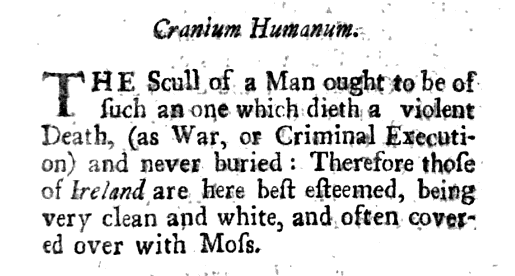
First off, it's worth stressing that, historically speaking, there is nothing particularly bizarre about eating people. Perusing one of my favorite early modern drug manuals, John Jacob Berlu's The Treasury of Drugs Unlock'd (London, 1690) makes it plain that a certain form of cannibalism was widely tolerated in Europe. Berlu's guide to drugs is not at all exotic or show off-y - on the contrary, it's a practical handbook aimed at working drugs merchants who needed to know basic facts about the wares they sold. Most of its entries involve relatively prosaic substances like tamarind, sassafras, cinnamon and elk antlers. But there are a few entries, like the one for "Cranium Humanum" shown below, which stand out to a modern eye:

Remember, this is a practical guide to consumable drugs. There's no trace of Swiftian satire or exoticizing hyperbole here. Berlu really does appear to be recommending, in a matter-of-fact way, that drug merchants should rove Ireland looking for moss-covered criminal's skulls, then sell them to apothecaries so they can be ground into powder and drunk by sick English people. 

Thus it shouldn't necessarily surprise us to find Egyptian mummies also appearing in lists of popular drugs and medical guides in the seventeenth century. As I mentioned in a previous post, Pierre Pomet, the apothecary of King Louis XIV, wrote extensively about the medical virtues of la mumie, even commissioning a detailed and not exactly accurate engraving of how he imagined mummies were prepared for burial:

Engraving of mummies from the English translation of Pomet's drug manual (Pierre Pomet, A Compleat History of Druggs published in London, 1712). 

Pomet, like Berlu, seems completely at home with the idea of eating mummy, and his main advice to the reader involves tips on how to avoid getting cheated by unscrupulous mummy merchants:

As I am not able to stop the Abuses committed by those who sell this Commodity, I shall only advise such as buy, to chuse what is of a fine shining Black, not full of Bones or Dirt, of a good Smell... This is reckoned proper for Contusions and to hinder Blood from coagulating in the Body; it is also given in Epilepsies, Vertigoes, and Palsies. The Dose is two Drams in Powder.

Pomet's discussion of eating mummy leads into a larger digression on various other forms of medical cannibalism such as "human Fat or Grease, which is brought us from several Parts, but, as every Body knows in Paris, the public Executioner sells it to those that want it." He even takes a moment to allude to the same moss-covered Irish skulls that Berlu had mentioned: 

The English druggists, especially those of London, sell the heads or skulls of the dead... The English Druggists generally bring these Heads from Ireland, where they frequently let the Bodies of Criminals hang n the Gibbets til they fall to Pieces. You may see in the Druggists Shops of London, some of these Heads entirely covere'd with Moss.
On the other hand, it's hard not to think that there'd be something distinctive about eating an Egyptian mummy rather than just some anonymous unburied criminal's skull (which, given the enormous amount of violence in the seventeenth century, would've been pretty easy to find). After all, we're talking about consuming human remains which are thousands of years old. It's not as if seventeenth century Europeans weren't aware of the rarity and age of what they were dealing with - on the contrary, many of them thought that these remains were far older. Herodotus, the ur-authority on Egyptian history for most Renaissance scholars, had claimed that the Egyptian priests possessed documents demonstrating an unbroken line of kingship stretching back 11,340 years.

In other words, from the perspective of a seventeenth-century European, the Egyptian mummies being sold by apothecaries could conceivably have been thirteen thousand years old.

I think it's reasonable, then, to conjecture that the early modern people who prescribed and consumed mummies valued them partially because of their reputed origins in a distant, Biblical antiquity. And, connected to this, their association with a great and mysterious civilization, a non-Christian society that rivaled any European empire.

Diagram of an Ancient Egyptian labyrinth imagined by the Jesuit polymath Athanasius Kircher in his Oedipus Aegyptiacus [Egyptian Oedipus] (Rome, 1653).

Talking to the Peruvianist Christopher Heaney about this sort of thing led us to wonder whether any early modern doctors believed that Andean Inca mummies shared the same medical virtues as Egyptian ones. It's still an open question, this being a fairly new line of research. But it does seem that at least some physicians and apothecaries did believe that Inca mummies were medically powerful in the same manner. In 1720, for instance, Johann Crüger’s De Mundi Creatione alluded to the drug "mumia" as having a potential origin in Peru. Crüger’s Latin text is intentionally obscure (since he was basically an alchemist)  but nonetheless makes the identification plain: “Wine,” he writes, “has the form of a vitriolic sulphur, not being a type of immature balsam of the Moon; and from thence [it can be found] in the fragrant white balsams of the liquid resins of Egyptian, Peruvian, or Copaici [?] mummies, whether an immature balsam, or a specific oil of the Moon.”

While researching this topic, I stumbled across a wonderfully strange piece of writing by the seventeenth-century physician Thomas Browne: his "Fragment on Mummies." I think Virginia Woolf was spot on when she compared reading Browne to wandering through a cabinet of curiosities - his style is baroque, intricate and mysterious in a way that I find fascinating. It would seem that Browne was opposed to the fashion for such "cannibal mixtures," but he couldn't deny its fascination:

That mummy is medicinal, the Arabian Doctor Haly delivereth and divers confirm; but of the particular uses thereof, there is much discrepancy of opinion. While Hofmannus prescribes the same to epileptics, Johan de Muralto commends the use thereof to gouty persons; Bacon likewise extols it as a stiptic: and Junkenius considers it of efficacy to resolve coagulated blood. Meanwhile, we hardly applaud Francis the First, of France, who always carried Mummia with him as a panacea against all disorders; and were the efficacy thereof more clearly made out, scarce conceive the use thereof allowable in physic, exceeding the barbarities of Cambyses, and turning old heroes unto unworthy potions.
Shall Egypt lend out her ancients unto chirurgeons and apothecaries, and Cheops and Psammiticus be weighed unto us for drugs? Shall we eat of Chamnes and Amosis in electuaries and pills, and be cured by cannibal mixtures? Surely such diet is dismal vampirism; and exceeds in horror the black banquet of Domitian, not to be paralleled except in those Arabian feasts, wherein Ghoules feed horribly.

December 27, 2012

Early Modern Drugs and Medicinal Cannibalism

An eighteenth-century German jar for medicinal mummy. Via Wikimedia Commons.
I spent much of the past year in Lisbon, Portugal, researching the development of the global trade in medicinal drugs during the seventeenth and eighteenth centuries. While there, I was struck by how extraordinarily different Portuguese pharmacies appeared from their United States counterparts. Some bore definite similarities to the type of American pharmacies I grew up regarding as normal: modern-looking edifices bathed in fluorescent light and painted a sterile white designed to set off the colorful packaging of the drugs for sale. Others, however, (like the Farmácia Andrade, which I walked by nearly every day) looked more like this well-preserved pharmacy in Stockholm:

The Apoteket Storken (Stork Pharmacy) in Stockholm, Sweden, 2009. Via Wikimedia Commons.
The same basic design (ceramic jars of herbs, minerals and animal products lined on wooden shelves along with the occasional specimen of exotica) can be seen in images from the eighteenth and seventeenth centuries:

An apothecary shop as depicted in Wolfgang Helmhard Hohberg, Georgica curiosa aucta (Nuremberg: 1697).
Yet what did these jars actually contain? Trying to actually learn the craft of early modern pharmacy is a difficult process: the apothecary was a member of a guild who held closely-guarded secrets, and apothecary manuals were frequently written in Latin and employed a host of specialist symbols and words like "drachm" and "scruple."

To make matters even more difficult, early modern drug lore predated the widespread adoption of Linnaean classification, so a plant called "Dragon's blood" in Italian might be totally different from a plant with the same name in English. What emerges when one overcomes these various obstacles and actually gets to the bottom of what was being prescribed, however, is a fascinating picture. It turns out early modern Europeans were prescribing some very familiar items – things found in herb teas sold in grocery stores today, like chamomile, fennel, licorice, and cardamom – alongside some utterly bizarre ones, like powdered crab's eyes, Egyptian mummies, and human skull, or "cranium humanum."

Late 17th or early 18th century medicine jars that once contained human fat – one of several gruesome "cannibal medicine" remedies now forgotten by all except collectors of antique jars and historians of early modern medicine.
In the sister post to this one, on The Appendix's blog, I listed a few intriguing medical recipes for things like "Snaill water" that I found in archives in Portugal and Philadelphia – you can read them here. But while I was revisiting these sources today, I was struck by the degree to which they take for granted something that I suspect most people in the contemporary world would find revolting: the consumption of human bodies as medicinal drugs.

As the picture above hints, substances like human fat or powdered mummy were once so common that hundreds or perhaps even thousands of antique ceramic jars purpose-built to contain them still exist in antique shops, museums and private collections. This is no secret, but it remains more or less the domain of specialists in early modern history and (judging by the reactions of friends and dinner guests I have broached the subject with!) appears to not be widely known to the general public.

One good popular resource on the subject is this May 2012 Smithsonian article by Maria Dolan, which quotes the authors of two recent academic works on the subject: Louise Noble's Medicinal Cannibalism in Early Modern Literature and Culture and Richard Sugg's Mummies, Cannibals and Vampires: The History of Corpse Medicine from the Renaissance to the Victorians. As the Smithsonian article notes, it was a relatively common sight in early modern France and Germany to witness relatives of sick people collecting blood from recently executed criminals to use in medical preparations:

For those who preferred their blood cooked, a 1679 recipe from a Franciscan apothecary describes how to make it into marmalade... [T]hese medicines may have been incidentally helpful—even though they worked by magical thinking, one more clumsy search for answers to the question of how to treat ailments at a time when even the circulation of blood was not yet understood. However, consuming human remains fit with the leading medical theories of the day. “It emerged from homeopathic ideas,” says Noble. “It’s 'like cures like.' So you eat ground-up skull for pains in the head.” Or drink blood for diseases of the blood. 

What is striking to me about such stories is not that merely that they occured – there are lots of similar oddities in the history of science and medicine – but that they appear to have been so strikingly commonplace.

Monrava y Roca, Breve curso de nueva cirurgia, (Lisbon, 1728). An interesting engraving illustrating a surgeon's medicine chest containing "mumia" and "human meat."
In my own research I've probably come across dozens of references to eating human remains at this point, and they're all delivered in a matter-of-fact, almost laconic tone. These accounts are especially jarring because they are from precisely the era – the 16th through 18th centuries – when Europeans were virtually obsessed with the supposed cruelties of cannibalism in a New World that was thought to be ruled by Satan. It seems to me that Montaigne was (characteristically) distinctive in noting this irony, in his brilliant essay "On Cannibals":

I am not sorry that we notice the barbarous horror of such acts [of cannibalism by indigenous Americans], but I am heartily sorry that, judging their faults rightly, we should be so blind to our own. I think there is more barbarity in eating a man alive than in eating him dead; and in tearing by tortures and the rack a body still full of feeling, in roasting a man bit by bit, in having him bitten and mangled by dogs and swine (as we have not only read but seen within fresh memory, not among ancient enemies, but among neighbors and fellow citizens, and what is worse, on the pretext of piety and religion), than in roasting and eating him after he is dead.

Even here, though, Montaigne was equating New World cannibalism with the cruelty of the French Wars of Religion – which involved extensive torture of civilians and atrocities like the St. Bartholomew's Day Massacre – and not with the medicinal cannibalism that was going on all around him. Strangely, even the shrewd Montaigne seems to miss the obvious equivalences to be drawn between ritualistic cannibalism of the sort practiced in Mesoamerica and early modern European's consumption of human bodies as part of their medical beliefs, which were intimately tied up with religion.

In such discussions, the specificity of what medicinal cannibalism entailed often gets lost. So I wanted to close by transcribing some "recipes" for early modern medicinal drug preparations that include humans. The following is from a 1676 manuscript called "Viridiarum Regale" that I consulted at the Van Pelt Library, University of Pennsylvania, in Philadelphia. I'd like to thank the Philadelphia Area Center for the History of Science and the Rare Books staff at the Van Pelt for making this research possible. This manuscript is written in a combination of Latin and Italian, which I've translated sloppily. The anonymous author promises his reader a list of "simple remedies gathered from diverse and celebrated authorities," but on page 591 we encounter a gruesome remedy that is anything but simple:
The regenerated mummy or microcosmic tincture: Take the body of a mummy with its own form and substance, whether it be a discrete limb, or the entire body, and allow this to putrefy in conserve of violets for a month, so that it becomes a mutillagenous blood. Then strain the putrefied matter and conserve this material… From this 'embrionic' mummy material you can separate a tincture. 

The alchemist Oswald Crull's  Basilica chymica (1608) gets even more specific, and macabre:
Take the fresh corpse of a redhaired, uninjured, unblemished man, 24 years old and killed no more than one day before, preferably by hanging, breaking on the wheel or impaling… Leave it one day and one night in the light of the sun and the moon, then cut into strips. Sprinkle on a little powder of myrrh to prevent it from being too bitter. Steep in spirit of wine for several days. As the foulness of it causes an intolerable humidity in the stomach, it is a good idea to macerate the mummy with oil.
It's hard to say how Croll expected his reader to successfully obtain a redhaired man of the exact age of 24 years who had died one day before. Imagining early modern physicians even attempting such a thing – let alone prescribing the bizarre "drug" of myrrh-coated human jerky that Croll's recipe describes – is a bit mind-boggling for me. Indeed, I wonder to what degree these recipes actually were carried out in practice. Were such elaborate descriptions of medicinal cannibalism more theoretical than practical?

The complex references to a "spiritual mummy" in the writings of Paracelsus, famously described in Popular Delusions and the Madness of Crowds, seem to me to point to a widespread metaphorical use of "mummy" to refer not to actual human bodies but to a theory of how illness and cures operate on the body. On the other hand, it is hard to get around the material evidence from apothecary jars, and the resolutely specific and tactile descriptions of dismembering and consuming human bodies in texts like Crull and Viridiarum Regale.

As my friend Rachel Herrmann put it in her research into cannibalism and starvation in colonial Jamestown: in the early modern era, humans truly were "the other, other white meat."

Further reading:

• Richard Sugg, Mummies, Cannibals and Vampires: The History of Corpse Medicine from the Renaissance to the Victorians (Routledge, 2011)
• Louise Noble, Medicinal Cannibalism in Early Modern Literature and Culture (Pallgrave, 2011)
The Chirurgeon's Apprentice on "corpse medicine in early modern England."
• Rachel Herrmann, "The "tragicall historie": Cannibalism and Abundance in Colonial Jamestown"
• Karen Gordon-Grube, "Evidence of Medicinal Cannibalism in Puritan New England"

February 28, 2011

A Defaced Herbal from 1710: William Salmon's Botanologia

A portrait of Salmon from the frontispiece
to his Ars Chirurgica (1699).
The image above is from a copy of William Salmon's Botanologia: The English Herbal, or History of Plants (London: I. Dawks for H. Rhodes and J. Taylor, 1710) which is available for view via Villanova University's digital library. Evidently the nudity of the figure (I suppose either the sun god Helios or Apollo) bothered an early owner of the book, since he or she appears to have obliterated the poor deity's rear quarters and genitalia with a quill pen. Conversely, perhaps someone had drawn something offensive onto the scratched-out area, and the ink was merely restoring modesty? Why is a man pouring a bucket of rain on the god from a cloud anyway?

It is all a bit of a mystery. And indeed, we know little more about the life of the man who wrote the book itself. William Salmon (1644-1713) numbered among the most successful medical practitioners of Restoration-era London but was largely forgotten after his death. Though he was much maligned as a quack doctor or 'mountebank' by eighteenth-century medical authorities, Salmon appears to have won considerable success as a self-proclaimed "Doctor of Physic," apothecary and author of popular treatises on everything from home surgery to figurative drawing, landscape painting and the science of hand gestures. Salmon's practice began in a tavern. Next, displaying a characteristic commercial shrewdness, the doctor rented space immediately opposite St. Bartholemew's Hospital in London and developed a medical practice that treated patients who were rejected from that institution. His specialty was drug mixtures and pills that featured a range of bizarre and exotic ingredients, the sort of thing that would later come to be called 'patent medicines.' (See my previous entry on early modern London's drug trade for some representative remedies, including a medicinal usage of 'Cranium Humanum,' i.e. human skull!).
The full frontispiece of Botanologia.
Little is known of Salmon's life. His Oxford Dictionary of National Biography by Phillip K. Wilson entry notes intriguingly,
"Contemporaries claimed that as a boy Salmon was apprenticed to a mountebank, whom he served as a ‘wachum’ or ‘zany’, and amused audiences by ‘tumbling through a hoop’ or with ‘tricks of legerdemain and slight of hand’; he also ‘made speeches and wrote Panygyricks in praise of his master's Panaceas. He wrote Almanacks to direct the taking of his medicines, and made the stars vouch for their virtue.’"
The same entry notes that "Salmon also created a cabinet of curiosities that included some items he brought back from his travels to the West Indies." Salmon himself referred in print to his travels "some years last past in the American World," noting modestly that he had "but lately returned home to perfect the whole System of Medical Learning." (See Allen Debus, ed. Medicine in Seventeenth Century England [Berkeley, 1974], 144). The nature and itinerary of these travels is still a bit of a mystery though, as far as I can tell.

I've been researching Salmon a bit recently and have noticed that he was a very prescient and effective advertiser. At least one of his books that I've consulted contains embedded advertisements for his medical practice and the 'Salmon's pills' for treatment of venereal disease available there, while a search of London newspapers circa 1660-1720 will turn up numerous notices such as the following, in The Flying Post (February 18-20, 1707):
I note in passing that this newspaper appears, most unusually, to have been published by a woman, one Ann Snowden, who resided "near Doctors-Commons."

For further reading see the discussion in Allan Debus, ed., Medicine in Seventeenth Century England (Berkeley, 1974), Craig Ashley Hanson's The English Virtuoso (Chicago, 2009).

Also worth checking out are "William Salmon, a 17th Century Renaissance Man," an essay on a rare books website by Bruce Tober that contains some interesting details I haven't seen elsewhere; and Phillip K. Wilson's Oxford Dictionary of National Biography piece, the authoritative account of his life. Caroline Rance's fabulous The Quack Doctor blog references and quotes Salmon here. Finally, Brent Elliot has written a very interesting and informative essay on the Botanologia here. I'm indebted to all of these authors for their work in uncovering the shadowy history of Salmon's interesting life.

November 5, 2010

"A Compleat History of Druggs." [Jan. 2011 Update]

"The study of simple drugs is a study so agreeable, and so exalted in its own nature, that it has been the pursuit of the first geniuses of all ages." - Pierre Pomet, Histoire generale des drogues (Paris, 1684).

"A book of high character was published in France at the conclusion of the seventeenth century, the General History of Drugs, by Monsieur Pomet, chief apothecary to the King... In this book M. Pomet expressed great indignation at the spirit of adulteration that had crept into the mummy trade. It was as hard then as now to get one's drugs in any reasonable state of purity." Charles Dickens, Household Words, February 25, 1857

Title page of the first English edition, 1712.
Pierre Pomet's Histoire generale des drogues (1684), translated into English in 1712 as A Compleat History of Druggs, was a manual not only of the substances now identified as 'drugs,' but of a vast range of medicines, intoxicants, narcotics, dyestuffs, spices, foods and animal products. (See my earlier post "A Drug Merchant in Seventeenth Century London" for a sample of what drugs encompassed in the early modern world -- mummies, human skulls, powdered gems and bezoar stones were all in high demand). Although the 17th century witnessed the publication of many guides to drugs and medicines, Pomet's stands out both for its high production values and for its cross-over appeal to a popular reading audience that was hungry for tales of exotic locales, freakish beasts and strange drugs.

Pomet's portrait, from the French edition.
Monsieur Pomet (1658-1699) was the chief druggist to Louis XIV, 'the Sun King,' and also maintained a fashionable private practice in Paris as the proprietor of an apothecary's shop. His book represents a breakthrough in European understandings of the new medicines and natural products being opened up by British, Dutch, Portuguese and Spanish expansion into the global tropics. The illustrations, in particular, are an advance on previous works. I plan to make a more in-depth post in the future about early modern theories of drugs -- which were connected closely to magic, spirituality and climate -- but for now I'll just post some of the most striking of the book's illustrations.

Slaves in the West Indies feeding sugar cane into a vertical mill and working a boiler,
which was among the most arduous and dangerous jobs a Caribbean slave could be
burdened with. Sugar was classed as a drug/drogue/droga by early modern European
medical authorities, and played a key role in a number of medical concoctions.
A standout plate from the English translation featuring unicorns. As the captions note,
most hail from John Johnston's 1657 Historiæ Naturalis de Quadrupedibus (see here for
more on this most interesting work of early modern animal lore.)
Bezoar stones were among the most precious substances known to early modern apothecaries, for it was believed that ingesting a tiny morsel of one could cure poisons and plagues. The fact that the fabled bezoar was essentially a hairball found in the viscera of certain goats and llamas did not deter kings, prelates and rich merchants from seeking them out.
Mandrake, Cork and the rare 'Peruvian Bark,' i.e. cinchona, which contains quinine.

This is by far my favorite image from the book, depicting the methods of making and finding mummy medicine -- note the bizarre pyramid at right, which looks vaguely South Asian to me. Unfortunately I couldn't find a detailed scan online.
Another view.
As an aside, I came across two interesting things while researching this post. The first, the bizarre and perhaps mythical 16th century Chinese medicine known as "Mellified Man" (in which one voluntarily overdoses on honey, is buried in same, and then is sold as a medicine) is a topic that I will probably devote a full post to in the months to come if I can find any further information. The second is a wonderful website called "Strange Science" which has a remarkably comprehensive archive of images of strange mammals from the Neolithic to the present here.

For scholarship on Pomet, see Sandra Sherman's "The Exotic World of Pierre Pomet's A Compleat History of Druggs" in Endeavor and an essay by Jordan Kellman in the December 2010 of the excellent new journal Atlantic Studies entitled "Nature, networks, and expert testimony in the colonial Atlantic: The case of cochineal." Those interested in early modern unicorn lore should check out this 2006 BibliOdyssey post on the subject.