|
| A detail from an engraving by Theodor de Bry showing indigenous Brazilians tormented by devils. |
"I sat awhile, cringing upon my Hams among the Indians, after their Fashion, painted as they were, and all naked but only about the Waist, and with my Nose-piece… hanging over my mouth. … 'Twas the better part of an Hour before one of the Crew, looking more narrowly upon me, cried out, Here's our Doctor; and immediately they all congratulated my Arrival among them. I did what I could presently to wash off my Paint, but 'twas near a Month before I could get tolerably rid of it." — Lionel Wafer, 1681
The pirate-surgeon Lionel Wafer (1640-1705) has won some modest attention from historians and fans of pirate lore due to his participation in the South Seas voyages of more famous buccaneers like William Dampier and Bartholomew Sharp.
Surprisingly, however, by far the most interesting era of Wafer's life — which hinges on a period of four months during which Wafer lived with the Kuna people of Panama, adopting their mode of dress, customs, and language — has gone without much notice. Wafer's account of this period is utterly fascinating, abounding with intriguing details about Kuna spirituality, surgical techniques, and even what Wafer, rather uncharitably, called the "Diabolical Conjurations" of the Kuna elders who nursed him back to health following a freak accident in the jungle.
Surprisingly, however, by far the most interesting era of Wafer's life — which hinges on a period of four months during which Wafer lived with the Kuna people of Panama, adopting their mode of dress, customs, and language — has gone without much notice. Wafer's account of this period is utterly fascinating, abounding with intriguing details about Kuna spirituality, surgical techniques, and even what Wafer, rather uncharitably, called the "Diabolical Conjurations" of the Kuna elders who nursed him back to health following a freak accident in the jungle.
 |
| Title page of Wafer's Voyage. |
After a few delirious days wandering in the jungle, Wafer was lucky enough to make his way to a village led by a Kuna leader named Lacenta, where he was given shelter and his injuries were slowly healed. By Wafer's account, at least, he then proceeded to learn the Kuna language, befriend Lacenta, and gain much knowledge of local plants and medicines. Wafer even claimed that he used his surgical skills (specifically, his practice of phlebotomy, or blood-letting) to “save the life” of one of Lacenta’s wives.
And he had witnessed the work of shamans who had predicted the circumstances of his own eventual return to the Christian world with uncanny accuracy. They had done so, Wafer claimed, by summoning the devil.
 |
| Lacenta with his family and attendants. From Wafer, New Voyage and Description of the Isthmus of America, 140. |
 |
| The Kuna method of blood-letting, performed on one of Lacenta's wives (Wafer, 28). |
 |
| “The Indians in their Robes in Councel, and Smoaking tobacco after their way" (102). |
Wafer’s vision of the indigenous cultures of the New World as haunted by Satanic magic was not new. Spanish and Portuguese chronicles of American conquest described indigenous Americans who wielded the power of the devil both to curse and to cure. But Wafer’s account further provoked unsettling questions about the potentially supernatural (and Satanic) origin of knowledge about the Americas in a specific time and place – Britain during the Scientific Revolution – when such knowledge had never been more valuable.
As David Livingstone , Simon Schaffer and Harold Cook
 have shown, traveler’s accounts provided the first-hand reporting of phenomena that fueled the development of the natural sciences. The big question among early modern European scientists was not about whether travel accounts were scientifically valuable. It was which ones to trust. Who was an acceptable source for scientific data? Could indigenous knowledge be trusted if, as many Christians believed in the seventeenth century, it had been shaped by witchcraft, magic, or Satan himself?
As David Livingstone
, Simon Schaffer and Harold Cook have shown, traveler’s accounts provided the first-hand reporting of phenomena that fueled the development of the natural sciences. The big question among early modern European scientists was not about whether travel accounts were scientifically valuable. It was which ones to trust. Who was an acceptable source for scientific data? Could indigenous knowledge be trusted if, as many Christians believed in the seventeenth century, it had been shaped by witchcraft, magic, or Satan himself? |
| Tupi Indians in Brazil fighting with demonic beings (detail). Theodor de Bry, Americae tertia pars (Frankfurt, 1592), 223. |
By the close of the seventeenth century, ‘buccaneer ethnographers’ such as Lionel Wafer’s travel partner William Dampier had demonstrated that even pirates could collect empirical data that was acceptable to scientists like the members of the Royal Society of London. Yet the personal histories of such individuals, who frequently resided among non-Christian indigenous peoples for extended periods, put them in the complex position of serving as mediators between what historians call "scientific travel" and indigenous spirituality.
Wafer was among the most dramatic examples of this unfolding story. As Britain’s preeminent firsthand witness of the Panama region, he was a key figure in early attempts to understand the American tropics — and in efforts to exploit tropical resources via new colonies. Indeed, in July of 1687 Wafer had been interviewed regarding the Darién’s colonization potential by none other than John Locke. Wafer’s account had also been printed and bound together with an account of Darien written by an unspecified “member of the Royal Society,” suggesting close links between Wafer and that institution.
What can these negotiations tell us about the transformations of science and of the British Empire at the dawn of the eighteenth century?
What can these negotiations tell us about the transformations of science and of the British Empire at the dawn of the eighteenth century?
Wafer served as a courier of knowledge about a tropical world that was still largely unknown to European science. But Wafer’s time in this space had bestowed on him a form of indigeneity that also rendered his testimony suspect among European Christians. Wafer’s adoption of Kuna dress and ceremonial body paint, in particular, raised concerns among Europeans that were tied to larger debates about demonology.
Take John Bulwer’s 1656 frontispiece to Anthropometamorphosis, or the Artificial Changeling, for instance.
 This utterly fascinating and bizarre image shows a European woman, a hair-covered man and a South American Indian with full body paint standing side by side. They are being judged by Nature, Adam and Eve and a body of disapproving magistrates (including the ghost of Galen) for transforming their bodies, while the devil flies above them laughing and saying, “In the image of God created he them! But I have new-molded them to my likeness.”
that was still largely unknown to European science. But Wafer’s time in this space had bestowed on him a form of indigeneity that also rendered his testimony suspect among European Christians. Wafer’s adoption of Kuna dress and ceremonial body paint, in particular, raised concerns among Europeans that were tied to larger debates about demonology.Take John Bulwer’s 1656 frontispiece to Anthropometamorphosis, or the Artificial Changeling, for instance.
 This utterly fascinating and bizarre image shows a European woman, a hair-covered man and a South American Indian with full body paint standing side by side. They are being judged by Nature, Adam and Eve and a body of disapproving magistrates (including the ghost of Galen) for transforming their bodies, while the devil flies above them laughing and saying, “In the image of God created he them! But I have new-molded them to my likeness.”
 |
| Europeans and indigenous Americans being judged by Nature for modifying their bodies. |
Wafer had written that his Kuna body paint eventually rubbed off, often with the “peeling away of flesh and all,” to reveal a European underneath.
But did his time in the world of the Kuna leave traces of the indigenous that took longer to disappear?
In the preface to the second edition to the New Voyage and Description, printed in 1704, Wafer attempted to reaffirm his status as a credible Christian observer, writing that he wished to “vindicat[e] my self to the World” regarding his previous account of “the Indian way of Conjuring,” which, he explained vaguely, had “very much startled… several of the most eminent Men of the Nation.” In this preface Wafer continued to maintain that the Kuna shamans practiced Satanism, and he buttressed his authority by citing parallel accounts produced by Scottish settlers in the Darién.
He pointedly refrained, however, from defending his earlier claims about the accurate predictions this method had supposedly produced.
In the end, Wafer decisively abandoned the Kuna version of his identity. His face paint was wiped off, his nose piercing removed, his tropical clothing replaced with the scratchy wool and close-bound cotton of a seventeenth-century Englishman. But his story reminds us that place can powerfully reshape identity, not just in the globalized present, but even during the height of European colonialism, when religious bigotry and prejudice ran rampant.
For a brief period, a British pirate surgeon became a Kuna healer. And then, just as suddenly, that identity was stripped off and discarded, no more permanent than the paint and piercings which had once sustained it.
Further reading
You can read Wafer's New Voyage and Description free of charge on Google books here. Ignacio Gallup-Diaz's The Door to the Sea and the Key to the Universe: Indian Politics and Imperial Rivalry in the Darién, 1640-1750 is the best account of the region's colonial history that I have found - it comes highly recommended, and is available free as a Gutenberg e-book via Columbia University Press.
The University of Ohio library has a great blog post on its copy of Bulwer's Anthropometamorphosis with accompanying scans here. Finally, for those interested in the larger questions surrounding exploration, indigenous-European interaction and science, I highly recommend William Hasty's essay "Piracy and the Production of Knowledge in the Travels of William Dampier."
For a brief period, a British pirate surgeon became a Kuna healer. And then, just as suddenly, that identity was stripped off and discarded, no more permanent than the paint and piercings which had once sustained it.
Further reading
You can read Wafer's New Voyage and Description free of charge on Google books here. Ignacio Gallup-Diaz's The Door to the Sea and the Key to the Universe: Indian Politics and Imperial Rivalry in the Darién, 1640-1750
is the best account of the region's colonial history that I have found - it comes highly recommended, and is available free as a Gutenberg e-book via Columbia University Press.The University of Ohio library has a great blog post on its copy of Bulwer's Anthropometamorphosis with accompanying scans here. Finally, for those interested in the larger questions surrounding exploration, indigenous-European interaction and science, I highly recommend William Hasty's essay "Piracy and the Production of Knowledge in the Travels of William Dampier."

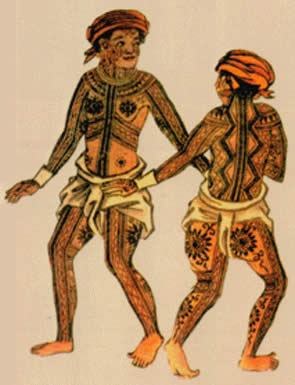
 (1697) and two gorgeous images of the East Indies from the 1599
 of


 , "[Giolo] was painted all down the breast, between his shoulders behind; on his thighs before; and in the form of several broad rings, or bracelets, round his arms and legs. I cannot liken the drawings to any figure of animals, or the like, but they were very curious, full of great variety of lines, flourishes, checkered work, etc. keeping a very graceful proportion, and appearing very artificial, even to wonder, especially that upon and between his shoulder blades... He told me that most of the men and women of the island were thus painted." (William Dampier, A New Voyage Round The World, 1697)