Showing posts with label Monkeys. Show all posts

May 23, 2018

A Medieval Emperor's Natural Language Experiment

Holy Roman Emperor Frederick II as depicted in the Shrine of Charlemagne, which he commissioned, c. 1215.
The Holy Roman Emperor Frederick II (1194-1250) was known as the stupor mundi ("the astonishment of the world") among his European contemporaries. But he did not cut an impressive physical figure, at least according to the Baghdad-born chronicler Sibt ibn al-Jawzi.

"The Emperor was covered with red hair, bald, and myopic," al-Jawzi recorded. "Had he been a slave, he would not have fetched 200 dirhams at market."

The quip didn't reflect any particular animus on the part of al-Jawzi. In fact, Emperor Frederick was well-regarded by many in the Muslim world. Dante, that most judgmental of all medieval writers, placed Frederick in the sixth level of his Inferno: the region reserved for heretics. The emperor was by all accounts deeply religiously heterodox, and was famous for feuding with the Pope and enlisting Muslim soldiers in his personal bodyguard.

The same unorthodox manner that had repelled Dante seems to have endeared Frederick to his rival Al-Kamil, the Ayyubid Sultan of Egypt. A strikingly good-natured exchange took place during the two rulers' parlay over the fate of Jerusalem. Al-Kamil's muezzin, out of respect for the presence of a Christian king, had refrained from the morning call to prayer. Emperor Frederick supposedly rebuked him, saying: "I stayed overnight in Jerusalem in order to overhear the prayer call of the Muslims and their worthy God." Frederick's ability to maintain respectful relations with the Sultan resulted in a bloodless transfer of Jerusalem to the Emperor's rule, in stark contrast to previous crusades which had typically resulted in massive amounts of senseless violence.

Emperor Frederick II and Sultan Al-Kamil clasping hands at the gates of Jerusalem, from Giovanni Villani's Nuova Cronica, Biblioteca Apostolica Vaticana, 14th century. 
Frederick's most recent biographer, David Abulafia, calls Frederick a "scientific" emperor, noting his deep-seated interest in the natural world, his rejection of religious orthodoxy, and his support for astronomical research.

But a closer look into the Emperor's own "experiments" yields some surprises.

Frederick's interests are emblematic of the difference between medieval investigations of nature and those that we today associate with modern science. For one thing, they were insanely unethical by modern standards. According to the Franciscan monk Salimbene (who we should take with a grain of salt - Abulafia calls him a "shameless gossip"), these experiments included dissections of two men who had been fed meals hours earlier, to see how vigorous exercise influenced digestion. Salimbene also mentions a dubious-sounding incident in which Frederick compelled a man known as "Nicholas the Fish" (who was said to have been "condemned to an amphibious life" by his mother's curse!) to continually dive and fetch an underwater golden cup until he drowned.

Children playing, from a 1338 Alexander Romance (Bodleian, Oxford, MS Bodley 264).
According to Salimbene, Frederick was also perhaps the first figure in recorded history to conduct a language deprivation experiment.

What happens to infants who are deprived of all language? It's a question with profound implications, because it potentially sheds light on long-standing debates over the degree to which the human brain has a "language instinct," as Steven Pinker put it in his book of the same name. But it's an experiment so deeply cruel that it has only been entertained as an option by a handful of medieval and early modern rulers (a category of human beings for whom harshness and violence were sometimes lauded as a virtue).

Here's my attempt at translating from Salimbene's Latin, which you can read here in full here:

The second of [Frederick's] superstitions is that he wished to discover what sort of language and speech children developed, when growing up, if they were spoken to by no one. And so he ordered nurses to give milk to the infants, and for their breasts to be suckled, and for them to be bathed and cared for, but that they should be in no ways be played with or spoken to. The emperor wanted to know whether these infants would begin to speak the Hebrew language (which had been the first), or the Greek, Latin, or Arabic tongues, or whichever language had been spoken by the parents from which they were born. However, he labored in vain. Whether children or infants, they all perished. For it was not possible to live without the rejoicing and games and happy faces and blandishments of their caregivers and nurses. 
This inhumane episode, if it was actually ever carried out, is oddly reminiscent of some of the work of mid-20th century behavioralists, like B. F. Skinner, and their critics, like Harry Harlow. Harlow's interest in what he called the "pit of despair" afflicting isolated infants (which the psychologist apparently originally wanted to refer to with the even more medieval-sounding phrase "dungeon of despair") led him to conduct a now-infamous series of experiments involving the total isolation of baby rhesus monkeys.

Harlow found that even providing access to an inanimate "surrogate" mother (if the surrogate was soft to the touch) could provide what he called a "psychological base of operations" that increased survival rates and improved the baby's ability to cope with stressors. Monkeys with no such comfort quickly succumbed to profound psychological distress; some even died.

A Life Magazine photograph of one of the unfortunate infant monkeys involved in Harlow's infamous monkey experiments, circa 1959.
Without wading too much into psychological explanations, it may be worth pointing out at this juncture that Frederick II lost his own mother at the age of three. Medieval lives tended to be harsh, and perhaps his own experience of traumatic loss of a loving parent inspired Frederick's supposed dabbling in the dark side of behavioralist psychology.

Or maybe Salimbene, the monk on whom so much of what we supposedly know of Frederick depends, was simply slandering the emperor. It's hard to know at this point. But the episode does serve as a good reminder that many ideas and practices we associate with "modern science" often have much older (and stranger) antecedents than we realize.

Incidentally, the obsession with seeing Hebrew as the "natural language" of humankind would stick around for a very long time. As late as 1760, the author of A New Complete English Dictionary speculated that Hebrew was the "language which God taught Adam." However, he noted that "others hold for the Syriac, Childee, Ethiopian, or Armenian" as potential first languages.

What I find most interesting, though, about Frederick's cruel experiment is not the speculation about some hypothetical "first" language, but the question of whether infants are somehow naturally able to speak the language of their parents, even without exposure to them.

The idea seems to me tantalizingly similar to the theory of inheritance popularized by Jean-Bapistque Lamarck centuries later, toward the end of the eighteenth century.


May 4, 2017

Why Are There So Many 17th Century Paintings of Monkeys Getting Drunk?


One cold Friday in 1660, Samuel Pepys encountered two unpleasant surprises. "At home found all well," he wrote in his diary, "but the monkey loose, which did anger me, and so I did strike her." Later that night, a candlemaker named Will Joyce (the good-for-nothing husband of one of Pepys's cousins) stumbled in on Pepys and his aunt while "drunk, and in a talking vapouring humour of his state, and I know not what, which did vex me cruelly." Presumably, Pepys didn't resort to blows this time around.

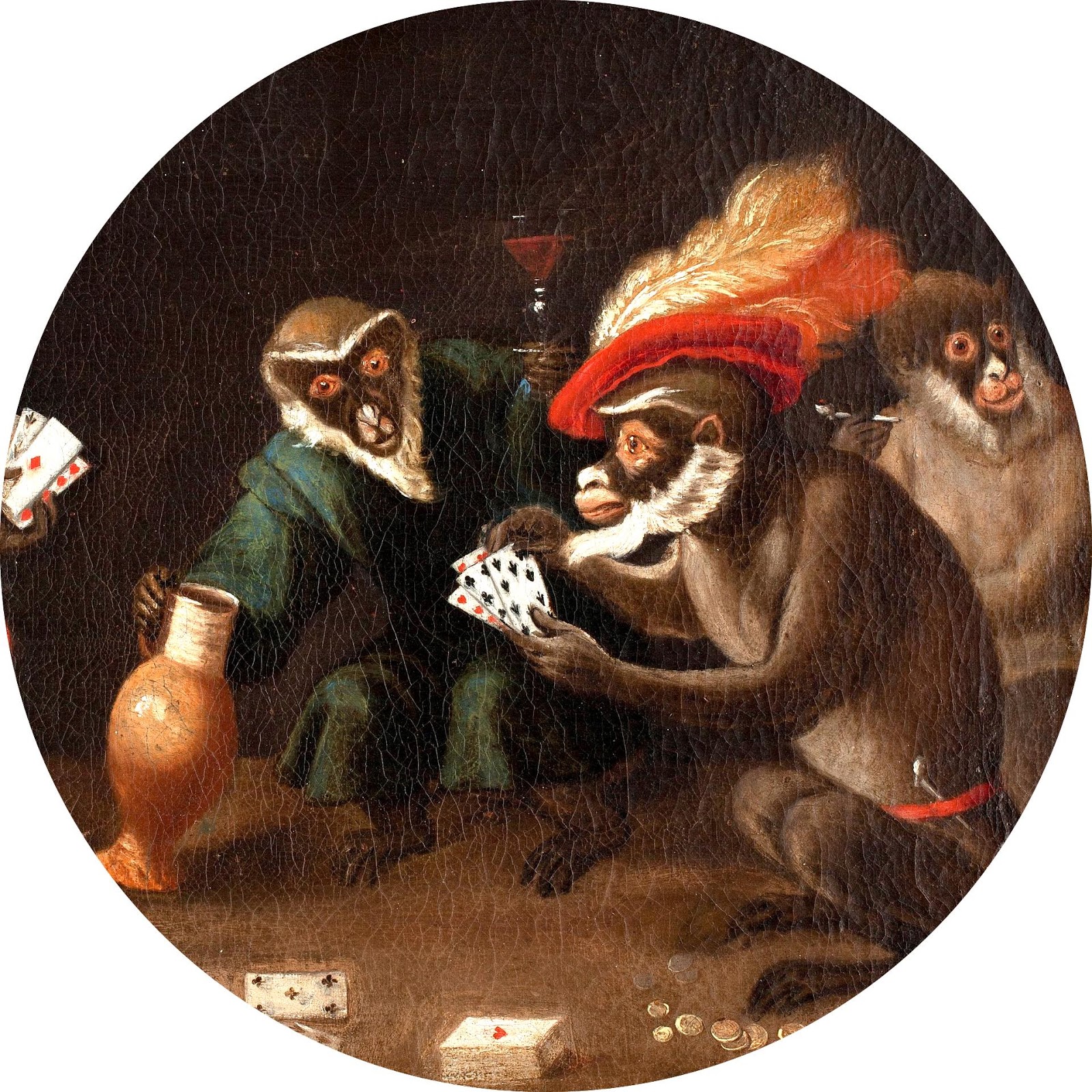
The two objects of Pepys' scorn that day, his disobedient pet monkey and his drunken cousin-in-law, were not as distant as one might think. Monkeys stood in for intoxicated humans on a surprisingly frequent basis in 17th century culture. In early modern paintings, tippling primates can frequently be seen in human clothing, smoking tobacco, playing cards, rolling dice, and just plain getting wasted.

Why?

One of several "monkeys in a tavern" paintings produced by the Dutch artist David Teniers (1610-1690).
The most simple answer is that these paintings are the early modern version of searching for "dog who thinks he's a human" on YouTube. They're funny. Paintings of intoxicated monkeys were actually a sub-set of a larger genre of paintings known as Singerie, which poked fun at occupations ranging from drunkard to painter by portraying the participants as frivolous simians.

There's clearly something universal about the basic idea of these works. As anyone who has read Aesop's fables or a watched a Disney movie can attest, depictions of animals with human characteristics allow us to satirize or mythologize ordinary human encounters. Thinking about animals as personalities that can recite poetry, hatch political schemes, or get drunk at a tavern allows us to see our own behavior and that of our fellow humans through a slightly off-kilter filter, as if we were aliens observing a different species.

The Crow King and his Councillors, from a 13th century manuscript of Kalila wa Dimna, the Arabic version of the Pachatantra animal stories originally from India.
In these 16th and 17th century European depictions of monkeys, however, I think there's something more specific going on.

Monkeys in these paintings are almost always shown with a tobacco pipe or wine cup close at hand, and they’re often brandishing the same types of items displayed in a popular series of images (discussed in a previous post) showing a foolish young man being cleansed of his materialistic desires via alchemical medicine: playing cards, backgammon boards, fencing swords, ostrich feather caps.

Kwakzalver [Quack] selling a patent medicine in the marketplace, by Pieter van der Borcht, ca. late 16th century.

In other images, monkeys are also shown in the guise of alchemists and drug sellers, poking fun at the pretensions of these two professions that were carving out an ever-greater economic and social role for themselves as exotic drugs from the Indies became global commodities.

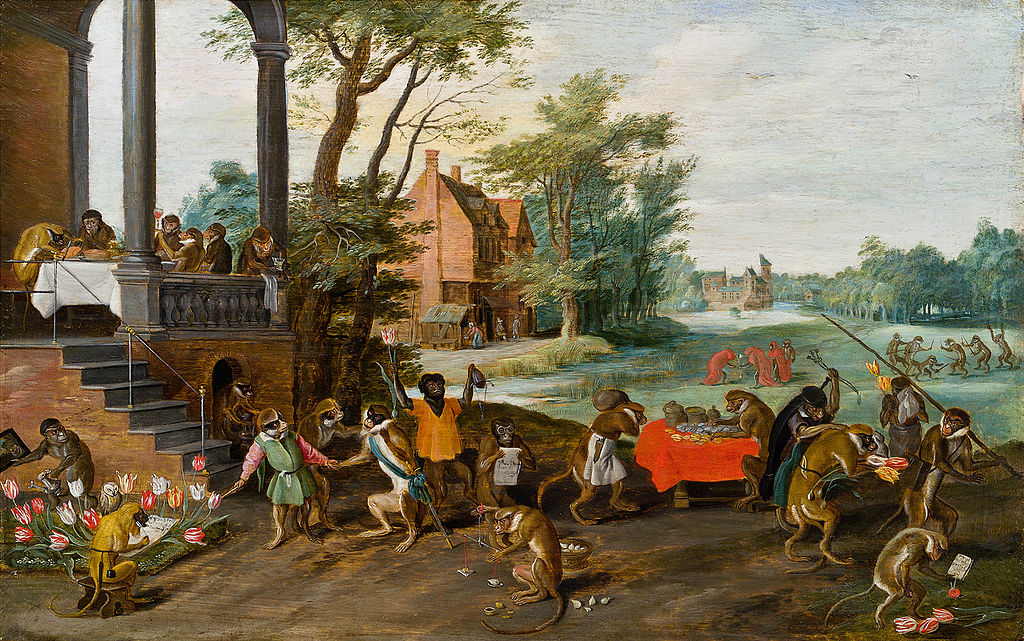
So what is going on with these images showing drunken and drug-selling monkeys? I think that what we're missing when we simply see these as a form of social satire is that these are also paintings about addiction. Desire is a dominant theme in these works: monkeys are shown jealously squabbling over piles of tobacco, or even, in the example below, hoarding tulip flowers during the height of the Dutch tulipmania (they appear to be using the profits to get drunk, in the upper left).

Allegorie der Tulipomanie [Allegory of Tulip Mania], by Jan Brueghel the Younger, 1640s.
The concept of addiction had not yet taken on anything like its modern form in this period. The word existed, but it simply meant an inclination or tendency: one could be "addicted to horses" or "addicted to song," etc. But the 17th century was a world in which distilled alcoholic spirits were still a relatively new invention, and one in which such addictive substances as tobacco, coffee and opium had become available to most global consumers within living memory of the people creating and buying these paintings.

In other words, these paintings are working through the idea that newly-available psychoactive substances -- and, perhaps, material objects as well -- could dehumanize those who consumed them, reducing them to an animalistic level. Such consumers, it is implied, had moved down a step on the chain of being, having lost their powers of reason and been reduced to creatures that were "sentient" in the original sense of the word: unable to think, and content simply to feel. They had moved from the human realm to that of the "brute beasts" in the schema for hierarchically ordering nature that medieval and early modern thinkers had inherited from Aristotle.

A depiction of the "Great Chain of Being" from a 1512 edition of Ramon Lull's De ascensu & descensu intellectus (1305). The steps are labelled, in ascending order, "Stone," "Fire," "Plant," "Brute," "Human," "Heaven," "Angel," and "God."

We see this argument in some written texts of the period as well. For King James, writing in his Counterblaste to Tobacco of 1604, the fashion for imitating the foolish novelties of lands “beyond the Seas” made English tobacco smokers “like Apes, counterfeiting the manners of others, to our owne destruction.” The adoption of tobacco smoking in Europe was not simply an issue of public health, but a spiritual crisis. Because he knew that tobacco was an element in indigenous American spirituality, James believed that Europeans who consumed it risked transforming not only their bodies, but their minds and souls, too.


But there's an alternative narrative running through these paintings as well. It epitomizes the ambivalence that has long surrounded intoxicating substances, in many cultures and in many times.

These monkeys seem to be having fun.

Die tabakrauchende Affenrunde [The Tobacco Smoking Monkeys], attributed to Ferdinand van Kessel, 17th century.

Singerie with smoking pipe, David Teniers the Younger, 17th century.

Monkeys Feasting by Breughel the Younger.

Monkey soldiers taking a cat prisoner, Sebastian Vrancx, early 17th century.
You can find more images of singerie paintings in an online gallery at the Public Domain Review. Here's a particular favorite: