|
| Brazilian BBQ from Theodor de Bry, America Tertiae Pars (1592). |
Although historians like Richard Sugg have already written perceptively about medical cannibalism, the special role played by mummies in this story has always seemed intriguing and rather under explored to me. I spoke a bit about this at Yale's History of Medicine colloquium last month, and thought I'd adapt some of my thoughts into a post.
First off, it's worth stressing that, historically speaking, there is nothing particularly bizarre about eating people. Perusing one of my favorite early modern drug manuals, John Jacob Berlu's The Treasury of Drugs Unlock'd (London, 1690) makes it plain that a certain form of cannibalism was widely tolerated in Europe. Berlu's guide to drugs is not at all exotic or show off-y - on the contrary, it's a practical handbook aimed at working drugs merchants who needed to know basic facts about the wares they sold. Most of its entries involve relatively prosaic substances like tamarind, sassafras, cinnamon and elk antlers. But there are a few entries, like the one for "Cranium Humanum" shown below, which stand out to a modern eye:
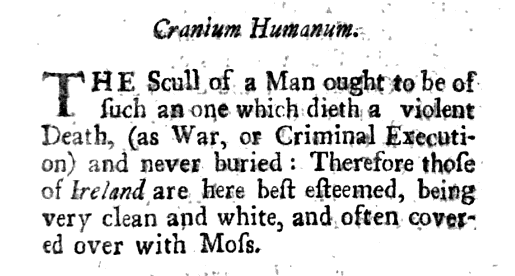
Remember, this is a practical guide to consumable drugs. There's no trace of Swiftian satire or exoticizing hyperbole here. Berlu really does appear to be recommending, in a matter-of-fact way, that drug merchants should rove Ireland looking for moss-covered criminal's skulls, then sell them to apothecaries so they can be ground into powder and drunk by sick English people.
Thus it shouldn't necessarily surprise us to find Egyptian mummies also appearing in lists of popular drugs and medical guides in the seventeenth century. As I mentioned in a previous post, Pierre Pomet, the apothecary of King Louis XIV, wrote extensively about the medical virtues of la mumie, even commissioning a detailed and not exactly accurate engraving of how he imagined mummies were prepared for burial:
 |
| Engraving of mummies from the English translation of Pomet's drug manual (Pierre Pomet, A Compleat History of Druggs published in London, 1712). |
Pomet, like Berlu, seems completely at home with the idea of eating mummy, and his main advice to the reader involves tips on how to avoid getting cheated by unscrupulous mummy merchants:
As I am not able to stop the Abuses committed by those who sell this Commodity, I shall only advise such as buy, to chuse what is of a fine shining Black, not full of Bones or Dirt, of a good Smell... This is reckoned proper for Contusions and to hinder Blood from coagulating in the Body; it is also given in Epilepsies, Vertigoes, and Palsies. The Dose is two Drams in Powder.
Pomet's discussion of eating mummy leads into a larger digression on various other forms of medical cannibalism such as "human Fat or Grease, which is brought us from several Parts, but, as every Body knows in Paris, the public Executioner sells it to those that want it." He even takes a moment to allude to the same moss-covered Irish skulls that Berlu had mentioned:
The English druggists, especially those of London, sell the heads or skulls of the dead... The English Druggists generally bring these Heads from Ireland, where they frequently let the Bodies of Criminals hang n the Gibbets til they fall to Pieces. You may see in the Druggists Shops of London, some of these Heads entirely covere'd with Moss.On the other hand, it's hard not to think that there'd be something distinctive about eating an Egyptian mummy rather than just some anonymous unburied criminal's skull (which, given the enormous amount of violence in the seventeenth century, would've been pretty easy to find). After all, we're talking about consuming human remains which are thousands of years old. It's not as if seventeenth century Europeans weren't aware of the rarity and age of what they were dealing with - on the contrary, many of them thought that these remains were far older. Herodotus, the ur-authority on Egyptian history for most Renaissance scholars, had claimed that the Egyptian priests possessed documents demonstrating an unbroken line of kingship stretching back 11,340 years.
In other words, from the perspective of a seventeenth-century European, the Egyptian mummies being sold by apothecaries could conceivably have been thirteen thousand years old.
I think it's reasonable, then, to conjecture that the early modern people who prescribed and consumed mummies valued them partially because of their reputed origins in a distant, Biblical antiquity. And, connected to this, their association with a great and mysterious civilization, a non-Christian society that rivaled any European empire.
 |
| Diagram of an Ancient Egyptian labyrinth imagined by the Jesuit polymath Athanasius Kircher in his Oedipus Aegyptiacus [Egyptian Oedipus] (Rome, 1653). |
Talking to the Peruvianist Christopher Heaney about this sort of thing led us to wonder whether any early modern doctors believed that Andean Inca mummies shared the same medical virtues as Egyptian ones. It's still an open question, this being a fairly new line of research. But it does seem that at least some physicians and apothecaries did believe that Inca mummies were medically powerful in the same manner. In 1720, for instance, Johann Crüger’s De Mundi Creatione alluded to the drug "mumia" as having a potential origin in Peru. Crüger’s Latin text is intentionally obscure (since he was basically an alchemist) but nonetheless makes the identification plain: “Wine,” he writes, “has the form of a vitriolic sulphur, not being a type of immature balsam of the Moon; and from thence [it can be found] in the fragrant white balsams of the liquid resins of Egyptian, Peruvian, or Copaici [?] mummies, whether an immature balsam, or a specific oil of the Moon.”
While researching this topic, I stumbled across a wonderfully strange piece of writing by the seventeenth-century physician Thomas Browne: his "Fragment on Mummies." I think Virginia Woolf was spot on when she compared reading Browne to wandering through a cabinet of curiosities - his style is baroque, intricate and mysterious in a way that I find fascinating. It would seem that Browne was opposed to the fashion for such "cannibal mixtures," but he couldn't deny its fascination:
That mummy is medicinal, the Arabian Doctor Haly delivereth and divers confirm; but of the particular uses thereof, there is much discrepancy of opinion. While Hofmannus prescribes the same to epileptics, Johan de Muralto commends the use thereof to gouty persons; Bacon likewise extols it as a stiptic: and Junkenius considers it of efficacy to resolve coagulated blood. Meanwhile, we hardly applaud Francis the First, of France, who always carried Mummia with him as a panacea against all disorders; and were the efficacy thereof more clearly made out, scarce conceive the use thereof allowable in physic, exceeding the barbarities of Cambyses, and turning old heroes unto unworthy potions.
Shall Egypt lend out her ancients unto chirurgeons and apothecaries, and Cheops and Psammiticus be weighed unto us for drugs? Shall we eat of Chamnes and Amosis in electuaries and pills, and be cured by cannibal mixtures? Surely such diet is dismal vampirism; and exceeds in horror the black banquet of Domitian, not to be paralleled except in those Arabian feasts, wherein Ghoules feed horribly.


 (2004) for a good introduction.