Showing posts with label Japan. Show all posts

July 27, 2010

Japanese Ethnographic Portraits of South Americans, 1720

 I was surprised to find that these images exist, but I'm glad they do. Apparently produced as part of a visual ethnography of the world's cultures written by a Japanese interpreter for the Dutch merchant community in Nagasaki named Nishikawa Joken, they depict "people from each of the 42 barbarian countries outside of Japan." (My main source for this information, and the images themselves, comes from the wonderful database of early American images maintained by the John Carter Brown library.)

Alas, I have only found two of the forty two online, but those two are quite fascinating. The first appears to depict two South American Indians, perhaps Amazonian judging by their dress, while the second portrays a "Native American Patagonian giant." I would be fascinated to learn what the accompanying Japanese text has to say about these and other New World cultures. If anyone reading this has any further information, please contact me!

"Two South American Indians" in Nishikawa Joken, Shijûni-koku Jinbutsu zusetsu (Kyoto, 1720). Xylograph print on paper with hand coloring, 31.1 x 18.2 cm.

"Patagonian Giant" in Nishikawa Joken, Shijûni-koku Jinbutsu zusetsu (Kyoto, 1720). Xylograph print on paper with hand coloring, 31.1 x 18.2 cm. 

I have yet to read this particular work, but according to the JCB's online catalog entry the great historian Charles Boxer touches upon these images in his work Jan Compagnie in Japan, 1600-1850, pg. 18-19. A cursory Google search of Joken's name also turns up this interesting-looking recent essay on Merchants and Society in Tokugawa Japan by Charles D. Sheldon.

July 2, 2010

Image of the Week 3: "Cats Forming the Characters for 'Catfish'"

Today's image is a surreal print by one of the last great masters of traditional Japanese woodblock printing, Utagawa Kuniyoshi (1797-1861). An assemblage of black and white, tan and calico cats, looking quite content with themselves, float in an abstract color field of steel gray, cream and blue, their twisting bodies forming an approximation of the Japanese character for 'catfish.' I have no idea what the historical background for this image is, but I really like it.

A couple of others by the same artist:


"Scribbling on the Storehouse Wall," seemingly an attempt to memorialize graffiti and the public doodles of strangers in a print.


"Cats Suggested as the Fifty-Three Stations of Tokaido," an even more elaborate depictions of cats that playfully alludes to Hiroshige's famous print series.

June 6, 2010

Europeans as 'Other,' Redux [February 2011 update]

A post today inspired by last week's post on early modern Japanese and Chinese depictions of Europeans. Thinking about that led me to look more closely at an image I've had filed away for awhile -- a remarkable example of sixteenth century Japanese Nanban ('Southern Barbarian') art depicting a group of Portuguese merchants at a Japanese port, apparently selling a small collection of exotic animals. Here is the image in full (or, at least, the most complete version of it I've found -- this is itself likely a detail from a larger painted screen):
Looking at the image more closely I realized that it could be cropped into detailed individual portraits. The result is a fascinating inversion of the early modern European ethnographic gaze -- one in which the Portuguese, rather than the Japanese, are depicted as exotic-looking foreigners.  The palpable strangeness that Portuguese clothing and physiognomy held for the painter is evident from the remarkable level of detail throughout, and especially the close attention paid to the figures' outlandish apparel.
Could this be an African slave or Afro-Portuguese crioulo?
What I find most interesting about these portraits is the acute attention given to ethnic signifiers, from skin color to clothing, and what they might tell us about the individuals of diverse backgrounds who were lumped into the undifferentiated category of 'Portuguese' in early modern Japan and elsewhere in the Portuguese empire.

(The role of animals -- some of New World origin -- in these images is another fascinating topic, one I plan to return to at a later date).

The Portuguese themselves, being, like other early modern Iberians, obsessed with limpieza de sangre, tended to depict themselves as exclusively Christian, European and, to use an anachronistic term, 'white.' Recent work on the Portuguese empire, however, is beginning to reveal a different picture. I've heard an estimate from one noted historian of slavery in the Lusophone world that up to one tenth of the population of Lisbon in the seventeenth century was of African origin, while another important recent work has revealed the pivotal role played by Portuguese Jews and Marranos in creating the networks of commerce and credit that were, in truth, the real substance of the Portuguese empire. Finally, in areas such as Goa, Sri Lanka, Cape Verde and East Timor, prominent Portuguese creole populations developed.

It is difficult to speculate about the backgrounds of the diverse Portuguese traders pictured in these images, but the potential countries of origins of these figures (from Malaysia and India to Angola and Brazil) is a testament to the truly global character of the Portuguese empire, and to the new perspectives which an outsider's gaze can bring.

A. J. R. Russell-Woods' The Portuguese Empire, 1415-1808: a World on the Move and Daviken Studnicki-Gizbert's A Nation Upon the Ocean Sea are two books I've been reading on this subject, both excellent in different ways. I'm particularly enjoying the Russell-Woods book.


Finally, here's an example of Nanban cuisine -- a Japanese recipe that originated as a Spanish and Portuguese dish called escabeche (I have yet to try it myself, but it looks pretty good). Other culinary cross polinations abound: apparently we even have the Portuguese to thank for tempura.

June 1, 2010

Europeans as 'Other'

They eat with their fingers instead of with chopsticks such as we use. They show their feelings without any self-control. They cannot understand the meaning of written characters. - From Charles R. Boxer, The Christian Century in Japan, 1549-1650 (London, 1951).

Chinese and Japanese representations of sixteenth century Europeans have always fascinated me. We're used to seeing early modern Europeans as the normative figures in the story of global exploration. After all, they were the ones who wrote the chronicles, diaries and letters upon which traditional historical narratives of the so-called 'Age of Discovery' were based. Japanese Nanban ("Southern Barbarian") art, or Nanbanbijutsu, and the accompanying chronicles such as the one quoted above, can be fascinating correctives to these Eurocentric narratives.


A seventeenth century Japanese painting of a group of Portuguese merchants, accompanied by what may be an African slave. Japanese depictions of early modern Europeans in paintings and literature tend to emphasize their terrible personal grooming -- "they stank of butter" as one observer put it -- and physical ugliness.


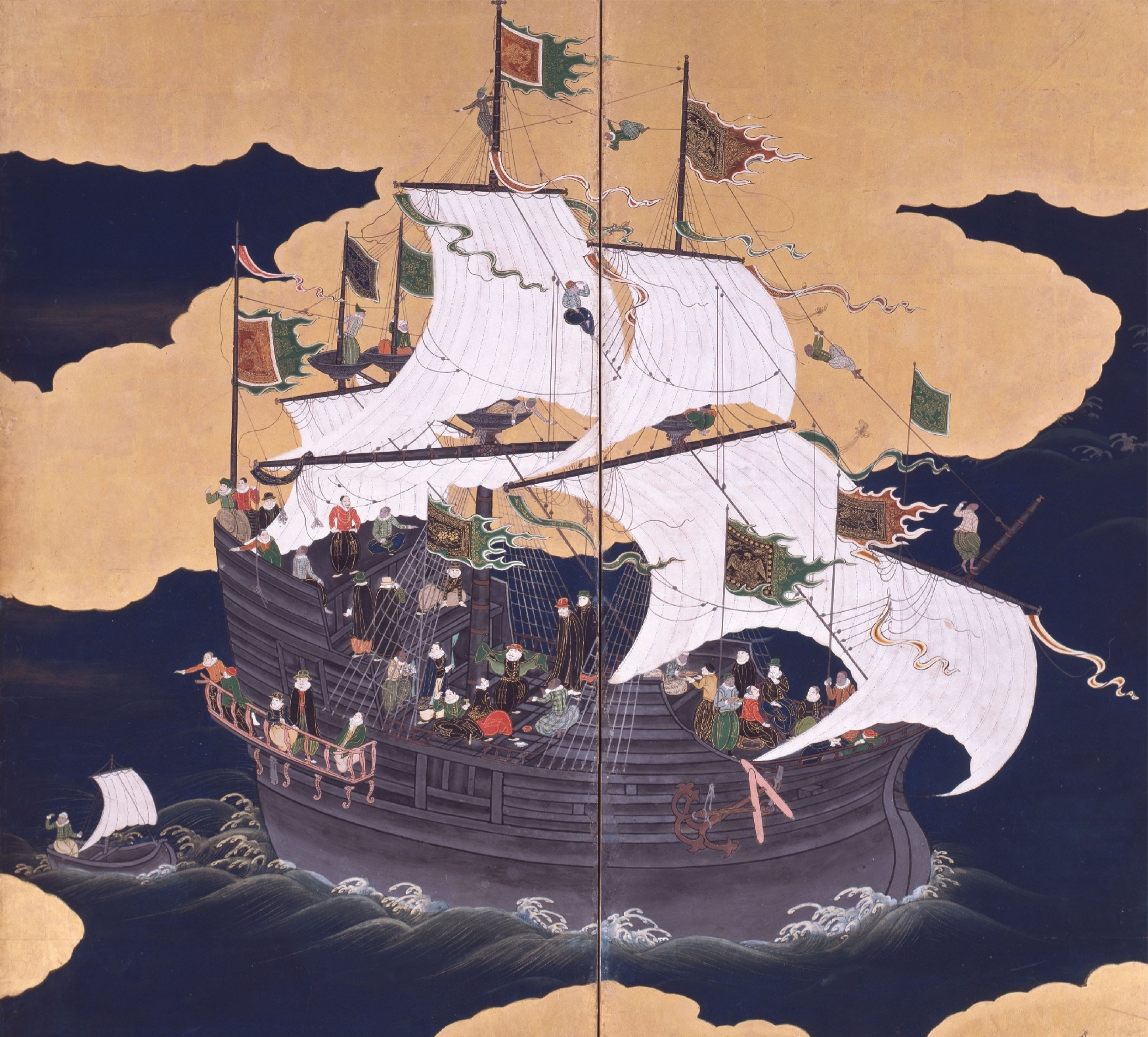
A nanban painting of a Portuguese carrack, seventeenth century. This particular ship design was quickly adopted and assimilated by Japanese craftsmen, as was the arquebus, the direct ancestor of the flint-lock rifle.

In the seventeenth and eighteenth centuries, East Asian depictions of Europeans began to change. Chinese painters at the court of the Kangxi Emperor, for instance, began to depict European Jesuits in a more sympathetic light. I'm particularly fascinated by this 1685 portrait of the Dutch Jesuit astronomer Ferdinand Verbiest. Clad in the robes of a Chinese man of learning, Verbiest's European origin is virtually indiscernible:


This sketch by Peter Paul Ruebens of the French Jesuit Nicolas Trigault makes for an interesting visual contrast. The note on the drawing states that he is adorned in Chinese dress.


The late eighteenth century witnessed an increase in European power in the East Asian sphere, and with it a new visual vocabulary for depicting Europeans. This painting by the remarkable Japanese artist Shiba Kokan (1747-1818) depicts A Meeting of China, Japan and the West. Note the European (probably Dutch) figure's up-to-date anatomical book.


For those interested in learning more, Charles Boxer's The Christian Century in Japan, 1549-1650 is an excellent start, as are many of the essays in Stuart Schwartz's collected volume Implicit Understandings (Cambridge, 1994). Wikipedia's page on the Nanban trade is pretty good as well.