I mentioned the brilliant Russian photographer
Sergei Mikhailovich Prokudin-Gorsky (or Gorskii, as his last name is sometimes spelled) the other week, with a promise to write more about his work at a later date. In a sentence, Prokudin-Gorsky was a photographer commissioned by the Russian Tsar Nicholas II to document the vast dominions of the Russian Empire using the novel technique of color photography - an innovation so new that Prokudin-Gorsky had to invent his own technical process for capturing color images, which involved taking photographs simultaneously through blue, green and red filters and then combining the resulting tinted images by projecting them on to one another. Between 1909 and 1915, the aristocratic but intrepid Prokudin-Gorsky traveled across Russia and central Asia with a special permit from the Czar and a custom-made railroad car that he had rigged into a mobile dark room. The results of his trip are astonishing, but were lost to public view following the Russian Revolution. Since their purchase by the United States Library of Congress, however, they have begun to find a wide audience.
 |
An example of Prokudin-Gorsky's three color technique: red, green and blue color
channels are combined to form a vivid full color image. |
I have to admit that most of what I know about Prokudin-Gorsky (1863-1944) comes from his Wikipedia page, since pre-Revolutionary Russia stands well outside my area of expertise. But his images are of immense value and interest to anyone who wants to gain insights into everyday life in the centuries before the modern era, because they offer such a vivid and intimate glimpse into a world (or, perhaps more accurately, several worlds) that existed before the Industrial Revolution had fully transformed the fabric of society. I especially like Prokudin-Gorsky's images of Central Asian nomads, since their way of life was so irreparably transformed by the enforced modernization programs of the Soviet Union - in many cases, these images might be the only photographic documentation of whole regions, cities or neighborhoods -- indeed, of entire cultures and peoples. Below are a sample of some of my favorites; more can be found on Prokudin-Gorsky's
Wikimedia Commons page, in this database hosted on a Carnegie Melon University server, and in
an online exhibit by the Library of Congress. For more on his photographic technique and some efforts to restore his photos, see
this informative site.
 |
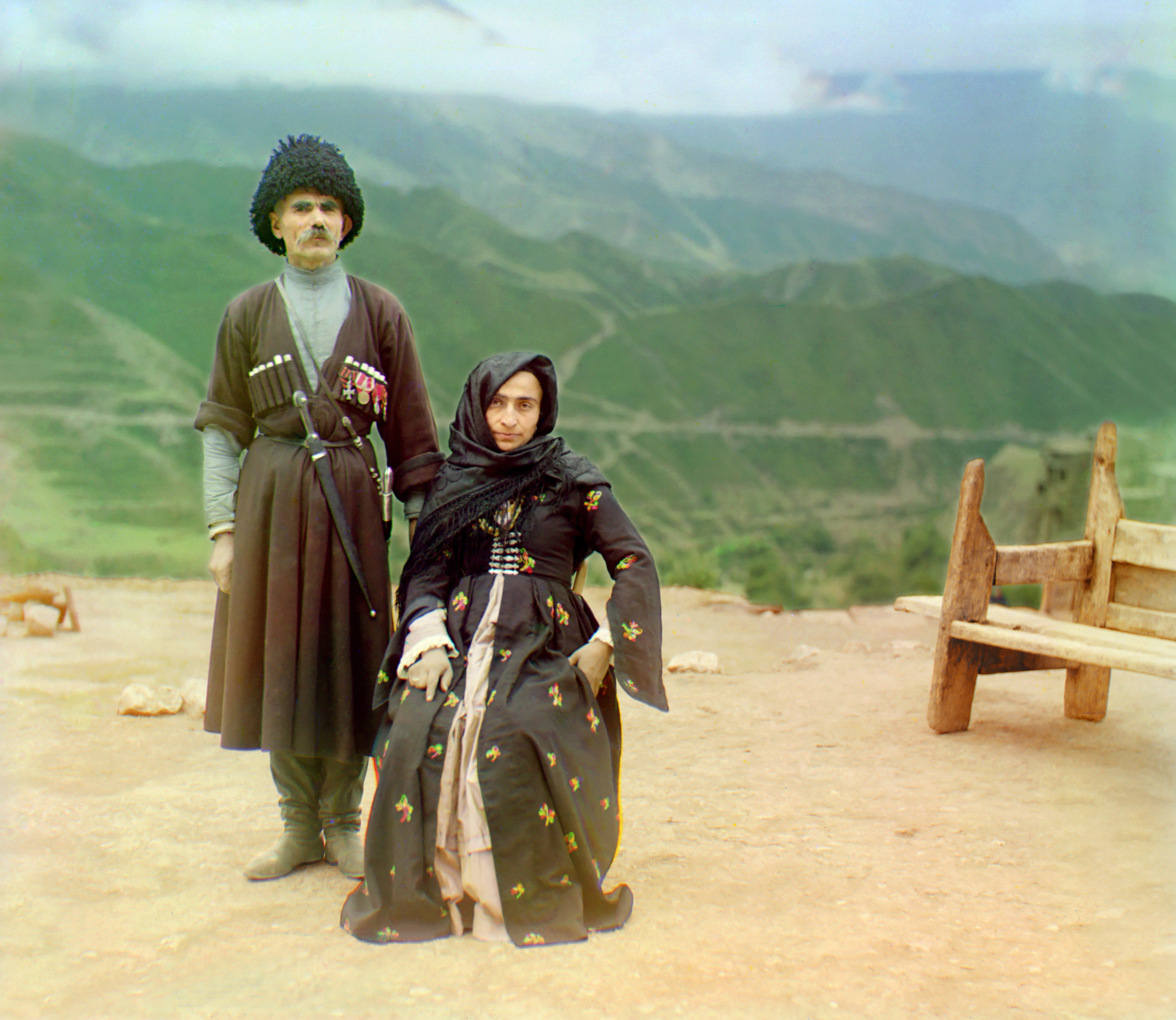
| A Dagestani couple in the Caucasus mountains. |
 |
| The entrance to the Passage of the Dead, Samarkand. |
 |
| Kebab house, Samarkand. |
 |
| Fabric merchant, Samarkand. |
 |
| Prisoners in shackles. |
|
|
 |
| Peasant girls in the Ural mountains. |
As you might have noticed already, Prokudin-Gorsky's tri-color technique leaves some visual artifacts in the images - since it was impossible to align the colors perfectly, certain patches of yellow, red, green or blue bleed over from time to time. Some see these as mistakes in need of restoration, but they are actually a big part of why I love these images so much - I really like the combination of vivid, crisp realism and randomly-produced abstraction. Below are a few of my favorite 'damaged' images so you can see what I mean: