Showing posts with label Monsters. Show all posts

January 10, 2012

American Monsters: Images of Brazilian Nature from Early Modern Europe

"The most disgusting and nauseating thing which man ever saw." 
-Spanish chronicler Andres Bernaldez on Christopher Columbus' first impression of Caribbean iguanas, 1513.

IN HIS BOOK Marvelous Possessions: The Wonder of the New World, Harvard literature professor Stephen Greenblatt argues that "the production of a sense of the marvelous in the New World is at the very center of virtually all of Columbus's writings about his discoveries, though the meaning of that sense shifts over the years." Greenblatt thinks that Columbus emphasized wonders and marvels "because marvels are inseparably bound up in rhetorical and pictorial tradition with voyages to the Indies. To affirm the 'marvelous' nature of the discoveries is, even without the lucrative shipments yet on board, to make good on the claim to have reached the fabled realms of gold and spices." Yet Greenblatt doesn't devote much space in his book to the flip side of the "marvelous": the monstrous.

As Iberian voyages of "discovery" segued into expeditions of conquest and settlement over the course of the sixteenth century, Europeans increasingly visualized the New World as a land of bizarre torments, freakish monsters and outlandish civilizations in thrall to the devil.
Map of Brasil, Dieppe School, 1547. Click to see
much larger version.
Spanish interpretations of the religious practices they encountered in the lands of the Aztec Triple Alliance have attracted the majority of historians interested in how Europeans expressed fear, apprehension and disgust -- as well as wonder -- toward the Americas (see below for some recommendations). The pictures below show that monsters and the monstrous were also depicted in the context of Portuguese Brazil. I'm particularly interested in how the incredible biodiversity of Amazonia was initially interpreted by European observers who had seen nothing to rival it in their temperate homelands. Although comparisons to the Garden of Eden were frequent, these images also reveal a profound anxiety about the abundance of nature in the Neotropics
The Flemish engraver Theodor de Bry's vision of Brazil mingles outlandish sea creatures with
flying devils who torment the Tupí Indian villagers at lower right. Theodor de Bry, Americae 
tertia pars (Frankfurt, 1592)
Birds of paradise feature in this detail from the 1547 Dieppe map of Brazil linked above.
Tupí Indians hunt leonine creatures, probably reflecting early accounts of jaguars. Another detail.
In the same pictorial field, villagers lounge while two tortoises amble by.
During the Dutch occupation of parts of Brazil in the 1640-60 period, a number of highly
skilled painters visited the new colony to record their impressions of its flora and fauna.
In this 1665 painting by Albert Eckhout, two dueling tortoises recall the pair in the detail
from the Dieppe map above.
Despite their skill in visual representation, however, Dutch artists were often at least as fanciful in their depictions of South American monsters as their French and Iberian peers. The engravings below, selected from the Dutch author Arnoldus Montanus' 1671 De Nieuwe en Onbekende Weereld (The New and Unknown World), offer a positively bizarre take on American animals and peoples. 
The "draco" (dragon) in this one bears a passing resemblance to the "Jenny Hanivers" and
"Sea Monks" of early modern sailors' lore.
Europeans were also fascinated and fearful of the "monstrous" forms of indigenous Brazilians themselves. Although most accounts remarked upon the good health, longevity and physique of Tupí Indians and other indigenous societies in Brazil (probably a reflection more of the poor health and diet of the European mariners than anything else), others focused on their tendency toward body-modification. The most entertaining and strange European take on piercing and tattooing I have been able to find is John Bulwer's fantastically titled Anthropometamorphosis: Man Transform’d, or the Artificial Changeling. Historically presented, in the mad and cruel Gallantry, foolish Bravery, ridiculous Beauty, filthy Fineness, and loathesome Loveliness of most Nations, fashioning & altering their Bodies from the Mould intended by Nature. With a Vindication of the Regular Beauty and Honesty of Nature, and an Appendix of the Pedigree of the English Gallant. (London: J. Hardesty, 1650). (I wrote about this a bit in an earlier post). Below he describes how "the Brasileans... are pricked within the flesh" with paint.
Bulwer's title page takes this a step further, showing an Amerindian figure sporting some truly remarkable tattoos! The European woman with facial tattoos to the figure's left highlights Bulwer's concern that this "barbarous" custom would become fashionable with his own countrymen (he was right, but it would take another three hundred years or so to really catch on, and the whole "face on a butt" tattoo fad seems to still lie in the future).

Readers wanting to learn more about the role of the devil and the monstrous in European interpretations of Amerindian societies might want to start with Fernando Cervantes' The Devil in the New World and Jorge Canizares-Esguerra's Puritan Conquistadors. Greenblatt's Marvelous Possessions, quoted above, is a great study of how the fantastical and marvelous figured into colonization, while Joyce Chaplin's Subject Matter: Technology, the Body and Science on the Anglo-American Frontier, revises and critiques his claims in various interesting ways. Those interested in New World nature and particularly animals should check out A New World of Animals: Early Modern Europeans on the Creatures of Iberian America Miguel de Asua and Roger French, a fun, learned and highly-entertaining book (from which I stole the quote on iguanas that opens this post). 

February 20, 2011

Strange Creatures Intermixt with a Spaniard's Voyage to the Moone, 1700

Nathaniel Crouch (c. 1632 - after 1700) was an obscure but most interesting man: a London bookseller, he took the unusual step of authoring his own books on many subjects and publishing them under pseudonyms. Crouch's nom de plume of choice was "R.B." or "Richard Burton." As revealed by the research of Robert Mayer, Crouch attended meetings of the Royal Society and was regarded by contemporaries as an "ingenious man" despite his craftsman's trade and lowly birth as the son of a tailor. Although he has gone largely unstudied by modern scholars, the works of Crouch/Burton were prized by both Samuel Johnson and a young Benjamin Franklin, whose autobiography records his high regard for "Burton's books" (Mayer 393). Today I present some images I came across in a work that Crouch published under the name of R.B. entitled The English Acquisitions in Guinea and East-India (London, 1700). As the full title reveals, this was an expansive work which not only described the new colonial possessions of an expanding British Empire but also offered accounts of "Religion, Government, Trade, Marriages, Funerals, strange Customs, &c., Also the Birds, Beasts Serpents, Monsters and other strange Creatures found there. Intermixt with divers Accidents..."
The woodcut illustrations of English Acquisitions are quite compelling, as they center almost exclusively on depictions of "Monsters and other strange Creatures" that were reported by travelers in the Indian Ocean region and coastal Africa. I suspect that most or all were plagiarized from earlier accounts, a common practice of the era. Here are the images, intermixed with extracts from Crouch's accompanying text:
Creatures of "Guinea," or west Africa.
More beasts of Africa, accompanied in true early modern fashion by an extract from the Roman poet Lucan.
Crouch did not shy away from gory descriptions, and indeed these may have contributed to the popularity of his works. Here he is on the execution techniques of the "Great Mogul" of India:
 And the rather frightening accompanying illustration:
As I read this book I was surprised to find that the middle section was devoted to a description of a voyage to the moon via swans! After reading a bit I realized that this was a reprint from a remarkable work of early science fiction written in manuscript by the Elizabethan bishop Francis Godwin: the Man in the Moone, or a Discourse of a Voyage thither, by Domingo Gonsales (c. 1600). Here's the amazing illustration of the bird-powered contraption created by the ingenious Spaniard Gonsales:

This work is remarkable for the way in which it conflates the voyages of Columbus and otehr New World explorers with space travel. Godwin (and Crouch as well, it seems) reasoned that if 'Moderns' had been able to discover vast and previously unknown new lands across seas, then it stood to reason that similar wonders awaited those who traveled into the sky:
Here  'Gonsales' offers a bizarre description of outer space as imagined in early modern times. This land was apparently haunted by demons and "Wicked Spirits" who spoke Spanish, Dutch and Italian, as well as creatures that his Gansas (swans), could consume as food:
Strange stuff, and all the more interesting because Crouch chose to include it in a book lauding the expansion of the British empire. Was the moon next?

For more on the early modern astronaut Domingo Gonsales, read the original work: The Strange Voyage and Adventures of Domingo Gonsales, to the world in the Moone. For more on Nathaniel Crouch see Robert Mayer, "Nathaniel Crouch, Bookseller and Historian: Popular Historiography and Cultural Power in Late Seventeenth-Century England," in Eighteenth-Century Studies Vol. 27, No. 3 (Spring, 1994), pp. 391-419.

December 28, 2010

The Baroque Monsters of Father Schott

In Portuguese, barroco means "imperfect pearl": a fitting name for the Baroque era, a period that combined ornate beauty with a distinct taste for the odd, macabre and irregular. This interplay between the beautiful and the monstrous -- and its connections to the rise of the "New Science" in the second half of the seventeenth century -- is vividly exemplified by the Jesuit Father Gaspar Schott's Physica Curiosa (1662), a compendium of abnormal births, strange animals and fabulous humanoid creatures thought to inhabit the far reaches of the world.
Frontispiece of Physica Curiosa. Source: University of Iowa Digital Library, John Martin Rare Books Room.
The work's Latin title page.
The German-born Schott (1608-1666) was a Jesuit with a keen interest in a number of disciplines, from hydraulic mechanics to medicine and optics. One can surmise that Schott acquired his wide-ranging interests from his mentor, the celebrated Jesuit genius Anathasius Kircher (a polymathic marvel, Kirchner was a founder of Egyptology, used an early microscope to study microbes, lowered himself into an active volcano to learn about the earth's crust, constructed automatons, invented a magnetic clock and authored an immense encyclopedia on China). Below are a selection of images from Schott's Physica Curiosa, all of which I selected from the digital collections of the John Martin Rare Books Room at the University of Iowa. I've cropped some of the engraved plates to show interesting details and added my attempt at translations of the Latin captions and occasional explanatory notes. As the work's extended title dryly notes, Schott seeks to document "Angels, Demons, Men, Spirits, the Devil-Possessed, Monsters, Portents, Animals, Meteors, and other rare, arcane and curious things... and to illustrate them by many examples."
Schott, 579. "Seven-headed monster."
Schott, 393. "Shaggy man who walks with hands on the ground."
Schott, 393. "Woman of the woods in Java." This creature was probably based on the reports of seventeenth century Dutch mariners in Indonesia, who, in turn, may have been drawing upon indigenous knowledge of the orangutan -- "Man of the Forest" in the Malay language.
Schott, 395. "Hair-covered girl of eight years." Clearly a girl born with hypertrichosis.
"Boy with the head of an elephant." His companion is "a horned infant with spread eyes." I have no idea what to make of this one.
The images in this section of the work appear to be a strange combination of depictions of actual birth defects or hereditary abnormalities and pictures of mythical man-beasts that were said by medieval travelers to inhabit the Antipodes. In a later section, the book turns to the interesting and fantastical creatures that were being 'discovered' by European overseas voyages at the time. Many of these illustrations were evidently drawn from a book I wrote about in my post on Edward Topsell's Historie of Foure-Footed Beasts -- others were more fantastical:
Schott, 616. Here we find a "winged bird-centaur with the head of a human" and "a three-headed monster with the heads of a fox, a dragon and an eagle."
And here are the more familiar raccoon and river otter. Note, however, that the raccoon (here identified by its Spanish name, "mapache,") is from the New World and thus would have been as unfamiliar to European audiences of the time as many fantastical beasts.
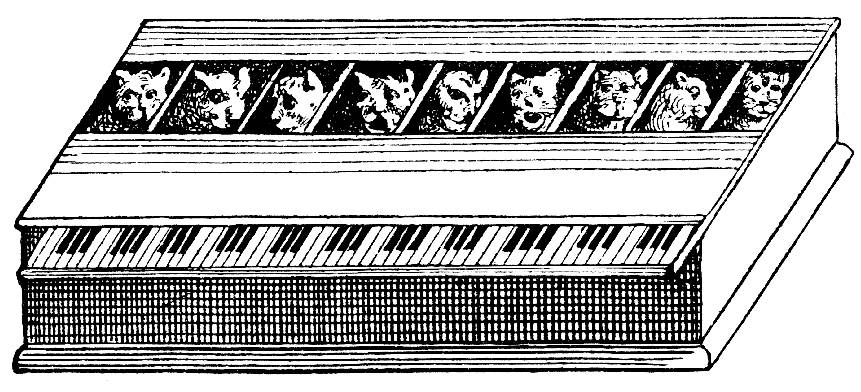
Cat piano from Schott's Magia Naturalis (Natural Magic).
Finally, an interesting aside: Schott was also the first to describe what may well be the most bizarre musical instrument in history. This was the so-called the Katzenklavier or 'cat piano.' See this blog post on the subject to learn more about this strange creation, apparently real, which was said by Kircher to have been invented to relieve the melancholy of an Italian prince. PETA would have been appalled. For those interested in learning more, I haven't been able to find much written on Schott. However, his teacher Athanasius Kircher has generated a large body of fascinating scholarship -- see Paula Findlen's edited volume Athanasius Kircher: the Last Man Who Knew Everything (2004) for a good introduction.