Showing posts with label Alchemy. Show all posts

June 26, 2017

Urine, Phosphorus, and the Philosopher's Stone

Joseph Wright of Derby, The Alchemist Discovers Phosphorus, 1771 (detail).
In 1681, the English writer John Evelyn covered his face with a glowing material, newly invented by an alchemist. He turned toward a mirror, and was astonished.

“I appeared in the darke like the face of the moone, or rather like some spirit, or strange apparition,” Evelyn wrote in his diary. This eerie substance had been given to Evelyn by a member of the Royal Society of London, Doctor Frederick Slare. It had been produced as a result of alchemical investigations by Slare and Robert Boyle into the "virtues" or “animal spirits” thought to imbue all living matter. Its mode of action was unknown, and for some reason it "had an urinous smell."

As he stared into the mirror, Evelyn’s thoughts drifted toward the Catholic Church. This was not surprising, since English politics at this time was consumed by the question of whether James, the heir to the throne and brother of King Charles II (both suspected Catholics), would be allowed to assume the throne and, potentially, unseat the Church of England as the nation's state religion. The attitude among English Protestants like Evelyn had become decidedly conspiratorial. Evelyn worried that if this “extraordinary” substance were to fall into the hands of Catholic priests, “what a miracle might they make it, supposing them either to rub the Consecreated Wafer with it, or washing the Priests face & hands with it, & doing the feate in some darke Church or Cloyster, proclaime it to the Neighborhood.”

“I am confident,” Evelyn concluded, “that the Imposture would bring thousands to them."

Evelyn also recalled that he had once seen something similar at the Piazza Navona in Rome, where “a certain Mountebank” (a public performer who sold dubious medicines) had demonstrated a seemingly magical ring that flared with a light as bright as a candle flame before he “fell to prating for the vending of his pretended Remedies.”

Frontispiece woodcut of a mountebank from Salvator Winter's A Pretious Treasury, or a New Dispensatory Contayning 70 approved Physical rare Receits (London, 1649).

Evelyn knew enough about natural philosophy to understand that this trick was not supernatural. Although he failed to obtain the recipe from the Roman mountebank years earlier, Evelyn realized that the trick depended on the so-called lapis illuminabilis, or glowing stone. But this new substance of 1681 seemed different. "Never did I see any [lapis illuminabilis] comparable to this," Evelyn wrote. Evelyn considered it safe enough both to paint onto his face and to consume as a medicine: on the recommendation of Robert Boyle himself, Evelyn mixed the substance with a glass of ale and quaffed it down, enjoying the "agreeable amber scent" of his cocktail and anticipating benefits to his health.

This eerie glowing substance, in other words, was not just a chemical experiment, but a medicinal drug.

And, what's more, it was a drug made out of huge amounts of human urine.

John Evelyn by Robert Walker, circa 1648.
Before we get to that, though, what exactly was the the phenomenon that Evelyn observed? The 1681 substance was an early example of the phenomenon that is today known as phosphorescence, after the chemical element phosphorus. The name itself means "light-bearer" and comes from the Greek word Φωσφόρος [phosphoros]. Interestingly, the same word was used to describe Satan in the Old Testament. When the Bible was translated into Latin, phosphoros turned into the more familiar devilish epithet "Lucifer."

It's not an unfitting association. When white phosphorus encounters oxygen, it undergoes a process known as chemiluminescence, a chemical reaction that results in the emission of light. In the specific case of phosphor, two molecules called HPO and P2O2 are produced via oxidation that emit a mild greenish glow. In later centuries, however, it was discovered that white phosphorus could also be turned into a gruesome weapon.

* * *

Although phosphorus wasn't formally identified as an element until the work of Lavoisier in 1777, it had been known in various forms to natural philosophers and alchemists from the early seventeenth century onwards. By 1680, these recipes had made their way to the laboratory of Robert Boyle, who in that year produced a phosphorescent compound that, he wrote, "shone so briskly and lookt so oddly that the sight was extreamly pleasing, having in it a mixture of strangeness, beauty and frightfulness."

Boyle had apparently learned of the substance from a German alchemist who, in turn, borrowed the formula for phosphorus from one Hennig Brand. Like many natural philosophers of his generation, Brand was passionately invested in the search for the Philosopher's Stone. This was a hypothetical substance that could transform base metals like lead into gold. Some also speculated that its transformative powers might also grant immortality. By 1669, Brand's search had led him down a somewhat unexpected path: he believed that human urine might hold the key.

Brand certainly couldn't be accused of being lazy. By one account, the total amount of urine he collected for his alchemical work amounted to 1500 gallons (note, however, that I haven't been able to find this figure in any peer-reviewed sources, so it's likely apocryphal). During one investigation of its chemical properties, Brand found that when urine was boiled down into a thick syrup, a red oil could be skimmed off the top of it. This he collected, refined, and heated for around sixteen hours. The resulting distillate produced flames upon encountering open air. It also produced an eerie glow. Brand had identified the trace amounts of phosphorus that occur naturally in urine.

Detail from The Quack Doctor, attributed to Jan Steen, 1650s.

This was probably not the first time that a chemiluminescent subject had been investigated by alchemists. Recalling the secret of the mountebank's glowing ring in Rome, Evelyn complained that "though there is a process in Jo. Baptista Porta and others how to do it, yet on several trials they none of them have succeeded." This was a reference to the recipes for glowing stones or liquids that circulated in a number of 16th and 17th century works of natural magic, such as Gianbattista della Porta's Magia Naturalis, which was first published in Naples in 1558.

An early example of such a stone was associated with one Vincenzo Casiorola who discovered a mineral which he called lapis solaris (solar stone) that, after being heated on a flame and exposed to sunlight, was capable of glowing in the dark. Theories regarding these forms of phosphoresence typically involved beliefs about the ability of materials to "store" the essence of the sun or of other forms of light. Urine and other products of the human body were thus of great interest, since if (as many early modern philosophers argued) there was indeed something divine in human bodies which permitted the use of reason and communion with God, then perhaps residues of this could be detected in the substances cast off by the body.

In other words, phosphorus shared a name with the Devil, but its unexplainable glow promised to unlock philosophers' understanding of the Divine.

* * *

By the middle decades of the eighteenth century, when experiments with phosphorus had become widespread, chemistry was beginning to come into its own as a discipline distinct from alchemy. The degree of difference between seventeenth-century alchemy and eighteenth-century chemistry has sometimes been overstated, and it was by no means the case that the generation that followed in the footsteps of Boyle and Brand abandoned their spiritual beliefs or sense of divine mission. But we can see signs of a larger shift here.

To the generation of natural philosophers who worked in the second half of the eighteenth century, Evelyn's fear that Catholic priests might harness phosphorescent substances to awe their congregations would likely have sounded quaint. Phosphorus was now firmly in the domain of the man of science, not of the priest or the mountebank. And the search for the philosopher's stone had been replaced by the search for the fundamental building blocks of chemistry and pharmacology, from hydrogen (discovered in 1766) and oxygen (discovered in 1772) to psychoactive compounds like morphine (first isolated and scientifically described in 1804) and caffeine (1819).

The images of Joseph Wright of Derby, a painter who documented and participated in the earliest phases of what is now called the Industrial Revolution, can give us a visual insight into this shift. Like Caravaggio and Georges de la Tour before him, Wright was fascinated by images that relied upon a single light source to produce a high-contrast chiaroscuro effect, picking out dots of light amid dark shadows.

Wright's 1771 painting The Alchemist Discovering Phosphorus looked backwards to an older era of chemical investigation, depicting a bearded natural philosopher in a rib-vaulted chamber staring in awe at the glowing gas emanating from a retort. The only other source of the light in the image is the glow of the moon through a Gothic arch, lending a mystical quality to the scene, and recalling the Catholic past that England was rapidly forgetting.


But it was a painting that Wright had created some years earlier, circa 1763, that seemed to point toward a new and uncertain future. In Wright's A Philosopher Giving a Lecture on the Orrery, there are no moons beyond the tiny artificial satellites orbiting a mechanical sun. The Gothic background has been replaced by a sturdy row of bound volumes, and the bearded alchemist has become a clean-shaven philosopher.

An unseen glow, mimicking that of the sun itself, shines on the faces of the three young boys clustered around the structure like a new dawn.


December 17, 2015

The Alchemy of Madness: Understanding a Seventeenth-Century "Brain Scan"


The image above is a detail from a remarkable 1620 engraving I first came across this past summer. It shows a man sliding another figure into what looks like an old-fashioned oven - but instead of smoke, images of the man's thoughts billow out of the oven's top. The "baker" is in fact an apothecary, the "oven" is a distillation apparatus, and the man whose thoughts are boiling out of his head is someone being treated (metaphorically) for madness.

The full image is even stranger. Two well-dressed figures stand before a wall of shelves stocked with drug jarsbearing labels like Modestie, Raison, and Memoire. One is pouring a potion marked Sagesse (wisdom) into the opened mouth of a seated figure who grips the pourer’s arm uneasily. Below, court jesters wearing fool’s caps tumble into a bedpan. 

"Le Médecin guérissant Phantasie," Mattheus Greuter, 1620 (Bibliothèque nationale de France).


To the right of these two— leaning in front of a distillation apparatus, a mortar and pestle, and a lengthy medical receipt pinned to the shelf—is an apothecary pushing a man on a long board into a distillation furnace. Above, the fantasies that had filled this man’s head emerge as the rarified quintessences of distillation: horses, backgammon boards, armor, pantaloons, women, swords, theater masks, flowers, hunting dogs, and, unaccountably, a monkey brandishing a walking stick. 


 I think that it's one of the most memorable and mysterious depictions of early modern science and medicine I've ever seen, and I thought I'd try to figure out a bit more about it here. 

The most obvious place to start is with the French caption which accompanies the image. Here's the original French:

Aprochez vous qu'avez la teste pleine
de phantasie, qui vous met en grande peine
assurez vous de ce Maistre sçavant,
quil voz humeurs seicherat tellemant,
dedans ce four, qu'aurez en peu de temps,
grand allegeance de beaucoup de torments,
aussi serez purge per ses brevages
qu'incontinant deviendrez du tout sages.

And here's my attempt to render it in something resembling the couplet rhyme scheme of the original:

You, come here! Your head is filled
With fantasies, that make you ill
Of this learned Master, be assured
That he will have your humours cured
In no time at all, within this furnace—
Great allegiance of many torments—
So too, he’ll purge with healing potions
That can make the foolish cogent. 
Even after the cursory research that I did when I first encountered the image, it became clear that this was a pretty popular motif. The basic imagery of a cloud of "phantasies" being distilled from a fool's head by a physician-alchemist appears in at least seven variants that I've been able to find: the French-language version shown above, apparently created by a printer named Mattheus Greuter in 1620; a German-language original from 1596 along with several later copies; a much-altered English versions; and, fascinatingly, a full-color French painting that was seemingly based on the engraving rather than the other way around. 

The earliest iteration of the image would seem to be from a book of emblems created by the Belgian engraver and printer Theodor de Bry (1528-1598) which was published two years before his death. This included a picture of a "Narrendoktor" (Fool Doctor) distilling the madness or folly out of a man's head using an alchemical still, while his associate opens a spigot in a man's stomach to purge him of his foolish humors. Interestingly, this version shows a closer attention to the actual technology of distillation, as it also shows a solid distillate falling to the ground in the form of mice. The Latin caption can be translated to something like "My art can be all knowledge--except wisdom." 

Engraving of the "De Narrendoktor" from Theodor de Bry's Emblemata Secularia (Frankfurt, 1596). 
an accompanying Latin epigram pokes fun at the boasts of Paracelsan physicians, who achieve
Quod non Hippocrates,
no noverat ante Galenas,
Arte mea cerebri
fatuos incido meatus.
What neither Hippocrates
nor Galen ever attained:
with my art I retrain
the paths of fools’ brains. 

Another German version, from 1648, offered an expanded caption in the voice of one Doctor Wurmbrandt (Wormburner), who implores, “trust me to bring you back to your right mind” when you suffer from “wild imaginings as when... having become quite drunk... you are conscious of nothing, whether you are a man or woman.” His cure is effected by the new chemical arts: a still worn over the head produces a kind of cognitive vapor—bat, dagger, backgammon set, a woman, dueling pistols—that sublimates into the air and leaves the patient freed from psychological distress.

It’s an image that would have had an obvious metaphorical resonance for early modern Europeans who saw the human body as a microcosm. If illnesses are indeed caused by fermentations of the blood, poisonsous corpuscles, or malignant humors, then why not move from distilling drugs to practicing medical chemistry directly on the human body itself?

The English version of this print veered into political territory, presenting the "Fool Doctor" in the midst of a far more elaborate allegorical scene referencing the political upheavals that preceded the English Civil War:


According to the British Printed Images to 1700 project, this version was refigured as "a satire of universal folly in which a tripartite division of the realm into Cuntry, Citty & the Court is symbolised, respectively, by rude 'Rusticall' being purged by the doctor on the close-stool, 'spruce master Cittyzsinne' standing behind the Doctor, and the Gallant (i.e courtier) whose head is just entering the subliming furnace." The print also appears to be demonstrating a new wariness about female sexuality and the perceived masculinity of women in positions of power, as the caption adjoining the female figure in the print  reads:
Once (faire) I knew the tongues Phlebotomie
Had powre to Cure your Sexes Maladie
But now youre manly humors boile so high
That you must in the Gallants Furnace lye.

It reminds me a lot of the metaphysical poetry of John Donne, with its complex medical and alchemical references ("the tongues Phlebotomie" is a reference to the common practice of medical blood-letting or phlebotomy, but seems to be suggesting that previous generations of women could be cured by speech, whereas now, because of their "manly humors," they required new alchemical technologies like "the Gallants Furnace").

In short, variants on this image seem to have circulated very widely indeed and fulfilled different functions of social commentary and satire in doing so, as evidenced by the fact that the original print also inspired at least one painting that may in fact have advertised an apothecary's services:

Anonymous painting in the Musée Rolin, Autun, France, mid to late 17th century.

I'm still trying to get to the bottom of this series of interrelated images, but I suspect that their popularity had to do with an emerging awareness of what we would now call mental illness in seventeenth-century Europe. As new drugs and therapies began to reach Europe via colonial networks that brought physicians into contact with non-European healing traditions, some began to wonder if the new medical practices of the seventeenth century could cure madness or folly in the same way that cinchona bark could cure fevers.

Natural philosophers like Robert Boyle also became interested in the possibility of what we would call psychedelics or smart drugs: in Boyle's remarkable list of "desiderata" for future inventions, he included "Potent Druggs to alter or Exalt Imagination, Waking, Memory, and other functions" as well as "Freedom from Necessity of much Sleeping exemplify’d by the Operations of Tea and what happens in Mad-Men." Likewise, when Robert Hooke experimented with cannabis in 1689, he concluded that it might "be of considerable Use for Lunaticks."

In short, these images point to an emerging interest in the brain and in the scientific alteration of mental states. When I first shared the French version of the image on Twitter, several people remarked that it seemed almost to be a seventeenth-century prefiguration of an fMRI. And indeed, I believe that in some ways they were - that these images were part of an emerging interest in cognition and mental illness that, in its convergence with alchemy, points the way toward a new approach to understanding the brain as a material structure that can be studied and manipulated in the same way that a chemist induces chemical reactions. 

January 23, 2012

Early Modern Alchemy: Heinrich Khunrath's "Amphitheater of Eternal Knowledge"


"While these Discontents continued, severall Letters past between Queene Elizabeth and Doctor Dee, whereby perhaps he might promise to returne; At length it so fell out, that he left Trebona and took his Iourney for England. The ninth of Aprill he came to Breame… Here that famous Hermetique Philosopher, Dr Henricus Khunrath of Hamburgh came to visit him." - Elias Ashmole, Theatrum Chemicum Brittanicum, (London, 1652), cited in Frances Yates' The Rosicrucian Enlightenment

I'M a bit obsessed with the Elizabethan occult author John Dee (even wrote a good chunk of his Wikipedia page), but I know very little about the man who the famed historian Frances Yates considered to be the critical link between Dee and the Continental tradition of European alchemy, Heinrich Khunrath. Last year I came across some of the book plates from Khunrath's occult work Ampitheatrum Sapientiae Aeternae (Hamburg, 1595), or "The Amphitheater of Eternal Knowledge," and was floored by their complexity and beauty. Remarkably, only three copies of the first edition of this work are known to exist. The University of Wisconsin Library has been good enough to scan the images of its copy and make them available online along with an excellent critical history of the book (here). The same site also offers a good overview of the little that is known about Khunrath's biography.

"The Cosmic Rose"
"The Hermaphrodite."
"The Alchemist's Laboratory." Each object bears a Latin motto offering advice
for the alchemical adept. For instance, the still reads FESTINA LENTE 
("hasten slowly"), the personal motto of Emperor Augustus.
"The Four, the Three, the Two, the One."
Remarkably these already exceptionally detailed images originally appeared surrounded by cryptic Latin text. Take "The Hermaphrodite" image displayed above, for example:

Click image for a much larger version. Transcription of the text here.
A detail from the same image:


Dee's Monas Hieroglyphica
(London, 1564), frotispiece.
Here we get a sense of the bafflingly complex nature of these images. The figure of the hermaphrodite as a metaphor for the dualistic nature of the universe and the human body is a common one in alchemical imagery. Likewise, the sun and moon are frequently used to symbolize the male and female natures inherent in different elements (the sun is gold/male, the moon female/silver, etc.) The black peacock labelled "AZOTH" leads us deeper into Hermetic territory. Azoth was the hypothesized universal solvent, the "ultimate substance" which could transform all elements. Here it seems to be used to convey the union of male and female (and of all elements) which would allow the corporeal human form to transcend to a divine plane (note the symbol of the trinity above the peacock feathers, which resemble diagrams of the celestial spheres). To top it all off, the "O" in "Azoth" made out of John Dee's "hieroglyphic monad"!

So what are we to make of all this? Quite a few scholars have examined Khunrath's Ampitheatre. In her book The Alchemy of Light, Urszula Szulakowska, for instance, argues that the engravings in Khunrath's texts
are intended to excite the imagination of the viewer so that a mystic alchemy can take place through the act of visual contemplation… Khunrath's theatre of images, like a mirror, catoptrically reflects the celestial spheres to the human mind, awakening the empathetic faculty of the human spirit which unites, through the imagination, with the heavenly realms. Thus, the visual imagery of Khunrath's treatises has become the alchemical quintessence, the spiritualized matter of the philosopher's stone (9).
A 17th century portrait engraving of
Khunrath.
The images, in other words, invite the viewer to engage in a meditation on the nature of the universe and on the links between the earthly and the divine, the corporeal and the spiritual. Of course, such a statement would be equally true of many other instances of early modern alchemical and Hermetic symbolism. I suspect that a lot of the meaning in these images and the text that accompanies them has actually been lost, due to the fact that alchemical practice depended upon face-to-face interactions (like the one between John Dee and Khunrath) which were never recorded. And this was precisely what was intended - the true secrets of early modern alchemy were intended for a small number of the "elect" and were elaborately concealed in complex and often inscrutable language when they were allowed into printed works.

On the other hand, the visual interest of these magnificent images is arguably all the greater owing to the unknowable mysteries that now surround their creation and meaning.

March 17, 2011

Res Obscura Miscellany, Part One

A medical alchemist, or 'iatrochemist,' examines a jar of urine in seventeenth-century Holland.
Well, I try to avoid posting decontextualized grab-bags of images (one of the drawbacks of Tumblr and its ilk, in my opinion), but I'm on vacation and busy with research, so this week I'm going to take the easy route and do just that. Below are some images that at one time or another I filed away as appropriate for Res Obscura, but which got lost in the shuffle for some reason or other. I've tried my best to add identifying details and short descriptions of their historical context.

A detail from Hans Memling's Triptych of Earthly Vanity and Divine Salvation, c.1485, Oil on oak panel, Strasbourg, 
Musée des Beaux-Arts de Strasbourg. Thanks to Morbid Anatomy for reminding me of this beautiful, haunting painting. 
I believe the scroll that Satan is holding at right reads, "There is no redemption in Hell." Frightening.
Tatars in Kazan, 1885
Temptation of Saint Anthony. Unfortunately I have no other identifying details for this bizarre work.
I suspect it hails from mid-19th century Iberia, or possibly Britain.
Jan van der Straet's illustration of Canto 34 of Dante's Inferno, circa 1585.
"Now came I (and with fear I bid my strain
Record the marvel) where the souls were all
Whelm'd underneath, transparent, as through glass...
 That emperor, who sways
The realm of sorrow, at mid breast from the ice
Stood forth..."
A remarkably vast apothecary's shop. Iberian, 18th century. Unfortunately I have no further details.
Alchemist filling wet drug jars, Italian, 17th century. Via the Chemical Heritage Foundation.
Franz Christophe Janneck, Medical alchemist, oil on copper, 18th century.
Also via the Chemical Heritage Foundation.
A harrowing vision of hell, featuring monks being boiled for their sins -- a typical pictorial jab at the
much-resented clergy of the Reformation era. Portuguese, c. 1530. 

January 12, 2011

The Domestic Life of Alchemists

Philadelphia's Chemical Heritage Foundation maintains a wonderful Flickr page of images relating to the history of chemistry, pharmacy and alchemy. While perusing their image banks, I came across this collection of 17th and 18th-century paintings of alchemists practicing their occult art -- paintings which include some revealing glimpses into the private life of those who searched for the fabled lapis philosophorum. Credit for the images and quoted text below goes to the Chemical Heritage Foundation, "a non-profit library, museum, and center for scholars that's dedicated to the history of chemistry." Some of these images are very large - I highly encourage readers to click to see the fabulous details (I've picked out a few below).
Alchemist. Thomas Wijck (Beverwijck 1616–1677 Haarlem), Holland, 17th Century, Oil on panel. From the CHF: "A dark study illuminated by single leaded glass window at left; in middle ground a seated man behind cluttered desk faces slightly left; open and closed books, papers, jars and jugs scattered on floor; at right a seated woman in white cap, collar and cuff, bends over a lacemaker; at left a glowing furnace, above that on wall a portrait of a man."  Fisher Collection; Gift of Fisher Scientific International. Photo by Will Brown.
The Alchemist. Francois-Marius Granet. Oil on canvas, 18th century. A bit more spare on detail, but this painting captures the moody contemplation of early modern occultists very well, I think. Also a great use of shadow.
An Alchemist in His Study. Egbert van Heemskerk I. Oil on canvas, 17th century. Fisher Collection, CHF Collections. Photo by Will Brown. 
Note the birdcages in both this painting and the Thomas Wijck.
Interior of a Laboratory with an Alchemist. David Teniers II. Oil on canvas, 17th Century  Eddleman Collection, CHF.
 And my favorite of all, a painting which has been wrongly attributed as a depiction of an alchemist, but which actually depicts an unlucky physician:
Trouble Comes to the Alchemist. Dutch School, 17th-century. Oil on canvas mounted on board. From the CHF: "Although the title suggests this is an image of an alchemist, the scene is one of a physician conducting a uroscopy for a female patient. The confusion may be due to the similarity in objects used in both relative practices. These include a mortar and pestle, a variety of flasks and containers, a human skull, an hourglass, a celestial globe, and books.  The overt hilarity of the old woman deliberately emptying her piss pot on the physician's head would have been instantly appreciated by any contemporary viewer of this work. Musical motifs, such as the cello in this painting, were traditionally a symbol of love and warning about sexual promiscuity. The poem on the table, attributed to Socrates, implies that the furious woman above is like Xanthippe, the Greek philosopher's famously shrewish wife. It reads: I knew well woman, it's no wonder, it would rain, after this thunder."
What's most interesting to me about all these paintings is the insight they give into the domestic spaces in which alchemy took place -- science was still, in the early modern era, practiced in spare rooms or 'closets' of houses rather than in institutions, so it is little wonder to find sleeping cats and dogs, servants, wives and lovers, tobacco pipes and other signs of domesticity in these paintings. Yet when we compare these charming vignettes to the forbidding and rather pretentious tone that alchemical texts of the 17th century assumed, it makes for a revealing contrast: sometimes a picture really is worth a thousand words. Some details:
A pipe and birdcage, apparent mainstays of the alchemist's quarters. This is a painting of the Dutch Golden Age, so that blurry image in the background could potentially be a woodblock print from China or Japan.
The detritus of a scholarly life.

A surreal flourish in the Tenier painting: crocodilians were commonly hung in the shops of apothecaries and other early modern drug-makers. They represented the natural wonders of the tropics, or 'Indies,' from which many such drugs hailed.
A sleeping dog, blissfully unaware of the pot of urine being poured on his master's head.
Those interested in alchemy and the occult might want to start with the works of Frances Yates, the doyenne of early modern magic and alchemical studies, and go from there. Personally, though, I've always found Yates to be a bit too speculative. A personal favorite work on alchemy and the occult in the early modern era is Deborah Harkness' masterful John Dee's Conversations with Angels, which contains some great details about Dee's home life and his relationship with his wife. For readers with JSTOR access, Harkness' journal article "Managing an Experimental Household: the Dees of Mortlake and the Practice of Natural Philosophy" contains further insights. Finally, The Alchemy Website has been an internet mainstay for primary source texts and images relating to alchemy for many years.

June 26, 2010

Images from the Voynich Manuscript

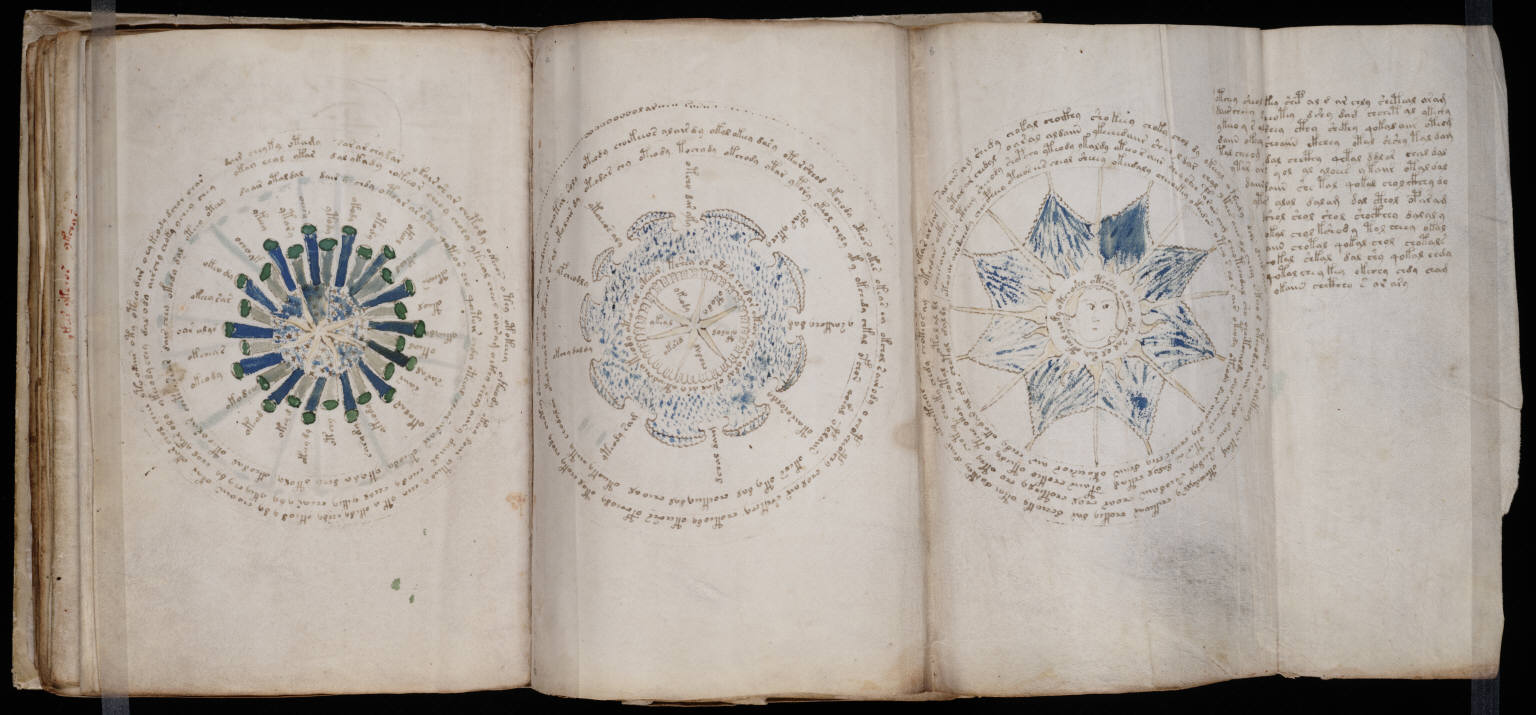
The Voynich Manuscript is one of my favorite historical mysteries and one that I plan to write about soon in more detail, but for now I present some (new to me) digitized images from this most obscure of books.


For more see the Wikimedia Commons page, which seems to contain the complete original text.