Showing posts with label East Indies. Show all posts

February 22, 2011

Jahangir's Turkey: Early Modern Globalization and Exotic Animals [Updated Nov. 2017]

The above image is one of my favorite examples of the cross-pollinations that early modern globalization brought about. It is a detail from a lavish watercolor painting created in 1618 by Bichitr for the Mughal emperor Jahangir (1569-1627). Here we find the strange juxtaposition of King James of England alongside a self-portrait of the artist, Bichitr. He is holding a small panel that seems to also depict Bichitr as he bows deeply while surrounded by an elephant and fine horses, probably animals from Jahangir's imperial menagerie.

At left is an official royal portrait of King James that probably served as the basis for Bichitr's more colorful depiction (you can click the image to see a high-res version). I suspect that a copy of this painting was presented to the Mughal court during the 1615-1619 embassy of Sir Thomas Roe, one of the early English emissaries sent to establish trade relations in India, as an attempt to demonstrate the grandeur of the English state.

The Mughals, however, were decidedly unimpressed. This is amply illustrated by Bichitr's full painting (see below) which depicts Jahangir turning away from both James and the Shah of Persia in order to converse with a humble Sufi holy man.

What I find most interesting about this work, however, is the painting of animals that Bichitr is holding. Why are they there?


Another work, by the celebrated Mughal court painter Ustad Mansur, offers an even more intriguing depiction of an animal from Jahangir's court. Jahangir described this creature in the official chronicle of his reign, the Jahangirnama, as an "extremely strange" wonder. The turkey was offered as a mate to a peacock and the bird's exotic looks and behavior became an object of debate among Jahangir's advisors, who couldn't guess where it had come from.

Ustad Mansur. India, Mughul period, 1612 (Victoria and Albert Museum, London).

As you likely have guessed, this is none other than a turkey. A domestic turkey, or Meleagris gallopavo, to be exact – a bird domesticated in Pre-Columbian Mexico and widely distributed throughout the indigenous cultures of North America. Now this iconic New World fowl was sitting in the throne room of one of the most powerful emperors in Asia.

To lock gazes with the turkey as it peers out at us from a Mughal watercolor is to confront a mystery.

By what route did this “true original Native of America,” as Benjamin Franklin called it, happen to arrive in the most powerful imperial court in Asia? In fact, this encounter was not as strange as it may at first seem. Emperor Jahangir (when not on an opium or alcohol binge) was a keenly observant man with an intense interest in nature. He kept an extensive menagerie of exotic creatures and delighted in recording their behaviors in his journal.

It was at Jahangir’s bidding that Mansur produced over one hundred natural history paintings that rival the work of any painter of the European Renaissance.  Two years earlier Mansur had painted a Mauritian dodo that is still cited by biologists as the most accurate surviving representation of the bird. In other words, Jahangir was exactly who a canny merchant or courtier would go to if they came across a highly unusual-looking bird.

From Wikipedia: "Two live [dodo] specimens were brought to India in the 1600s according to Peter Mundy, and the specimen depicted might have been one of these. Other birds depicted are Loriculus galgulus (upper left) Tragopan melanocephalus (upper right), Anser indicus (lower left) Pterocles indicus (lower right)." Hermitage, St. Petersburg.
By the beginning of Jahangir’s reign (1605-1627), Spanish, Portuguese, Dutch and English ocean-going vessels were plying the spoils of American nature throughout all the major emporia of the Old World, from Senegal to Japan. Although Jahangir regarded the Portuguese and other Europeans as a negligible presence in his domain, he was well aware that the people he called ‘Franks’ had access to trade networks that were closed off to his own subjects. Indeed, Jahangir’s sole reference to the Portuguese colony at Goa in his self-authored chronicle of his reign, the Jahangirnama, was to note that his turkey had been obtained along with several other exotic beasts by a servant sent to the “vice-rei” at “the port of Goa… to purchase any rarities he could get hold of there for the royal treasury.”

To Jahangir, the Portuguese were simply go-betweens. It was the American animal – and not the European merchant – that interested Jahangir and his court.   Nor was Jahangir the only Asian potentate to be fascinated by the exotic beasts carried by the Portuguese. I've written previously, for instance, about this fascinating Japanese nanban screen from the 16th century that depicts Portuguese creole traders selling animals from faraway lands in a Japanese market:


A detail showing a richly attired Portuguese trader with a shrewd-looking Indian or African monkey.
Jahangir's turkey was, ultimately, a harbinger of great changes. It had been carried to Jahangir's court in Agra by an underling Jahangir sent to purchase 'rarities' from the Portuguese. Although the Mughals were still secure in their power in this period, with Europeans serving as little more than petty traders in the periphery, times would change. By the reign of Jahangir's grandson Aurgangzeb (1658-1707), the British, French and Dutch had made serious territorial gains and were beginning to dominate trade in the Indian Ocean.

Many global trade networks in the early modern period tended to be based around exotica likes gems, drugs and animals, but these trades had very real effects. The appearance of strange objects from unknown lands (from tobacco to turkeys) was often the first harbinger of the epochal changes that brought the colonial powers of Europe into conflict with the vast 'gunpowder empires' of Asia.

The balance of world power was shifting. In its own humble way, Jahangir's turkey had something to do with it.

Further reading:
The history of animals is still a relatively new field, so I don't believe much has been written specifically on exotic creatures and early European empires. Three exceptions I can think of are Elephant Slaves and Pampered Parrots and The Emperor's Giraffe. Virginia DeJohn Anderson's Creatures of Empire is a very interesting and provocative study of the role of the more prosaic (but perhaps most important) domesticated animals in the service of British imperial expansion. Finally, the British Library's Asian and African Studies blog is a great place to start for those interested in the material cultures of premodern Asia.

Sources: 
Jahangir, The Jahangirnama, (Oxford University Press, 1999), Wheeler Thackston, ed. and trans., 133-4. Som Prakash Verma, Ustad Mansur: Mughal Painter of Flora and Fauna (Abhinav Publications, 1999).

February 20, 2011

Strange Creatures Intermixt with a Spaniard's Voyage to the Moone, 1700

Nathaniel Crouch (c. 1632 - after 1700) was an obscure but most interesting man: a London bookseller, he took the unusual step of authoring his own books on many subjects and publishing them under pseudonyms. Crouch's nom de plume of choice was "R.B." or "Richard Burton." As revealed by the research of Robert Mayer, Crouch attended meetings of the Royal Society and was regarded by contemporaries as an "ingenious man" despite his craftsman's trade and lowly birth as the son of a tailor. Although he has gone largely unstudied by modern scholars, the works of Crouch/Burton were prized by both Samuel Johnson and a young Benjamin Franklin, whose autobiography records his high regard for "Burton's books" (Mayer 393). Today I present some images I came across in a work that Crouch published under the name of R.B. entitled The English Acquisitions in Guinea and East-India (London, 1700). As the full title reveals, this was an expansive work which not only described the new colonial possessions of an expanding British Empire but also offered accounts of "Religion, Government, Trade, Marriages, Funerals, strange Customs, &c., Also the Birds, Beasts Serpents, Monsters and other strange Creatures found there. Intermixt with divers Accidents..."
The woodcut illustrations of English Acquisitions are quite compelling, as they center almost exclusively on depictions of "Monsters and other strange Creatures" that were reported by travelers in the Indian Ocean region and coastal Africa. I suspect that most or all were plagiarized from earlier accounts, a common practice of the era. Here are the images, intermixed with extracts from Crouch's accompanying text:
Creatures of "Guinea," or west Africa.
More beasts of Africa, accompanied in true early modern fashion by an extract from the Roman poet Lucan.
Crouch did not shy away from gory descriptions, and indeed these may have contributed to the popularity of his works. Here he is on the execution techniques of the "Great Mogul" of India:
 And the rather frightening accompanying illustration:
As I read this book I was surprised to find that the middle section was devoted to a description of a voyage to the moon via swans! After reading a bit I realized that this was a reprint from a remarkable work of early science fiction written in manuscript by the Elizabethan bishop Francis Godwin: the Man in the Moone, or a Discourse of a Voyage thither, by Domingo Gonsales (c. 1600). Here's the amazing illustration of the bird-powered contraption created by the ingenious Spaniard Gonsales:

This work is remarkable for the way in which it conflates the voyages of Columbus and otehr New World explorers with space travel. Godwin (and Crouch as well, it seems) reasoned that if 'Moderns' had been able to discover vast and previously unknown new lands across seas, then it stood to reason that similar wonders awaited those who traveled into the sky:
Here  'Gonsales' offers a bizarre description of outer space as imagined in early modern times. This land was apparently haunted by demons and "Wicked Spirits" who spoke Spanish, Dutch and Italian, as well as creatures that his Gansas (swans), could consume as food:
Strange stuff, and all the more interesting because Crouch chose to include it in a book lauding the expansion of the British empire. Was the moon next?

For more on the early modern astronaut Domingo Gonsales, read the original work: The Strange Voyage and Adventures of Domingo Gonsales, to the world in the Moone. For more on Nathaniel Crouch see Robert Mayer, "Nathaniel Crouch, Bookseller and Historian: Popular Historiography and Cultural Power in Late Seventeenth-Century England," in Eighteenth-Century Studies Vol. 27, No. 3 (Spring, 1994), pp. 391-419.

June 4, 2010

Giolo, the Painted Prince

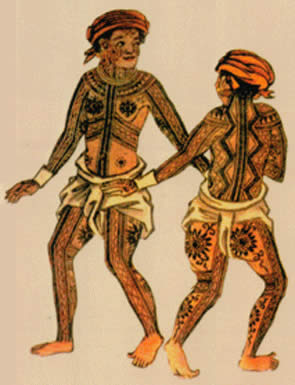
Prince Giolo, Son of ye King of Moangis or Gilolo: lying under the Equator in the Long[itude] of 152 Deg[rees] 30 Min[utes], a fruitful Island abounding with rich spices and other valuable Commodities. This famous Painted Prince is the just Wonder of ye Age. His whole Body (except Face, Hands and Feet) is curiously and most exquisitely Painted or Stained full of Variety and Invention with prodigious Art and Skill perform'd. In so much of the ancient and noble Mistery of Painting or Staining upon Human Bodies seems to be comprised in this one stately Piece. The more admirable Back-parts afford us a Representation of one quarter part of the Sphere upon & betwixt his shoulders where ye Arctick & Tropick Circles center in ye North Pole of his Neck... The Paint itself is so durable, which nothing can wash it off or deface ye beauty of it. It is prepared from ye Juice of a certaine Herb or Plant, peculiar to that Country, w[h]ich they esteem infallible to preserve Human Bodies from ye deadly poison or hurt of any venomous Creature whatsoever, & none but those of ye Royal Family are permitted to be thus painted with it. This admirable Person is about ye Age of 30, graceful and well proportioned in all his Limbs, extreamly modest & civil, neat & cleanly; but his Language is not understood, neither can he speak English. (1697)

In 1691, the buccaneer and naturalist William Dampier returned to England after a daunting circumnavigation of the Earth, his first of what would be three round the world journeys. When he returned to London, Dampier was accompanied by a slave from the island of Miangas he had acquired in the course of this journey -- a man he called 'Prince Giolo.' 

As Dampier recollected in his published account of his travels, "[Giolo] was painted all down the breast, between his shoulders behind; on his thighs before; and in the form of several broad rings, or bracelets, round his arms and legs. I cannot liken the drawings to any figure of animals, or the like, but they were very curious, full of great variety of lines, flourishes, checkered work, etc. keeping a very graceful proportion, and appearing very artificial, even to wonder, especially that upon and between his shoulder blades... He told me that most of the men and women of the island were thus painted." (William Dampier, A New Voyage Round The World, 1697)
Dampier was blunt about his reasons for taking Giolo back to London: "I proposed no small advantage to myself from my painted prince... [that] might be gained by shewing him in England" (Voyage, 347). A manuscript by Dampier curently housed in the British Library is even more blunt: "I only brought with me this Journall & my painted prince which I might haue made a great deal of money by but I lep out of the frying pan into the fire in leaueing gouernour Senden to come home with Captain heath." For more on this see Geraldine Barnes, "Curiosity, Wonder and William Dampier's Painted Prince," in the Journal for Early Modern Studies. Giolo is also discussed in a recent book on Dampier called A Pirate of Exquisite Mind. I hope to consult Dampier's manuscripts when I do research in London this July, so perhaps I'll be able to write about Giolo in much more detail in a month or two.

At the moment, the best account of Dampier and Giolo that is freely available online seems to be this blog entry. Although usually mentioned as an interesting anecdote, Giolo's story was quite tragic. Exhibited for money in London, Giolo was later taken to the University of Oxford to be examined, where he died from smallpox. Apparently, samples of Giolo's tattooed flesh were preserved in the library of St. Johns College, Oxford under the macabre entry, "a bit of an Indian prince's skin," but they appear not to have survived.

Pintados, 'the Painted Ones,' in an early Spanish record of the Philippines, the Boxer Codex, c. 1595.