Showing posts with label the Occult. Show all posts

January 23, 2012

Early Modern Alchemy: Heinrich Khunrath's "Amphitheater of Eternal Knowledge"


"While these Discontents continued, severall Letters past between Queene Elizabeth and Doctor Dee, whereby perhaps he might promise to returne; At length it so fell out, that he left Trebona and took his Iourney for England. The ninth of Aprill he came to Breame… Here that famous Hermetique Philosopher, Dr Henricus Khunrath of Hamburgh came to visit him." - Elias Ashmole, Theatrum Chemicum Brittanicum, (London, 1652), cited in Frances Yates' The Rosicrucian Enlightenment

I'M a bit obsessed with the Elizabethan occult author John Dee (even wrote a good chunk of his Wikipedia page), but I know very little about the man who the famed historian Frances Yates considered to be the critical link between Dee and the Continental tradition of European alchemy, Heinrich Khunrath. Last year I came across some of the book plates from Khunrath's occult work Ampitheatrum Sapientiae Aeternae (Hamburg, 1595), or "The Amphitheater of Eternal Knowledge," and was floored by their complexity and beauty. Remarkably, only three copies of the first edition of this work are known to exist. The University of Wisconsin Library has been good enough to scan the images of its copy and make them available online along with an excellent critical history of the book (here). The same site also offers a good overview of the little that is known about Khunrath's biography.

"The Cosmic Rose"
"The Hermaphrodite."
"The Alchemist's Laboratory." Each object bears a Latin motto offering advice
for the alchemical adept. For instance, the still reads FESTINA LENTE 
("hasten slowly"), the personal motto of Emperor Augustus.
"The Four, the Three, the Two, the One."
Remarkably these already exceptionally detailed images originally appeared surrounded by cryptic Latin text. Take "The Hermaphrodite" image displayed above, for example:

Click image for a much larger version. Transcription of the text here.
A detail from the same image:


Dee's Monas Hieroglyphica
(London, 1564), frotispiece.
Here we get a sense of the bafflingly complex nature of these images. The figure of the hermaphrodite as a metaphor for the dualistic nature of the universe and the human body is a common one in alchemical imagery. Likewise, the sun and moon are frequently used to symbolize the male and female natures inherent in different elements (the sun is gold/male, the moon female/silver, etc.) The black peacock labelled "AZOTH" leads us deeper into Hermetic territory. Azoth was the hypothesized universal solvent, the "ultimate substance" which could transform all elements. Here it seems to be used to convey the union of male and female (and of all elements) which would allow the corporeal human form to transcend to a divine plane (note the symbol of the trinity above the peacock feathers, which resemble diagrams of the celestial spheres). To top it all off, the "O" in "Azoth" made out of John Dee's "hieroglyphic monad"!

So what are we to make of all this? Quite a few scholars have examined Khunrath's Ampitheatre. In her book The Alchemy of Light, Urszula Szulakowska, for instance, argues that the engravings in Khunrath's texts
are intended to excite the imagination of the viewer so that a mystic alchemy can take place through the act of visual contemplation… Khunrath's theatre of images, like a mirror, catoptrically reflects the celestial spheres to the human mind, awakening the empathetic faculty of the human spirit which unites, through the imagination, with the heavenly realms. Thus, the visual imagery of Khunrath's treatises has become the alchemical quintessence, the spiritualized matter of the philosopher's stone (9).
A 17th century portrait engraving of
Khunrath.
The images, in other words, invite the viewer to engage in a meditation on the nature of the universe and on the links between the earthly and the divine, the corporeal and the spiritual. Of course, such a statement would be equally true of many other instances of early modern alchemical and Hermetic symbolism. I suspect that a lot of the meaning in these images and the text that accompanies them has actually been lost, due to the fact that alchemical practice depended upon face-to-face interactions (like the one between John Dee and Khunrath) which were never recorded. And this was precisely what was intended - the true secrets of early modern alchemy were intended for a small number of the "elect" and were elaborately concealed in complex and often inscrutable language when they were allowed into printed works.

On the other hand, the visual interest of these magnificent images is arguably all the greater owing to the unknowable mysteries that now surround their creation and meaning.

May 9, 2011

The Key of Hell: an Eighteenth-Century Sorcery Manual [Updated]

Astrological talisman from an 1801 grimoire.
I found these amazing illustrations on Wellcome Images, a useful online database devoted to images related to the history of medicine from ancient times to the present. It is a small part of the larger Wellcome Trust archives. According to the image captions supplied by the Wellcome, all of the images below come from an eighteenth century German magical text known as the Clavis Inferni sive magia alba et nigra approbata Metatrona -- which translates as "The Key of Hell with white and black magic proven [or approved] by Metatron."

Cyprien et le démon, French, 14th century.
According to its catalogue entry, this mysterious manuscript was purchased from Sotheby's on March 29, 1912. Although the title-page inscription seems to date it to 1717, the catalogue notes that "the script seems to be of the late 18th century." As for the text's origins, the Wellcome's caption writes that it
is also known as the Black Book, and is the textbook of the Black School at Wittenburg, the book from which a witch or sorcerer gets his spells. The Black School at Wittenburg was purportedly a place in Germany where one went to learn the black arts.
I was somewhat dubious of this Harry Potter-esque claim so I researched the title a bit more and found that the attributed author, one Cyprianus, probably refers to St. Cyprian of Antioch (d. 304 CE): a very common apocryphal attribution for medieval magical texts, since Cyprian was reputed to have been a powerful magician and demon-summoner before converting to Christianity (see also the Iberian grimoire The Great Book of Saint Cyprian).

The martyrdom of Cyprian and Justina, medieval
Portuguese, oil on panel.
I also found that this very manuscript has actually been published by something called the Avalonia Press, which appears to be one of several such boutique presses devoted to occultism and attempts to revive 'black magic' as a religion or way of life. (I find that these folks usually do more harm than good by spreading poorly-researched information which hinders actual historical research into the history of magic and alchemy, but I am glad that they put texts like this into print).

An interesting-seeming book by a professor of Norwegian literature named Kathleen Stokker (Remedies and Rituals: Folk Medicine in Norway and the New Land) offers a different take on the reputed identity of Cyprianus (pp. 100-101). Stokker writes:
The identity of the mysterious figure Cyprianus varied wildly. People in Holstein, Denmark, imagined Cyprianus to be a fellow Dane so evil during his lifetime that when he died the devil threw him out of Hell. This act so enraged Cyprianus that he dedicated himself to writing the nine Books of Black Arts that underlie all subsequent Scandinavian black books.
Next comes a surprising twist:
In stark contrast, the Cyprianus of Oldtidens Sortebog [a Norwegian grimoire] is a ravishingly beautiful, irrestistibly seductive, prodigiously knowledgeable, pious Mexican nun. The nun's gory story, dated 1351, details her mistreatment by a debauched cleric whose advances she steadfastly refused.
It goes unexplained how a Mexican nun could have even existed in 1351! Perhaps the identity of Cyprianus, and of the Wellcome manuscript attributed to him, will never be known with much certainty owing to the profusion of misinformation that seems to surround all things related to black magic. The images, however, are incredibly evocative and mysterious, and tell a fascinating story in themselves.


The work's title page. Note the date, provided in curly Roman numerals toward the bottom of the page, and the cipher script above it. "Metratona" refers to the angel mentioned as God's courier and scribe in the Talmud and Judaic lore. [Update 5/11] Also note the two lines at the bottom made up of Greek, Latin and a few symbols. The anonymous poster in the Comments section below has kindly translated these lines to something like "You hang it above the pentacle, you bring together the earth from a known thread." With 'thread' (filo) having connotations of the thread measured out by the Fates. Still fairly opaque.


Cyprianus, Clavis Inferni sive magia alba et nigra approbata Metratona. German, 18th century, ink and watercolor. The script is a cipher. According to the Wellcome's caption, this image depicts "Maymon - a black bird - as King of the South; and Egyn - a black bear-like animal with a short tail - as King of the North."


Cyprianus, Clavis Inferni sive magia alba et nigra approbata Metratona. German, 18th century, ink and watercolor. "Uricus - a red-crowned and winged serpent - as King of the East" and "Paymon - a black cat-like animal with horns, long whiskers and tail - as King of the West."


Cyprianus, Clavis Inferni sive magia alba et nigra approbata Metratona. German, 18th century, ink and watercolor. A crowned dragon consumes a lizard, arching over a snake-wrapped cross with skull and cross-bones. The sword and branch probably refer to the common iconography of God's twinned powers to create destruction or peace. The Latin text reads Qui facis mirabilia magna solus finis coronat opus. I translate this to something like "You who act alone with great miracles [or miraculous things], the end shall crown the work." But my Latin is quite rusty.


Cyprianus, Clavis Inferni sive magia alba et nigra approbata Metratona. German, 18th century, ink and watercolor. The archangel Metatron with allegorical objects. I have no idea what to make of this one. The text is in Kabbalistic Hebrew and cipher, with Greek alpha and omega symbols.

The final page. Note the symbol, which looks strangely like the emblem of the Society of Jesus to me. [Update 5/11] The same Anonymous in the comments section has also contributed a rough translation of this passage: "I truly, from the law of that Majesty, do receive and take the treasure requested by you in the sent proclamation. Go away now most calmly to your place, without murmor [assuming rumore instead of umore] and commotion, and without harm to us and to the circle of other men. In the name of the Father, the Son and the Holy Ghost, AMEN." Sounds like a spell or prayer to return a summoned being to its place of origin, perhaps.

These magical texts can make you feel a bit crazy if you spend too much time researching them (I was recently told as a bit of historian gossip that a prominent early researcher of John Dee went mad from precisely this cause, and I wasn't surprised). So I'll stop there.

As a side note, I'm hosting this month's early modern Carnivalesque (a round-up of recent blog posts on early modern history) so please send submissions to resobscura@gmail.com!

January 12, 2011

The Domestic Life of Alchemists

Philadelphia's Chemical Heritage Foundation maintains a wonderful Flickr page of images relating to the history of chemistry, pharmacy and alchemy. While perusing their image banks, I came across this collection of 17th and 18th-century paintings of alchemists practicing their occult art -- paintings which include some revealing glimpses into the private life of those who searched for the fabled lapis philosophorum. Credit for the images and quoted text below goes to the Chemical Heritage Foundation, "a non-profit library, museum, and center for scholars that's dedicated to the history of chemistry." Some of these images are very large - I highly encourage readers to click to see the fabulous details (I've picked out a few below).
Alchemist. Thomas Wijck (Beverwijck 1616–1677 Haarlem), Holland, 17th Century, Oil on panel. From the CHF: "A dark study illuminated by single leaded glass window at left; in middle ground a seated man behind cluttered desk faces slightly left; open and closed books, papers, jars and jugs scattered on floor; at right a seated woman in white cap, collar and cuff, bends over a lacemaker; at left a glowing furnace, above that on wall a portrait of a man."  Fisher Collection; Gift of Fisher Scientific International. Photo by Will Brown.
The Alchemist. Francois-Marius Granet. Oil on canvas, 18th century. A bit more spare on detail, but this painting captures the moody contemplation of early modern occultists very well, I think. Also a great use of shadow.
An Alchemist in His Study. Egbert van Heemskerk I. Oil on canvas, 17th century. Fisher Collection, CHF Collections. Photo by Will Brown. 
Note the birdcages in both this painting and the Thomas Wijck.
Interior of a Laboratory with an Alchemist. David Teniers II. Oil on canvas, 17th Century  Eddleman Collection, CHF.
 And my favorite of all, a painting which has been wrongly attributed as a depiction of an alchemist, but which actually depicts an unlucky physician:
Trouble Comes to the Alchemist. Dutch School, 17th-century. Oil on canvas mounted on board. From the CHF: "Although the title suggests this is an image of an alchemist, the scene is one of a physician conducting a uroscopy for a female patient. The confusion may be due to the similarity in objects used in both relative practices. These include a mortar and pestle, a variety of flasks and containers, a human skull, an hourglass, a celestial globe, and books.  The overt hilarity of the old woman deliberately emptying her piss pot on the physician's head would have been instantly appreciated by any contemporary viewer of this work. Musical motifs, such as the cello in this painting, were traditionally a symbol of love and warning about sexual promiscuity. The poem on the table, attributed to Socrates, implies that the furious woman above is like Xanthippe, the Greek philosopher's famously shrewish wife. It reads: I knew well woman, it's no wonder, it would rain, after this thunder."
What's most interesting to me about all these paintings is the insight they give into the domestic spaces in which alchemy took place -- science was still, in the early modern era, practiced in spare rooms or 'closets' of houses rather than in institutions, so it is little wonder to find sleeping cats and dogs, servants, wives and lovers, tobacco pipes and other signs of domesticity in these paintings. Yet when we compare these charming vignettes to the forbidding and rather pretentious tone that alchemical texts of the 17th century assumed, it makes for a revealing contrast: sometimes a picture really is worth a thousand words. Some details:
A pipe and birdcage, apparent mainstays of the alchemist's quarters. This is a painting of the Dutch Golden Age, so that blurry image in the background could potentially be a woodblock print from China or Japan.
The detritus of a scholarly life.

A surreal flourish in the Tenier painting: crocodilians were commonly hung in the shops of apothecaries and other early modern drug-makers. They represented the natural wonders of the tropics, or 'Indies,' from which many such drugs hailed.
A sleeping dog, blissfully unaware of the pot of urine being poured on his master's head.
Those interested in alchemy and the occult might want to start with the works of Frances Yates, the doyenne of early modern magic and alchemical studies, and go from there. Personally, though, I've always found Yates to be a bit too speculative. A personal favorite work on alchemy and the occult in the early modern era is Deborah Harkness' masterful John Dee's Conversations with Angels, which contains some great details about Dee's home life and his relationship with his wife. For readers with JSTOR access, Harkness' journal article "Managing an Experimental Household: the Dees of Mortlake and the Practice of Natural Philosophy" contains further insights. Finally, The Alchemy Website has been an internet mainstay for primary source texts and images relating to alchemy for many years.

June 26, 2010

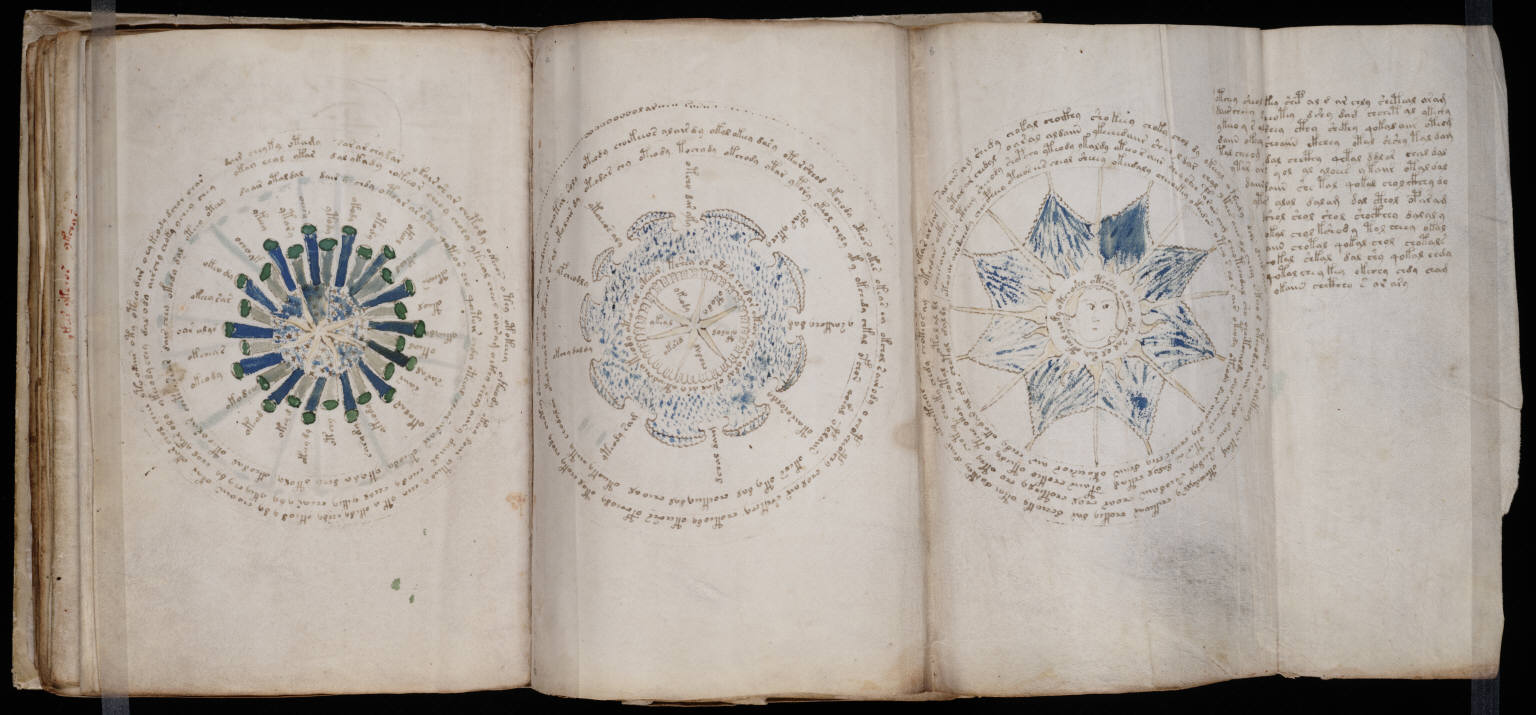
Images from the Voynich Manuscript

The Voynich Manuscript is one of my favorite historical mysteries and one that I plan to write about soon in more detail, but for now I present some (new to me) digitized images from this most obscure of books.


For more see the Wikimedia Commons page, which seems to contain the complete original text.