Showing posts with label Jesuits. Show all posts

December 28, 2010

The Baroque Monsters of Father Schott

In Portuguese, barroco means "imperfect pearl": a fitting name for the Baroque era, a period that combined ornate beauty with a distinct taste for the odd, macabre and irregular. This interplay between the beautiful and the monstrous -- and its connections to the rise of the "New Science" in the second half of the seventeenth century -- is vividly exemplified by the Jesuit Father Gaspar Schott's Physica Curiosa (1662), a compendium of abnormal births, strange animals and fabulous humanoid creatures thought to inhabit the far reaches of the world.
Frontispiece of Physica Curiosa. Source: University of Iowa Digital Library, John Martin Rare Books Room.
The work's Latin title page.
The German-born Schott (1608-1666) was a Jesuit with a keen interest in a number of disciplines, from hydraulic mechanics to medicine and optics. One can surmise that Schott acquired his wide-ranging interests from his mentor, the celebrated Jesuit genius Anathasius Kircher (a polymathic marvel, Kirchner was a founder of Egyptology, used an early microscope to study microbes, lowered himself into an active volcano to learn about the earth's crust, constructed automatons, invented a magnetic clock and authored an immense encyclopedia on China). Below are a selection of images from Schott's Physica Curiosa, all of which I selected from the digital collections of the John Martin Rare Books Room at the University of Iowa. I've cropped some of the engraved plates to show interesting details and added my attempt at translations of the Latin captions and occasional explanatory notes. As the work's extended title dryly notes, Schott seeks to document "Angels, Demons, Men, Spirits, the Devil-Possessed, Monsters, Portents, Animals, Meteors, and other rare, arcane and curious things... and to illustrate them by many examples."
Schott, 579. "Seven-headed monster."
Schott, 393. "Shaggy man who walks with hands on the ground."
Schott, 393. "Woman of the woods in Java." This creature was probably based on the reports of seventeenth century Dutch mariners in Indonesia, who, in turn, may have been drawing upon indigenous knowledge of the orangutan -- "Man of the Forest" in the Malay language.
Schott, 395. "Hair-covered girl of eight years." Clearly a girl born with hypertrichosis.
"Boy with the head of an elephant." His companion is "a horned infant with spread eyes." I have no idea what to make of this one.
The images in this section of the work appear to be a strange combination of depictions of actual birth defects or hereditary abnormalities and pictures of mythical man-beasts that were said by medieval travelers to inhabit the Antipodes. In a later section, the book turns to the interesting and fantastical creatures that were being 'discovered' by European overseas voyages at the time. Many of these illustrations were evidently drawn from a book I wrote about in my post on Edward Topsell's Historie of Foure-Footed Beasts -- others were more fantastical:
Schott, 616. Here we find a "winged bird-centaur with the head of a human" and "a three-headed monster with the heads of a fox, a dragon and an eagle."
And here are the more familiar raccoon and river otter. Note, however, that the raccoon (here identified by its Spanish name, "mapache,") is from the New World and thus would have been as unfamiliar to European audiences of the time as many fantastical beasts.
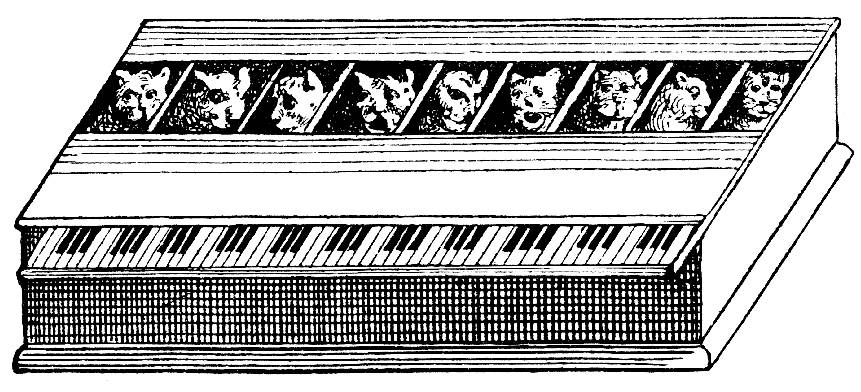
Cat piano from Schott's Magia Naturalis (Natural Magic).
Finally, an interesting aside: Schott was also the first to describe what may well be the most bizarre musical instrument in history. This was the so-called the Katzenklavier or 'cat piano.' See this blog post on the subject to learn more about this strange creation, apparently real, which was said by Kircher to have been invented to relieve the melancholy of an Italian prince. PETA would have been appalled. For those interested in learning more, I haven't been able to find much written on Schott. However, his teacher Athanasius Kircher has generated a large body of fascinating scholarship -- see Paula Findlen's edited volume Athanasius Kircher: the Last Man Who Knew Everything (2004) for a good introduction.

September 22, 2010

Early Chinese World Maps

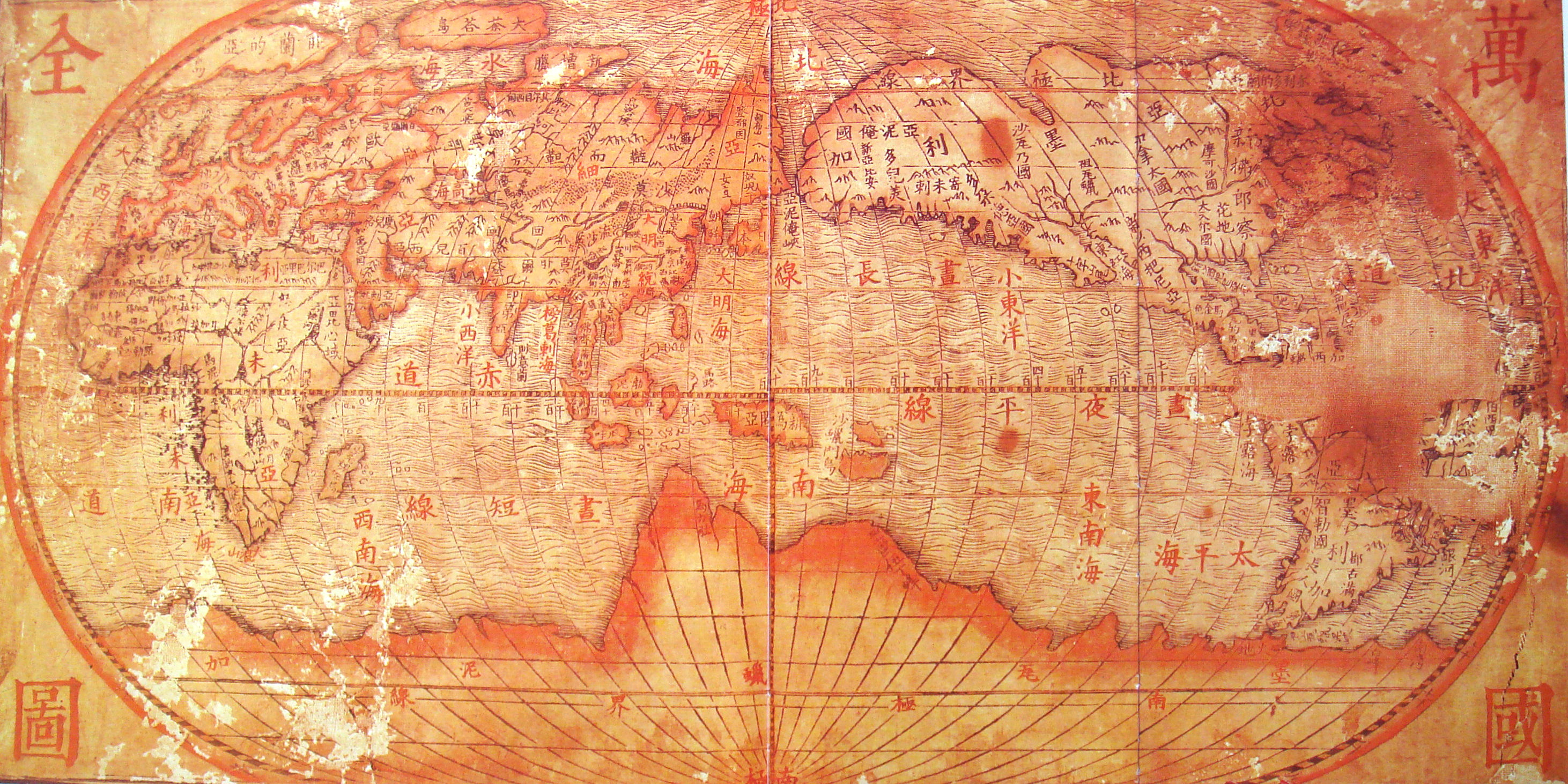
 I recently came across this fascinating world map while researching the history of the Jesuit missions in seventeenth century China. Apparently developed by the Italian Jesuit Giulio Aleni while he was working as a missionary in 1620s China, the map strikes me as being remarkably advanced for its time.

 Witness, for instance, the fact that California is shown to be linked to the mainland of North America - portraying California as an island was a famous error of mapmakers of the seventeenth century and continued to be repeated by eminent cartographers up until the early years of the eighteenth century (for a few examples of these maps see here).  Also interesting is the fairly accurate outline of the northern coastline of Australia embedded in an imagined southern landmass (the Terra Australis Incognita or 'Unknown Southern Land' of cartographic lore).

Perhaps the most telling difference between this map and its European counterparts is the Sino-centric nature of its orientation: here the Celestial Empire stands at the very center of the world map. If any of my readers happens to have any knowledge of Chinese characters, I'd be very curious to learn what the labels and captions say. Could the cross-shaped character visible in parts of Africa and Europe be a sign of Christianity? [Edit, September 30.] An anonymous commentator has kindly informed me that this in fact "a regular chinese character pronounced "ya". It was used as a phonetic here in the name of countries. For example, on northern Africa, you can notice from top to bottom, the three characters "利未亞". In modern chinese, this is pronounced Li Wei Ya, but at the time, the pronounciation was different and more like Li bi ya (Libya)." Thanks anonymous, whoever you are!


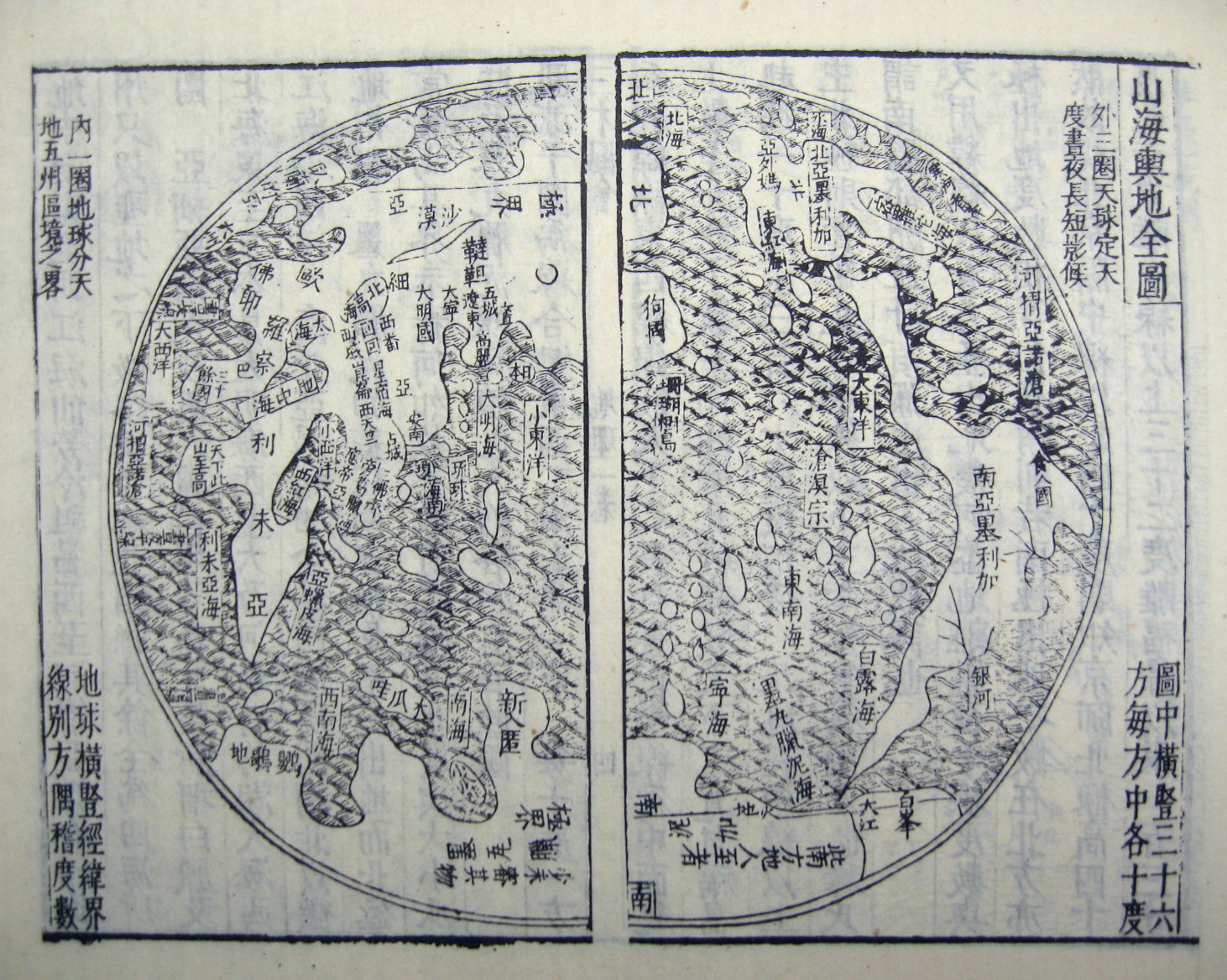
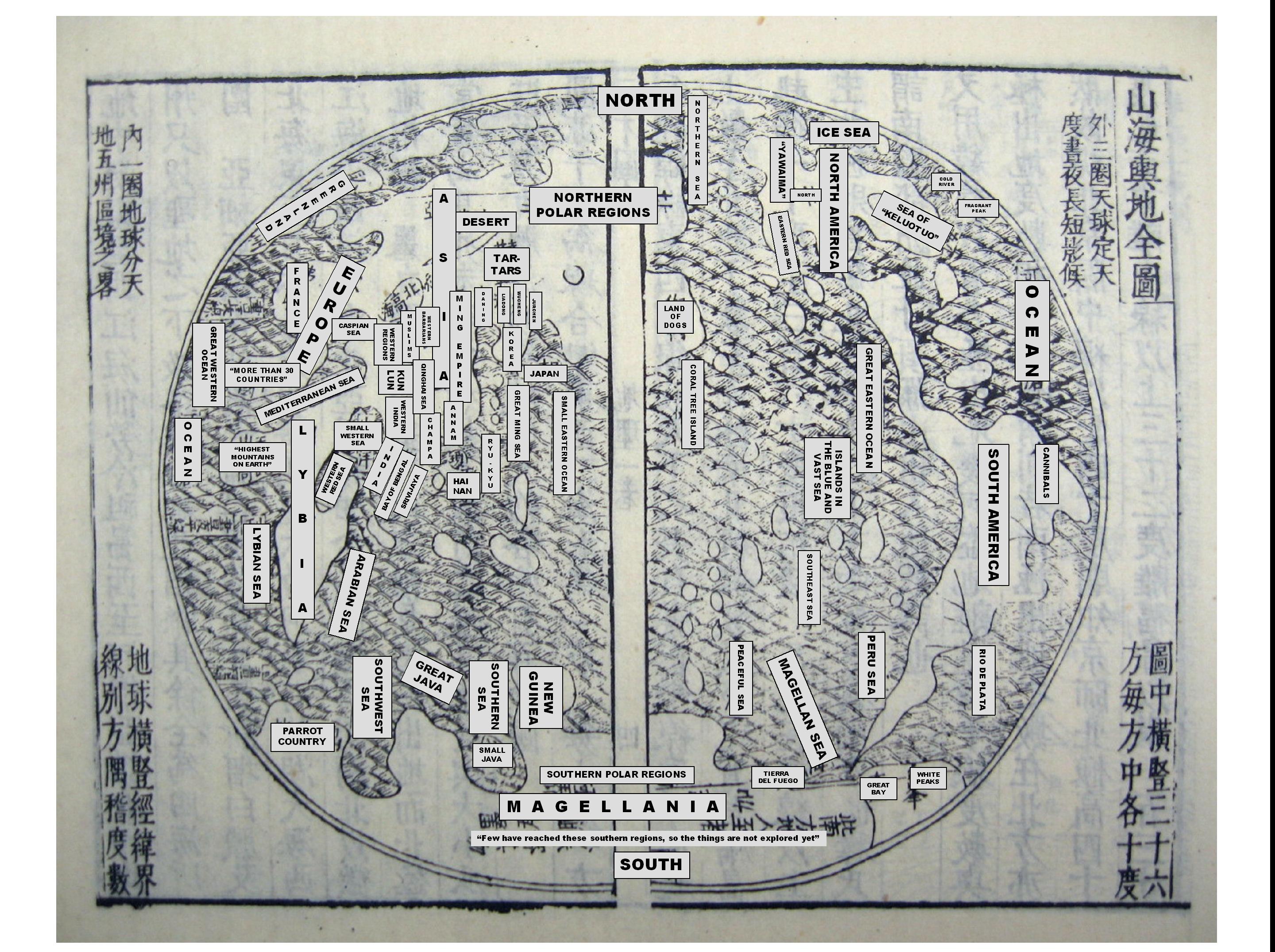
Luckily there is a slightly earlier Chinese world map, known as the Shanhai Yudi Quantu, that a Wikipedia user has generously gone to the trouble of translating.
Below is the original:


And here is the same map with translated captions:

I love the caption floating over Iberia: "More than Thirty Countries." And I'm curious about the "Land of Dogs" caption, apparently somewhere near the Kamchatka Peninsula, and the nearby "Coral Tree Islands." I wish more maps of this kind were translated, since they offer such a fascinating glimpse into different cultural modes of understanding space and geography. Its worthwhile to remember from time to time that maps are often as much depictions of a culture and its preoccupations as they are depictions of physical space!

[Edit, September 28]. I just came across an earlier Chinese world map, the Kunyu Wanguo Quantu or "Map of the Myriad Countries of the World,"  created by the famed Italian Jesuit Matteo Ricci in collaboration with Zhong Wentao and Li Zhizao in 1602. The Wikipedia page on it is quite good, and includes a remarkably detailed scan of this fascinating map. The full image seems to be too large to post here, but I've cropped a couple interesting details:

According to Wikipedia: The brief description of North America mentions "humped oxen" or bison (駝峰牛 tuófēngníu), feral horses (野馬, yěmǎ), and a region named Jiānádá (加拿大, Canada). The map identifies Florida as Huādì (花地), the "Land of Flowers."
If you're interested in this stuff, I've made a couple earlier posts on Asian perceptions of Europeans (see here and here) and can recommend a few books that deal with similar themes: Jerry H. Bentley's Old World Encounters (1993) is a pioneering work that got me thinking about this subject in the first place. Stuart Schwartz's edited volume Implicit Understandings (1994) is also excellent. For those interested in the themes of cross-cultural exchange and travel in Asia before Europe arrived on the scene, I recommend Janet Abu-Lughod's Before European Hegemony (1991) and K.N. Chaudhuri's Asia Before Europe (1991).