-Spanish chronicler Andres Bernaldez on Christopher Columbus' first impression of Caribbean iguanas, 1513.
IN HIS BOOK Marvelous Possessions: The Wonder of the New World, Harvard literature professor Stephen Greenblatt argues that "the production of a sense of the marvelous in the New World is at the very center of virtually all of Columbus's writings about his discoveries, though the meaning of that sense shifts over the years." Greenblatt thinks that Columbus emphasized wonders and marvels "because marvels are inseparably bound up in rhetorical and pictorial tradition with voyages to the Indies. To affirm the 'marvelous' nature of the discoveries is, even without the lucrative shipments yet on board, to make good on the claim to have reached the fabled realms of gold and spices." Yet Greenblatt doesn't devote much space in his book to the flip side of the "marvelous": the monstrous.
As Iberian voyages of "discovery" segued into expeditions of conquest and settlement over the course of the sixteenth century, Europeans increasingly visualized the New World as a land of bizarre torments, freakish monsters and outlandish civilizations in thrall to the devil.
 |
| Map of Brasil, Dieppe School, 1547. Click to see much larger version. |
Spanish interpretations of the religious practices they encountered in the lands of the Aztec Triple Alliance have attracted the majority of historians interested in how Europeans expressed fear, apprehension and disgust -- as well as wonder -- toward the Americas (see below for some recommendations). The pictures below show that monsters and the monstrous were also depicted in the context of Portuguese Brazil. I'm particularly interested in how the incredible biodiversity of Amazonia was initially interpreted by European observers who had seen nothing to rival it in their temperate homelands. Although comparisons to the Garden of Eden were frequent, these images also reveal a profound anxiety about the abundance of nature in the Neotropics.
 |
| The Flemish engraver Theodor de Bry's vision of Brazil mingles outlandish sea creatures with flying devils who torment the Tupí Indian villagers at lower right. Theodor de Bry, Americae tertia pars (Frankfurt, 1592) |
 |
| Birds of paradise feature in this detail from the 1547 Dieppe map of Brazil linked above. |
 |
| Tupí Indians hunt leonine creatures, probably reflecting early accounts of jaguars. Another detail. |
 |
| In the same pictorial field, villagers lounge while two tortoises amble by. |
 |
| During the Dutch occupation of parts of Brazil in the 1640-60 period, a number of highly skilled painters visited the new colony to record their impressions of its flora and fauna. In this 1665 painting by Albert Eckhout, two dueling tortoises recall the pair in the detail from the Dieppe map above. |
Despite their skill in visual representation, however, Dutch artists were often at least as fanciful in their depictions of South American monsters as their French and Iberian peers. The engravings below, selected from the Dutch author Arnoldus Montanus' 1671 De Nieuwe en Onbekende Weereld (The New and Unknown World), offer a positively bizarre take on American animals and peoples.


 |
| The "draco" (dragon) in this one bears a passing resemblance to the "Jenny Hanivers" and "Sea Monks" of early modern sailors' lore. |
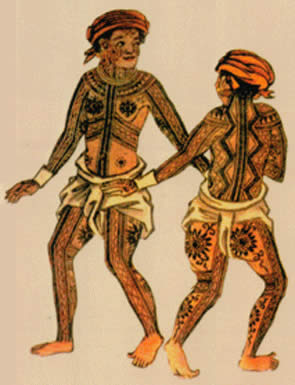
Europeans were also fascinated and fearful of the "monstrous" forms of indigenous Brazilians themselves. Although most accounts remarked upon the good health, longevity and physique of Tupí Indians and other indigenous societies in Brazil (probably a reflection more of the poor health and diet of the European mariners than anything else), others focused on their tendency toward body-modification. The most entertaining and strange European take on piercing and tattooing I have been able to find is John Bulwer's fantastically titled Anthropometamorphosis: Man Transform’d, or the Artificial Changeling. Historically presented, in the mad and cruel Gallantry, foolish Bravery, ridiculous Beauty, filthy Fineness, and loathesome Loveliness of most Nations, fashioning & altering their Bodies from the Mould intended by Nature. With a Vindication of the Regular Beauty and Honesty of Nature, and an Appendix of the Pedigree of the English Gallant. (London: J. Hardesty, 1650). (I wrote about this a bit in an earlier post). Below he describes how "the Brasileans... are pricked within the flesh" with paint.

Bulwer's title page takes this a step further, showing an Amerindian figure sporting some truly remarkable tattoos! The European woman with facial tattoos to the figure's left highlights Bulwer's concern that this "barbarous" custom would become fashionable with his own countrymen (he was right, but it would take another three hundred years or so to really catch on, and the whole "face on a butt" tattoo fad seems to still lie in the future).

Readers wanting to learn more about the role of the devil and the monstrous in European interpretations of Amerindian societies might want to start with Fernando Cervantes' The Devil in the New World and Jorge Canizares-Esguerra's Puritan Conquistadors. Greenblatt's Marvelous Possessions, quoted above, is a great study of how the fantastical and marvelous figured into colonization, while Joyce Chaplin's Subject Matter: Technology, the Body and Science on the Anglo-American Frontier, revises and critiques his claims in various interesting ways. Those interested in New World nature and particularly animals should check out A New World of Animals: Early Modern Europeans on the Creatures of Iberian America Miguel de Asua and Roger French, a fun, learned and highly-entertaining book (from which I stole the quote on iguanas that opens this post).

 , "[Giolo] was painted all down the breast, between his shoulders behind; on his thighs before; and in the form of several broad rings, or bracelets, round his arms and legs. I cannot liken the drawings to any figure of animals, or the like, but they were very curious, full of great variety of lines, flourishes, checkered work, etc. keeping a very graceful proportion, and appearing very artificial, even to wonder, especially that upon and between his shoulder blades... He told me that most of the men and women of the island were thus painted." (William Dampier, A New Voyage Round The World, 1697)