Showing posts with label Middle Ages. Show all posts

May 23, 2018

A Medieval Emperor's Natural Language Experiment

Holy Roman Emperor Frederick II as depicted in the Shrine of Charlemagne, which he commissioned, c. 1215.
The Holy Roman Emperor Frederick II (1194-1250) was known as the stupor mundi ("the astonishment of the world") among his European contemporaries. But he did not cut an impressive physical figure, at least according to the Baghdad-born chronicler Sibt ibn al-Jawzi.

"The Emperor was covered with red hair, bald, and myopic," al-Jawzi recorded. "Had he been a slave, he would not have fetched 200 dirhams at market."

The quip didn't reflect any particular animus on the part of al-Jawzi. In fact, Emperor Frederick was well-regarded by many in the Muslim world. Dante, that most judgmental of all medieval writers, placed Frederick in the sixth level of his Inferno: the region reserved for heretics. The emperor was by all accounts deeply religiously heterodox, and was famous for feuding with the Pope and enlisting Muslim soldiers in his personal bodyguard.

The same unorthodox manner that had repelled Dante seems to have endeared Frederick to his rival Al-Kamil, the Ayyubid Sultan of Egypt. A strikingly good-natured exchange took place during the two rulers' parlay over the fate of Jerusalem. Al-Kamil's muezzin, out of respect for the presence of a Christian king, had refrained from the morning call to prayer. Emperor Frederick supposedly rebuked him, saying: "I stayed overnight in Jerusalem in order to overhear the prayer call of the Muslims and their worthy God." Frederick's ability to maintain respectful relations with the Sultan resulted in a bloodless transfer of Jerusalem to the Emperor's rule, in stark contrast to previous crusades which had typically resulted in massive amounts of senseless violence.

Emperor Frederick II and Sultan Al-Kamil clasping hands at the gates of Jerusalem, from Giovanni Villani's Nuova Cronica, Biblioteca Apostolica Vaticana, 14th century. 
Frederick's most recent biographer, David Abulafia, calls Frederick a "scientific" emperor, noting his deep-seated interest in the natural world, his rejection of religious orthodoxy, and his support for astronomical research.

But a closer look into the Emperor's own "experiments" yields some surprises.

Frederick's interests are emblematic of the difference between medieval investigations of nature and those that we today associate with modern science. For one thing, they were insanely unethical by modern standards. According to the Franciscan monk Salimbene (who we should take with a grain of salt - Abulafia calls him a "shameless gossip"), these experiments included dissections of two men who had been fed meals hours earlier, to see how vigorous exercise influenced digestion. Salimbene also mentions a dubious-sounding incident in which Frederick compelled a man known as "Nicholas the Fish" (who was said to have been "condemned to an amphibious life" by his mother's curse!) to continually dive and fetch an underwater golden cup until he drowned.

Children playing, from a 1338 Alexander Romance (Bodleian, Oxford, MS Bodley 264).
According to Salimbene, Frederick was also perhaps the first figure in recorded history to conduct a language deprivation experiment.

What happens to infants who are deprived of all language? It's a question with profound implications, because it potentially sheds light on long-standing debates over the degree to which the human brain has a "language instinct," as Steven Pinker put it in his book of the same name. But it's an experiment so deeply cruel that it has only been entertained as an option by a handful of medieval and early modern rulers (a category of human beings for whom harshness and violence were sometimes lauded as a virtue).

Here's my attempt at translating from Salimbene's Latin, which you can read here in full here:

The second of [Frederick's] superstitions is that he wished to discover what sort of language and speech children developed, when growing up, if they were spoken to by no one. And so he ordered nurses to give milk to the infants, and for their breasts to be suckled, and for them to be bathed and cared for, but that they should be in no ways be played with or spoken to. The emperor wanted to know whether these infants would begin to speak the Hebrew language (which had been the first), or the Greek, Latin, or Arabic tongues, or whichever language had been spoken by the parents from which they were born. However, he labored in vain. Whether children or infants, they all perished. For it was not possible to live without the rejoicing and games and happy faces and blandishments of their caregivers and nurses. 
This inhumane episode, if it was actually ever carried out, is oddly reminiscent of some of the work of mid-20th century behavioralists, like B. F. Skinner, and their critics, like Harry Harlow. Harlow's interest in what he called the "pit of despair" afflicting isolated infants (which the psychologist apparently originally wanted to refer to with the even more medieval-sounding phrase "dungeon of despair") led him to conduct a now-infamous series of experiments involving the total isolation of baby rhesus monkeys.

Harlow found that even providing access to an inanimate "surrogate" mother (if the surrogate was soft to the touch) could provide what he called a "psychological base of operations" that increased survival rates and improved the baby's ability to cope with stressors. Monkeys with no such comfort quickly succumbed to profound psychological distress; some even died.

A Life Magazine photograph of one of the unfortunate infant monkeys involved in Harlow's infamous monkey experiments, circa 1959.
Without wading too much into psychological explanations, it may be worth pointing out at this juncture that Frederick II lost his own mother at the age of three. Medieval lives tended to be harsh, and perhaps his own experience of traumatic loss of a loving parent inspired Frederick's supposed dabbling in the dark side of behavioralist psychology.

Or maybe Salimbene, the monk on whom so much of what we supposedly know of Frederick depends, was simply slandering the emperor. It's hard to know at this point. But the episode does serve as a good reminder that many ideas and practices we associate with "modern science" often have much older (and stranger) antecedents than we realize.

Incidentally, the obsession with seeing Hebrew as the "natural language" of humankind would stick around for a very long time. As late as 1760, the author of A New Complete English Dictionary speculated that Hebrew was the "language which God taught Adam." However, he noted that "others hold for the Syriac, Childee, Ethiopian, or Armenian" as potential first languages.

What I find most interesting, though, about Frederick's cruel experiment is not the speculation about some hypothetical "first" language, but the question of whether infants are somehow naturally able to speak the language of their parents, even without exposure to them.

The idea seems to me tantalizingly similar to the theory of inheritance popularized by Jean-Bapistque Lamarck centuries later, toward the end of the eighteenth century.


October 5, 2010

Vanished Civilizations III: Trebizond

This is the third in an occasional series of posts about my favorite 'vanished' civilizations (the first was on Carthage and the second was on the mysterious Tocharians). I put the word 'vanish' in scare quotes because in fact few if any civilizations truly disappear: they simply transmute. Ancient Carthage was destroyed as a state by the Roman empire, but the people who composed the Carthaginian empire never really went away. (St. Augustine, for instance, is usually thought of as a Roman, but he was born in the Carthaginian heartlands and was of Berber ancestry.) But there is something essential about a culture that can be lost to time or conquest, and that's what I want to get at with this series.

Both of these points are certainly true of this week's civilization: the culture that grew up around the ancient city of Trebizond (currently known as Trabzond), on the southern shores of the Black Sea. I had always wondered about the place named Trebizond since I was a kid looking through my father's Penguin Atlas of History (a really wonderful series of books by Colin McEvedy). But what sparked my attention again was stumbling across Pisanello's remarkable depiction of Trebizond at the height of its wealth in a fifteenth century fresco complete with sailing ships, saints, dogs and hanged men:
A detail of the city itself (how realistic, I don't know):

Trebizond reached its cultural and political peak in the twelfth century, when it was an important breakaway state from the Byzantine empire and one of the principle termini of the Silk Road (see below map), but its historical roots are ancient.
The city began as a Miletian Greek colony whose citizens made their living by trading with the 'barbarous' peoples of the northern Black Sea coast -- called by the Greeks mossynoikoi ("those who dwell in wooden towers"). According to the historian Xenophon, the mossynoikoi were "fair-complexioned and white-skinned, with their backs variegated and their breasts tattooed with patterns of all sorts of flowers."

Coin of Mithridates VI of Pontus.
In the first century BCE, Trapezius/Trebizond became a center of the little-known Pontic Kingdom of Mithridates VI (143-63 BCE), a Greco-Iranian military genius who claimed descent from both Alexander of Macedon and the Persian Emperor Darius. Trapezius gained reknown as the home port for the Pontic Fleet of Mithridates, who successfully evaded Roman conquest for decades and became legendary in the ancient world for his supposed resistance to poisons, a feat made possible by his continual ingestion of small amounts of poison provided by a group of Scythian shamans called the Agari. This practice eventually allowed him to build up a tolerance and, hence, immunity. (For more on Mithridates, poison and the Agari, see this interview with Adrienne Mayor, the author of a well-received recent biography of the monarch called The Poison King.)
A bust of Mithridates.
In the end, of course, the Romans won, and Trebizond became incorporated into the empire as a key port city and an important buffer between the Roman world and the Armenian empire and the states of the Caucasus. Its important regional role continued under a period of Muslim rule in the vast Umayyad Caliphate of the 8th century CE, and through to its reconquest by a resurgent Byzantine Empire in the early Middle Ages.

However it was not until the sack of Constantinople by Christian crusaders in 1204 that Trebizond reached its cultural and political zenith, when it became the capitol of a new breakaway Empire of Trebizond declared by the Georgian prince Alexios Komnenos.
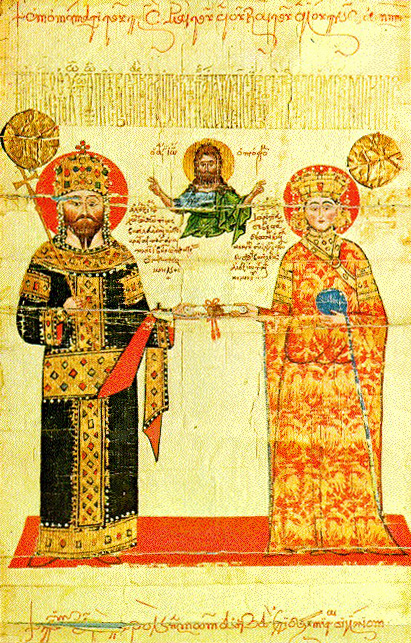
Alexios and his queen.
Under Alexios Trebizond developed quite a distinctive regional culture which mingled influences from the Muslim and Byzantine worlds with those from the ancient societies of the Caucasus Mountains. The monasteries built at this time are architectural standouts for their gravity-defying mountaintop construction, and are to me the most distinctive legacy of the empire:
The beautifully-situated Sumela monastery in winter.

A view from a courtyard at Sumela. A frescoed chapel wall is visible to the left.
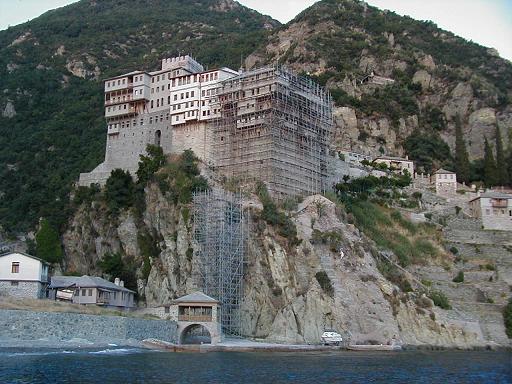
The castle-like monastery of Dionysiou, greatly enlarged by Alexios.
The Trebizondian Empire actually managed to outlast the Byzantine Empire itself, holding off the Ottomans until 1461, some eight years after the fall of Constantinople. However, it too ultimately fell to the Turks, and the modern day Republic of Turkey, successor to the Ottoman Empire, is where the city lies to this day. The city endures, as it has always done, but the Empire of Trebizond (and the Pontic Kingdom that established its greatness) have faded away.

Some Trebizondian ruins:
A Byzantine hilltop fortress, at left, and at right a Roman-era tomb carved into a cliffside.
A Trebizondian castle and the secret tunnel that connected it to the world.
As an aside, the legends surrounding Mithridates and his poison-resistance gave rise to the substance known as Mithridatium or Mithridate, believed in the early modern period to be one of the most powerful medicines known to man, a universal antidote for all poisons. Interestingly, Mithridatium never had any one common recipe: it was more like a melange of all the most expensive and rare materia medica, from opium and ground pearls to the bones of salamanders and even the ashes of mummies! (On mummy as medicine see my earlier post touching on the subject).