Hello readers! After 13 years, I've decided to turn the Res Obscura blog into the Res Obscura Substack newsletter. Very little is changing, excerpt for the fact that I've returned to writing it regularly: I'm aiming for weekly posts about the stranger corners of history, focused mainly around my research interests of the history of science and medicine, globalization, empire, drugs, etc. It remains free to read, with no ads.
Aesthetic modes can be surprisingly persistent, even as technologies change.
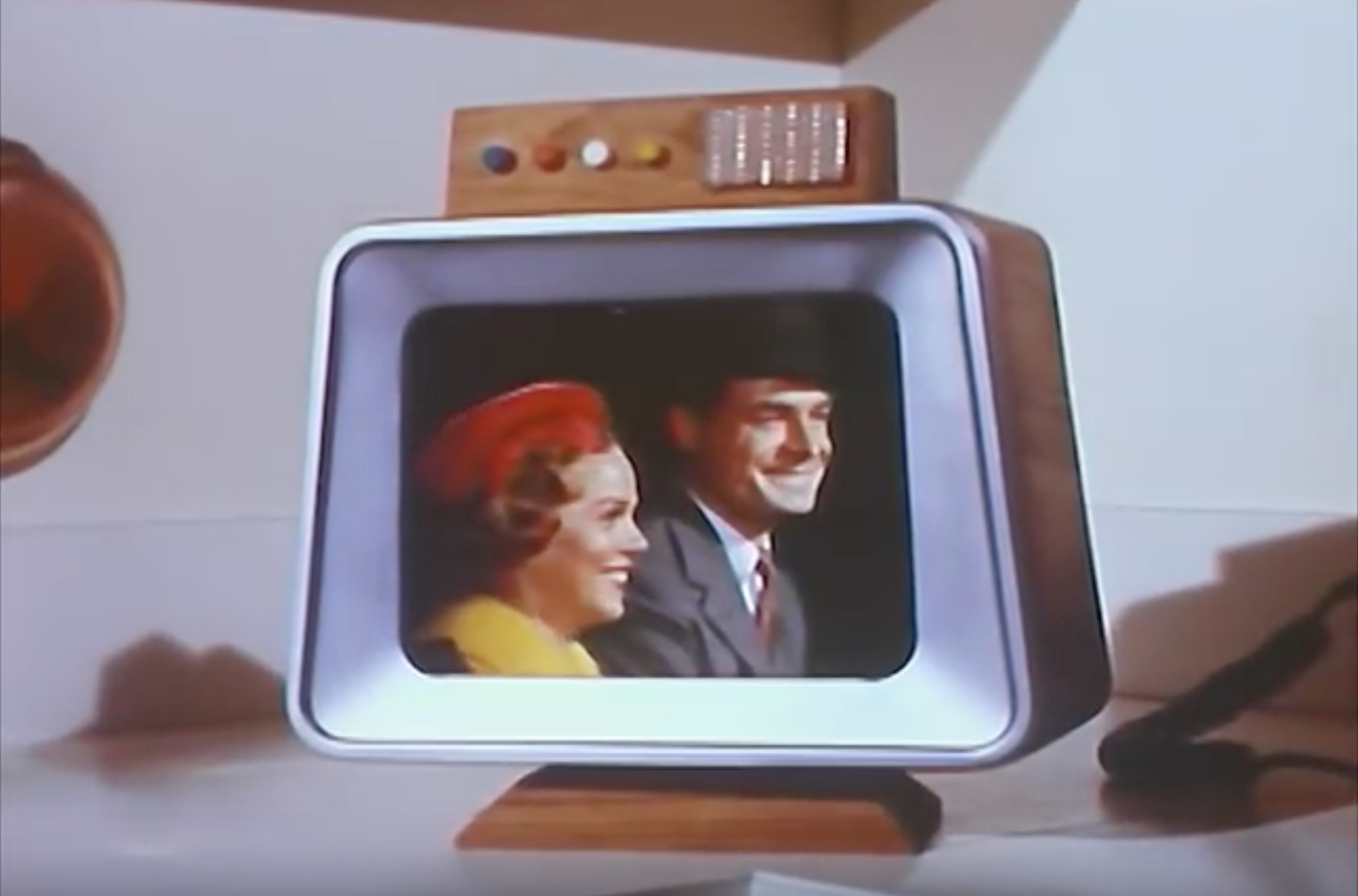
Electric light strips automatically illuminate as the young couple approach the house's front steps. They pause before a pearlescent circle embedded in the wood of the door – it's a tiny security camera, beaming their image onto a screen on the kitchen counter within.
Following a push-button approval from the woman inside, the door unlocks automatically. Success!
These are screenshots from a promotional film made by the Westinghouse Corporation in the mid 1950s. The film advertised Westinghouse's vision of the "Total Electric Home": one of the earliest and most detailed previews of what is now known as a smart home.
This home of the future doesn't just use technology to heat, cook, cool, and light. It also "entertains, encourages hobbies, makes it the easiest way ever for you and your family to be happier, healthier, to live fuller lives."
When guests approach your Total Electric Home, a soft glow of Rayescent (TM) lamps along the entrance path guides them up to the entrance. Additional lights go on automatically as they come near... When guests arrive at the door, a television camera takes their picture and transmits it automatically to closed-circuit monitors located throughout the house. As you view your guests, you'll be able to welcome them over the voice intercom.
Some of the innovations inside the home are not terribly impressive, even from the perspective of the 1980s.
For instance, the promotional video boasts that “the temperature of each room in the Total Electric Home can be set individually," via this overly-complicated "weather control center."
"The pride and joy of the man of the house is the 'weather control center.'"
The barometric pressure read-out and the sidewalk de-icers are kind of cool, I guess:
"In summer, an automatic sensor starts the lawn sprinkers when the lawn gets thirsty."
To my eyes, though, the actual smart home technology in this section looks garish and seems difficult to use. On the other hand, the blonde wood panelling on the walls is, to me, timeless and appealing.
The situation is similar when it comes to other parts of the house: bold technological claims that would sound prosaic within the lifetimes of the actors involved. The film hypes the washer/dryer unit as a "program computer... that can think," but it's actually just a push-button system that has different settings for different types of clothing.
"It’s the first home laundry… that can think.”
By contrast, the combination barbecue and fireplace (!) looks far less dated than the other elements in the house, as does the beautiful living room. The most futuristic elements of this home aren't the "thinking machines" – they're the elements of mid-century modern design, mostly made out of age-old materials like copper and wood.
Detail from a Westinghouse promotional brochure.
The whole video is worth watching in full – don't miss the microfilm cookbook in the kitchen.
The Westinghouse Electric Home shown in this film was for show, but many elements of 1950s smart home design aesthetics and technology did end up in production.
The science fiction author Robert Heinlein and his wife Virginia were profiled in one representative example in the June, 1952 issue of Popular Mechanics. The Heinlein's Colorado Springs house was their own take on a connected home of the future:
Their home in Bonny Noon, California, near the UC Santa Cruz campus, continued the same style.
Courtesy UC Santa Cruz Special Collections. (Fun fact – the other photographs in this folder were candid shots of a young L. Ron Hubbard!)
From my perspective, the most futuristic thing about these homes is not "cybernetic" circuitry and electronic gizmos of the technology itself – it's the design sensibility of such decidely non-high tech elements as wood, copper, and paint.
* * *
A home of the year 2119 will almost certainly not include "smart" products made by Amazon or Apple (when was the last time you bought a Westinghouse appliance?). But there's a decent chance that it will include furniture inspired by mid-century modern aesthetics. Aesthetic modes can be surprisingly persistent, even as technologies change – in historian Fernand Braudel's terms, design styles are often multi-generational "conjunctures" spanning several decades or even centuries. These can easily outlast the more rapidly-passing "history of events."
A favorite example: The "Crakow" or "Poulaine" style of shoe – you might not know the name, but you probably know the look. It's the curly-toed, long-pointed footwear that you might recognize from medieval manuscripts or from historical films, Renaissance fairs, and the like.
There's no technological rationale for these absurdly long shoes: they are simply a fashion choice. But it proved to be a fashion that was amazingly persistent, originating in the twelfth century and not falling out of style until the childhood of Henry VIII (that's over 300 years).
Or take the design of radios and televisions throughout the first six decades of the twentieth century.
Cutting-edge products of modern technology, yes. But a form of technology that gets disguised in carved wooden cabinets that look straight out of the nineteenth century.
A 1951 magazine advertisement for a Zenith "Black Magic" television.
Perhaps the most prescient twentieth-century vision of a smart home isn't from a commercial or promotional video promising specific technologies. It's from Stanley Kubrick's 2001: A Space Odyssey, when the astronaut David Bowman finds himself in a sort of alien-designed observation room, where he lives out the rest of his life.
As Michael Benson writes in his excellent recent book about the making of 2001, Kubrick and Arthur C. Clark's vision of the final space in the film was "supposed to have overtones of a holding tank or zoo cage." They tried out various space-age design elements for this "hyperreal hotel room," but in the end they settled on something oddly traditional: Louis XVI furniture, muted paint tones, and decorative objects that look like something Queen Victoria might nod approvingly at.
It's safe to say that Kubrick's alien hotel room is not a good guide to what the homes of the future will actually look like. But I think that Kubrick intuitively grasped something that his space-age peers did not: technology changes far more quickly than aesthetics does.
We might not have fussy Victorian-style furniture or Danish modernist tables in space, but then again – maybe we will.
A detail of one of Etienne Gaspard Robertson's "phantasmagoria."
Ghosts were in the air in eighteenth-century London. Few knew this better than James Boswell, the friend and biographer of Samuel Johnson. On a gloomy Saturday in March of 1762, feeling “cold and spiritless” and having “lost all relish of London,” Boswell sought out the company of some friends. Unfortunately for Boswell, after dinner had ended, the group began to “talk of death, of theft, robbery, murder, and ghosts.”
Lady Betty and Lady Anne declared seriously that at Allanbank they were disturbed two nights by something walking and groaning in the room, which they afterwards learned was haunted. This was very strong. My mind was now filled with a real horror instead of an imaginary one. I shuddered with apprehension. I was frightened to go home.
Luckily, Boswell had a good friend in his companion Erskine, who “made me go home with him, and kindly gave him half of his bed, in which, though a very little one, we passed the silent watches in tranquility.” (Later, Boswell admitted that his lifelong fear of ghosts had made it impossible for him to sleep alone until he was eighteen.)
Perhaps ghosts had become a topic of conversation for Boswell's friends that evening due to the infamous case of the Cock Lane ghost. One of the most celebrated news stories of 1762, the Cock Lane affair had all the usual trappings of newspaper drama, including illicit sex, a controversial expert commission (which included Samuel Johnson), and spectacular allegations of murder – supposedly made by the ghost of the victim herself, one Fanny Lynes. All throughout the dreary winter and early spring of 1762, crowds of Londoners gathered outside the scene of the crime, regularly attempting to make contact with the spirit of the victim.
That same year, a play called The Orators had been staged in London which featured an incompetent attorney defending a client who happened to be a ghost. “What is a ghost? A spirit,” the grandstanding lawyer declaims:
What is a spirit? A Spirit is a thing that exists indepentently of, and is superior to, flesh and blood. And can any man go for to think, that I can advise my client to submit to be tried by people of an inferior rank to herself?... I therefore, humbly move to squash this indictment, unless a jury of ghosts be first had.
The works of Shakespeare, especially his ghost-haunted plays Hamlet and Macbeth, began to enjoy a new level of renown in the same period, inspiring an entire sub-genre of spectral paintings and prints.
Detail from Benjamin Wilson's William Powell as Hamlet Encountering the Ghost (circa 1768).
In her book The Ghost: A Cultural History, Susan Owens argues (rightly, I think) that ghosts are “mirrors” of the cultures they haunt: “They reflect our preoccupations, moving with the tide of cultural trends and matching the mood of each age.” But I would go a bit further than this: ghost sightings seem to me to reflect, most of all, the technological preoccupations of an age. Thus it's little surprise that Enlightenment-era debates about ghosts fixated on whether the use of experimental tools, allied with reason, could banish these pesky supernatural entities altogether.
For the Scottish Enlightenment philosopher David Hume, ghosts and apparitions helped inspire what is perhaps the most famous passage in Hume's Enquiry Concerning Human Understanding: Section X, “Of Miracles.” By Hume's definition (“a transgression of a law of nature” enacted by "the Diety, or by the interposition of some invisible agent”) ghosts and haunting fell under the heading of “miracles,” just as the resurrection of Christ did. Hume was having none of it: the laws of nature are products of “a firm and unalterable experience,” he argued, that can only be changed by the testimony of many people from different times and places – a variation on the practices of collective observation and “virtual witnesses” that historians of science identify as one of the key aspects of the Scientific Revolution. According to Hume, ghosts and other miracles fail this test, because they are single, unique events. It is more sensible, he argued, to attribute claims of miracles to unreliable observers (motivated, for instance, by the desire to promote religious beliefs) than to assume a true violation of the laws of nature.
Given this, it's tempting to tie eighteenth-century ghosts to a larger narrative about what Keith Thomas called the “decline of magic” during the Enlightenment era. The witchcraft trials which had convulsed Europe in the seventeenth century began to peter out in the early decades of the eighteenth. Although Jane Wenham, an alleged witch who was condemned to death by a jury in 1712, was not the very last witch to be executed in England (as sometimes claimed), her case was deeply emblematic. In response to witnessing Jane's trial, a clergyman named Francis Hutchinson wrote an impassioned, skeptical essay on witchcraft that debunked many of the famous persecutions of the past few decades, including the Salem trials. Perhaps the decline in popular belief in the existence of living, human wielders of supernatural powers displaced that belief in the supernatural into non-living magical entities: ghosts, spirits, apparitions, and the like.
Francis Hutchinson's Historical Essay Concerning Witchcraft (London, 1718) and Richard Boulton's attempt to "vindicate" the concept of magic in response (London, 1722). Boulton's book is discussed below.
Eighteenth-century ghosts were not quite the same as the ones familiar from present-day horror literature and films. They were not even the same as the ghosts of the Victorian era, which haunted seances with their disembodied rappings and knockings. The difference shows how technological change maps onto the ways that people think about magic. Victorian seances were inspired by what was, at the time, cutting-edge research into such things as X-rays, radio waves, and the aether. The spirits of the dead appeared in these late nineteenth-century accounts as something akin to telegraph operators, sending out long-distance communications by means of cryptic, coded communication. As Hilary Grimes points out in her book The Late Victorian Gothic, spiritualist seances mapped directly onto the technological changes of the nineteenth century. Early in the Victorian period, ghosts regularly communicated in Morse code; when the telephone was invented, however, disembodied voices began to be picked up from the aether.
In the earlier context of Enlightenment-era Europe, natural philosophers were intensely concerned with the question of how the limits of perception and reason could be experimentally determined. This was not just a philosophical debate, but one that related to specific technological changes. Devices like the microscope and telescope, though invented in the seventeenth century, emerged as widely-available consumer items in the early decades of the eighteenth. The promise these new tools offered of being able to see what had previously been invisible prompted new questions about what else might be revealed by future technological advances, lurking beneath the surface of ordinary human perception.
George Cruikshank's "The Gin Shop," 1829. Notice the dancing ghosts in the "Spirit Vault" behind the bar. Admittedly, this is an early nineteenth-century image, but the link between distilled spirits and ghosts was older.
In the same period, another esoteric technology of seventeenth-century alchemists and natural philosophers became truly accessible to common folk: distilled spirits. The gin craze of 1720s and 1730s London is the most famous manifestation of this trend, but the vogue for drinking all manner of distilled spirits never really went away. (Here I can't avoid making a plug for my forthcoming book, The Age of Intoxication: Origins of the Global Drug Trade, which charts how eighteenth century Europe and its colonies became suffused with new forms of intoxication). The revelation of the power of this more prosaic form of “spirits” shaped how eighteenth century thinkers imagined the spirits within human beings. Robert Pitt, in his 1705 attack on “the Frauds and Villanies” of apothecaries, argued that distilled alcoholic spirits “evaporate" the spirits within the human body itself, creating a sort of feedback loop whereby “the Spirits and Blood are made more Spiritual, til the Senses are decay'd.”
In a 1722 book, written in response to Hutchinson's, which purported to “demonstrate" the “reality of magick, sorcery, and witchcraft,” Richard Boulton wrote that "human... Spirits” could be “altered, and preternaturally indisposed” by “evil Spirits.” This was a prosaic claim. But Boulton framed his beliefs in the worldview of an Enlightenment-era natural philosopher, arguing that the existence of evil spirits could be deduced from the principles of a Cartesian universe in which "new Forms, which were in Motion" continually bounced up against one another. This constantly-changing world of violent motion, invisible to the naked eye but experimentally detectable by means of tools like the microscope, was a domain in which not only physical bodies, but “Impressions of the Mind” could also make themselves felt: Boulton claims that this is evident due to the fact that “Grief and Sorrow” are well-known causes of the death and decay of the human body. “If the Body be afflicted,” he explained, “the Soul suffers, and the Spirits are depressed, and consequently the whole languishes and decays.” And if, following scripture, we take it as a given that “all spiritual Bodies are immaterial substances,” then Boulton believed this provided a space of possibility for immaterial “spirits” to impact the physical universe – including, yes, ghosts.
An engraving of one of Robertson's "phantasmagoria" performed in 1797, from Etienne Gaspard Robertson, Mémoires récréatifs, scientifiques et anecdotiques du physicien-aéronaute E. G. Robertson (Paris, 1831).
By the final decades of the eighteenth century, the concept of ghosts with a form that could manifest in the material world was falling into decline. Ghosts didn't go away, of course: as always, they simply adapted to new technologies. Susan Owens documents how ghosts gradually became transparent in this period due to the influence of a new breed of stage shows which relied on the use of magic lanterns to project images of spirits. Performers like Etienne Gaspard Robertson began advertising their ability to summon “apparitions of Spectres, Phantoms and Ghosts” on demand by using vaguely-described new techniques (Robertson wrote, perplexingly, of “experiments with the new fluid known by the name of Galvanism”). Given the enormous popularity of magic lanterns in the decades bookending 1800, one suspects that Robertson's audiences knew perfectly well that he was not, in fact, a practitioner of the dark arts. Instead, he was something closer to what would come to be known as a stage magician, a performer whose audiences were aware that what they were watching was a clever trick, not real magic.
Ultimately, the newly-transparent ghosts of the Romantic era dwindled further still, disappearing entirely from view to become the “telegraph ghosts” of the Victorian seance. Unlike Victorian children, these ghosts were to be heard, but not seen.
As for today? “Cursed images” haunt social media, and ad hoc collections of ghost stories like r/nosleep proliferate featuring a new breed of digital ghosts. From the corporeal ghost of the Enlightenment, to the transparent ones of the Romantic era, to the etheric specters of the Victorians, we have reached something that, once again, holds a mirror to our own technological preoccupations: the ghost in the networked machine.
At some point in 1589, a Milanese cartographer named Urbano Monte made up his mind: his self-portrait needed updating.
Monte carefully crouched over the section of his map that bore his self-portrait from two years earlier — close-cropped sandy hair, a trim beard, modest clothes — and pasted a new self-portrait over it. The resulting double self-portrait (Monte at 43, hidden beneath a new portrait of Monte at 45) testifies to the persistence of male pattern baldness throughout human history.
It also exemplifies Monte's astonishing attention to detail. The task he had set himself was to map every corner of the known world, not only showing cities, rivers and mountains, but giving warnings about monsters (beware the trickster spirits that lurk in Central Asian deserts) and wondrous beasts like unicorns.
If the two years that divide Monte's self-portraits seem to have led to some lost hair and added wrinkles, we can hardly blame him. Because in that time, Urbano Monte had been hard at work creating what, for my money, is the most fascinating and wonderful map ever made.
Perhaps the most striking thing about the map is the elaborate organizational schema of the 60 sheets that comprise it. Monte intended for each of these sheets to be assembled into a vast, 9-foot-square circular world map that had a markedly different projection than the more famous style that had been adopted by Mercator some two decades earlier. As an excellent recent essay about the map explains, Monte used an innovative "polar azimuthal projection; that is, a portrayal of the globe as radiating from a central North Pole, with the degrees of latitude shown at equidistant intervals."
A composite image of 42 sections of Monte's map "stitched" together, as originally intended. The center of the map is the North Pole.
And here it is in a more familiar projection:
Monte's map is quite impressive as a work of continental-scale cartography. He gets a lot of things right, relative to his sixteenth-century peers: California is not an island. Africa is fairly accurately delineated, and Europe and the Mediterranean are quite accurate. But that's not what makes the map unique. It's the fact that the enormous scale of Monte's vision gave him space to crowd his map not only with a tremendous amount of local cartographic detail, but with tiny illustrated figures (of demons, monsters, unicorns, and more), mini-maps of major cities, and highly eclectic captions.
Above all, Monte's was an ocean-oriented map. Ships of all description can be found criss-crossing his oceans. King Philip II of Spain himself — who, in his rule as Duke of Milan, was Monte's liege lord — makes an appearance on a ship of state off the coast of Brazil. He is offered a wreath by a mermaid ("here you are, magnanimous and sovereign King," reads a caption). King Philip holds a sphere of the world, mimicking the circular shape of the map itself. And at his side appears Atahualpa, the Inca Emperor, who offers a container of gold and a sphere labelled "Peru." In an accompanying caption, Atahualpa says, "When subject to me and to Satan, the New World was unhappy. Now that it is your's, it is more happy."
An English ship off the coast of South America. Sir Francis Drake raided several Spanish colonial cities in the Americas during 1585-6, the years when Monte was beginning work on his map. Given Drake's fame at the time, it's not inconceivable that Monte was thinking of him.
However, my favorite details in the map are not at sea, but on land. Monte seems to have been fascinated with animal life, both real and mythical. In his map of West Africa, for instance, he makes sure to include animals like the pantera (panther) and vipera (viper.)
As well as this somewhat dismayed looking camel:
The most wonderful details of all, in my opinion, can be found in the section of the map dealing with northern Asia. Some of the details are fairly predictable, like the many tents and wagons indicating that many of the inhabitants of the region have a nomadic way of life.
Wagons and tents of "Tartars... who have no [fixed] habitation."
But others are incredibly odd, like the Mongolian unicorn frolicking next to a caption that appears to be claiming that the ten Lost Tribes of Israel live nearby ("dove sono diece Tribu d'Israel").
Nearby, in Manchuria, lurks the fearsome manticore, which a caption tells us "is an animal with the face of a lady, the body of a lion, and the tail of a scorpion."
My favorite details of all, however, are the demons that lurk in the empty zones east of Persia and Turkestan. "In this desert there are spirits who deceive," states the caption next to the city of Lop in my (admittedly poor) attempted translation from the Italian. It seems to me like Monte was digesting Persian stories about the djinn and divwho were reputed to trick desert travelers.
To round things out, here's a final aspect of the map I found fascinating: Monte's trading card-like portraits of what he evidently regarded as the eight leading monarchs of the earth. The list is interesting for who it leaves out. There's no Queen Elizabeth here, and no Emperor Akbar of India. In order, the list of monarchs features:
"The chief of Christians, the Pontifex Maximus," Pope Sixtus V.
"The great Prester John, King of Great Ethiopia," mythical but perhaps in reference to Sarsa Dengel.
"The King of Poland," presumably Stephen Báthory, King of Poland and Grand Duke of Lithuania.
"The King of Portugal," as it happens, this was also Philip II of Spain during the 1580s! (For an explanation, begin here).
"Matezuma who was King of Mexico and the Western Indies" - a fascinating detail.
"[Holy] Roman Emperor," Rudolph II. Who was Philip II's nephew. Among other things, this map really demonstrates the degree to which the Spanish state dominated the world in the 1580s.
Personally, I think that this is the most visually compelling, detailed, and just plain interesting map I've ever seen. And I can't believe I had never heard of it until today. Thanks to the David Rumsey Map Collection for buying and making freely available one of only two known copies of the map, and thanks also to Jorge Cañizares-Esguerra for publicizing it via Facebook, which is how I came across these scans.
If you find any of this interesting, the best thing to do is to jump right into the map itself. You can find an overview from the map's owner and digitizer, the David Rumsey Map Collection, here.
Best of all, every section of the map is available to download in ultra high resolution here. There's even an interactive version of the map available to explore via Google Earth.
March 30 edit: Jeremy Ashkenas has made his own zoomable version of the globe map here - it takes some time to load but is well worth a look.
Detail of a 1921 map that visualizes its own accuracy: red regions are accurately mapped, orange less so, etc.
Historians love maps, but we don't always use them to their full potential. I'm as guilty of this as anyone; for my own book, I'm probably going to keep things cartographically simple, like most other academic historians. A few straightforward, black-and-white maps with labels for the key places mentioned in the book. Nothing innovative; just a practicality to help the reader.
Sometimes, however, historians manage to do something truly interesting with maps.
My favorite example has long been a series of maps by the French historian Fernand Braudel, featured in his first book The Mediterranean and the Mediterranean World in the Age of Philip II. The history of the book itself is pretty fascinating in its own right: remarkably, Braudel managed to write much of it while he was in a Nazi prisoner of war camp in Lübeck, Germany, between 1942 and 1945.
Three of Braudel's maps from the book, which I've stitched together into a single GIF, brilliantly depict the time it took for a letter to reach Venice if it had been sent from a number of different cities: Moscow, Lisbon, Istanbul, and more.
Each line in the map depicts a week. So, for instance, in 1500 a letter sent from Antwerp to Venice would've taken three weeks to arrive; one from Lisbon would've taken around seven. An amazing amount of work went into these simple images: for each city in each time, Braudel was drawing on letters he'd found in his archival research. (If you want to study these maps more carefully, they've been digitized here.)
I didn't know the name for this type of map until recently. It turns out that they're called isochrone or isochronic maps. An isochrone is, according to Wikipedia, "a line drawn on a map connecting points at which something occurs or arrives at the same time."
They're not just brilliantly concise ways of conveying information - in my opinion, isochrone maps can also be incredibly beautiful. Sometimes they seem on the verge of becoming abstract art, like this 1882 map of the communication times between Paris and the rest of France:
There's something biological about these maps, which sometimes look more like cell cultures in a Petri dish than the stuff of atlases: it's as if they reveal the unthinking, unplanned, semi-random aggregate behaviors of huge numbers of humans. There's also something distinctively modern about such maps. They rely on large amounts of information, which needs to be at least somewhat accurate, and hence it wasn't really possible to make them until fairly recently.
Francis Galton in 1893.
The creator of the first isochronic map appears to have been Francis Galton. He was Charles Darwin's cousin and colleague (here are some letters they sent to one another), and one of the founders of the concept of what came to be called "social Darwinism." His legacy is mixed, to put it mildly. Galton's advocacy for scientific racism and eugenics would, after his death, indirectly inspire Hitler. But he was also a pioneer in the field of data visualization: he invented the idea of composite portraiture and created some of the first systematic weather charts.
In 1881, Galton also published one of the first isochronic maps.
Francis Galton, "Isochronic Passage Chart for Travellers," London, 1881.
The map was color-coded to show the expected travel time from London to anywhere on earth. Green areas could be reached in less than ten days, yellow in ten to twenty, pink in twenty to thirty, and so on. It was clearly a rough approximation, and I doubt that it was useful to many people on a practical level. But as a new way of thinking about data visualization, it was a breakthrough.
One product of doing historical research is that you end up with vast amounts of metadata. That's what Braudel so shrewdly capitalized on with his Venetian letters map: anyone who works in historical archives for long will end up leafing aimlessly though stacks of letters sent by bureaucrats. Usually, when we do this, we're scanning for a specific bit of information or thematic element.
But we also happen to be accessing all sorts of additional data in the process: when and where was the letter written, when it was received? Who read it, and what did they underline? Or even, how damaged is paper? What color is the ink? The answers to all of these questions, taken in aggregate, have the potential to tell us something new.
Isochronic maps relating to travel times for humans and letters have been particularly popular with historians, because it's so easy to find archival documentation relating to the setting-off and arrival points of both.
Here are two examples from the early United States, made by Allan Pred:
Another interesting example of the technique comes from a vintage map I own, a detail from which began this post. It depicts the state of English geographic knowledge of the earth in 1921, with high cartographic accuracy labelled in darker reds and lower accuracy shading into orange and yellow. Entirely unknown areas are in white; most of them seem to be in the Arctic Circle and the Sahara.
I'm curious whether other forms of information that historians come across in archives could also be visualized in this way. One example that comes to mind from my own research in the history of drugs is an isochronic map of travel times for important drugs: i.e., how long did it take for opium to travel from India to China in 1800? What about tea? Sugar? It would conceivably be possible to create such a thing using records relating to taxation and purchasing at different points.
Or, perhaps isochrones could be based on prices for drugs or other commodities: where are the boundaries between the prices of silver, say, or tobacco, at different time periods, and how do these differences flatten out as globalization accelerates? If you have any ideas for other interesting approaches to mapping history, please let me know in the comments.
"Protective spirit" from Nimrud, c. 850 BCE, British Museum, London.
If you turn to an early page in one of the dozens of books about the history of opium, there's a decent chance that you will run into the claim that opium use goes back to ancient Sumer. Specifically, the argument goes, the Sumerians called opium hul gil, meaning "joy plant," and memorialized their use of the drug in sculptures like the one above, which supposedly shows a deity holding poppy pods.
This blog post is about how everything in the above statement is wrong.
Why do I care about what is, admittedly, kind of a trivial detail? Two reasons. The first is that the history of opiates strikes me as a highly underrated topic. Despite the recent popular interest in opiate addiction and opiate production in the US media, the deeper historyof opiate use and addiction rarely gets mentioned in major public forums. Based on my anecdotal experiences talking to members of the public (and teaching a history of drugs class at UCSC), there's a lot of interest in the topic, but very little popular knowledge about it—no Ken Burns documentaries, no best-selling books, no education in secondary schools. So when we do talk about the history of opium and other drugs, we should try to get it right.
A second reason for why the "hul gil myth" matters is that it's a great example of how historical misinformation spreads even long after it has been proven wrong. The origin of the myth actually turns out to be a now-forgotten book from the 1920s, which was then debunked in the 1970s. But somehow that almost century-old error continues to have a life of its own.
* * *
Here are some examples of the hul gil myth in action, from two recent, well-respected academic books both published by Oxford University Press:
David O. Kennedy, Plants and the Human Brain (Oxford University Press, 2014), pg. 6.
Virginia Berridge, Demons: Our Changing Attitudes to Alcohol, Tobacco, and Drugs (Oxford University Press, 2013), pg. 9.
The list goes on. If you search "hul gil opium" on Google Books, you'll end up with over a thousand hits. In a classic 1997 Harpers article about his attempts to grow opium poppies, Michael Pollan notes that his interest in the topic was piqued by "read[ing] about what the ancient Sumerians had called 'the flower of joy.'" Hul Gil shows up on an official DEA website which claims the drug dates back to 3400 BCE, and in a PBS Frontline documentary about opium. Someone at the River's Edge Brewing Company even decided to name a golden ale after it. And, naturally, hul gil has made its way into Wikipedia. Although the core information (Sumerians, "joy plant," etc) remains the same in these accounts, the dates given range widely. As it happens, if there really were references to opium in 4000 or 3400 BCE, they would not only be the oldest references to a drug in history. They'd be the oldest decipherable written texts of any kind.
Abraham Krikorian, a biology professor, was the first to map the tangled web of assumptions and misunderstandings that gave rise to the Hul Gil myth. His paper "Were the Opium Poppy and Opium Known in the Ancient Near East?" (1975) traced the origin of the claim that Sumerians used opium back to a British colonial official and physician named A. R. Neligan, who had served as physician to the United Kingdom's legate in Tehran and who published a 1914 book of "hints" for travelers to the region.
Title page and frontispiece illustration of a book by Reginald Campbell Thompson (1876-1941), accidental founder of the Sumerian opium myth.
Neligan's book The Opium Question (1927) erroneously reported that the Sumerian state dated back to "five or six thousand years before the birth of Christ" and speculated that Persian opium use was based on an older Sumerian precedent. Neligan appears to have based this on conversations he had with a Cambridge archaeologist named Reginald Campbell Thompson, who had translated a series of Assyrian medical texts in the early 1920s and authored the wonderfully-titled book Devils and Evil Spirit of Babylonia. Thompson thought he'd found references to opium use in a set of Assyrian medical tablets that had belonged to an ancient library in Nineveh, and shared the information with Neligan.
The tablets in question were from the 7th century BCE, some 2,000 years after the Sumerians. Thompson thought he'd discovered a word in them ("HUL-GIL") which was Sumerian in origin, and thus much older than the Assyrian civilization which had created the texts themselves. But the connection between this term and opium was based on the flimsiest of guesses.
A fragment of a film that was apparently made at Thompson's dig in Ninevah in the 1920s or 30s.
Raymond Dougherty, a colleague of Thompson's who led the Babylon Collection at Yale and assisted in translating the tablets in question, explained their reasoning. HUL, Dougherty wrote, was thought to mean "joy" or "rejoicing," while GIL "as a single ideogram represented a number of plants." Beyond this, things got ambiguous. "It may be suggested in a very tentative way," continued Dougherty, "that the Sumerians in their system of pictographic writing endeavouerd to depict the power of opium to produce a sense of delight."
However, the only evidence we really have for this is the prior assumption that Sumerian "joy plant" simply must mean opium because... well, there really is no "because" here. It's a shot-in-the-dark guess that snuck into the scholarly record via a 1920s conversation between an archaeologist and a colonial physician. This theory was then "very tentative[ly]" entertained as a possibility by another scholar, and has been repeated as truth ever since.
Once the idea was established, it made it easy for sleuths to spot supposed iconographic references to opium poppies in Near Eastern art. Two examples are the following:
LEFT: Relief from the palace of Sargon II, 8th century BC. RIGHT: Detail from first image in this post.
The image at left is from a restatement of the hul gil myth that has been shared nearly 500 times on Facebook. At right is a photo I took of an Assyrian bas relief when I was at the British Museum last month. Both images have been theorized to depict opium pods.
But if we take into account that the textual evidence for Ancient Near Eastern opium is non-existent, it seems much more likely to me that they're simply holding pomegranates, which we already know had a significant symbolic role in Mesopotamia and which show up elsewhere in Assyrian art of the same period—and which happen to look almost exactly like the "poppy pods" that scholars have identified in other ancient artworks.
A Neo-Assyrian ivory pomegranate from 9th century Nimrud, via the Metropolitan Museum of Art, NYC.
* * *
In the end, it seems that this early generation of scholars was completely wrong about the hul gil ideogram. We can't really blame them. After all, Dougherty and Thompson were working in a language which was still being deciphered, and were tasked with translating a set of technical and uncommon botanical terms. It turns out that the cuneiform that had been interpreted as "HUL-GIL" in the 1920s could also be interpreted as "UKUS-RIM." As best Krikorian could figure out—and he seems to have gone really deep when it comes to reading the relevant cuneiform scholarship, so I believe him on this—the ideogram in question actually means something like "cucumber-like plant" or perhaps the unrelated plant known as bitter cucumber (Citrullus colocynthis).
Thompson himself was aware of the confusion later in his career, but explained it by saying that the Sumerians used the term UKUS-RIM for both plants "because of the similarity of the poppy capsule to the small cucumber."
Honestly, I'm not seeing it.
(Admittedly, Citrullus colocynthis looks a little bit more like a poppy pod, but still, the comparison seems like a stretch to me.)
These new findings debunking the older theory didn't spread widely enough. Some mentions of Sumerian opium use do hedge their bets somewhat (for instance, Antonio Escohotado, in his widely-read General History of Drugs, repeats the claim but adds "there is also argument against this.") The thing is, it's not an argument or a debate. As far as I can tell, it's a settled fact.
I realize I'm getting into the scholarly weeds here. But I think it's important to pay attention to how myths about drugs originate and circulate. Drugs are not just a topic for niche scholarship. They're a major social force: our assumptions about drugs and drug history can reshape social policy, which in turn can directly impact the course of people's lives. And it seems to me that drug history is particularly susceptible to misinformation because the field has been neglected for so long by academic historians, and because there's so much distrust about official narratives relating to drugs.
* * *
As is often the case in history, it turns out that the truth is actually more interesting than the fiction here. Based on the best guesses of contemporary archaeologists, opium actually turns out to be a drug native to western Europe. Opium poppy (Papaver somniferum) residue has been conclusively identified in analyses of early Bronze Age European agricultural sites in the Alps, and there's some reason to think that Papaver somniferum is native to this region. Although it's possible that the poppies were processed for their oil rather than their psychoactive latex, their presence in ritual burials (notably in a Bronze Age cave in Spain) point to the use of opium as a drug. Certainly by the time of the Greeks of the 5th century BCE, who widely interpreted Helen's use of a sadness-reducing substance called nepenthe in the Odyssey as a reference to opium, the drug had become widespread in the Mediterranean.
A wall painting showing poppies, mandrakes, and cornflowers in the tomb of Sennedhem, Deir el-Medina. Via.
The question of whether the Egyptians used opium in earlier centuries is still open. There's some iconographic evidence of poppy pods in Egyptian art, but we need to be careful about distinguishing between the opium poppy (Papaver somniferum) and its non-psychoactive cousins like the corn poppy (P. rhoeas), the seeds of which were found in a Middle Dynasty Egyptian tomb. Although it has been claimed that a set of jars traded by Cypriot merchants in the 14th century Eastern Mediterranean contained opium, this was recently disproven using chemical analysis of the residue.
Gold earrings of Queen Tausret, circa 1190 BCE, possibly made in imitation of poppy pods. Via.
In short, we're left with a story that's very different from what the public seems to think. Opium is actually a nativeEuropean drug. It didn't reach Egypt, Persia or Mesopamia until the the classical period, some three to four thousand years later than the Hul Gil proponents claim. Opium use never disappeared in Europe (medieval and early modern drug manuals commonly mention the drug). But over the centuries, opium became associated with "the East" and disassociated from its European origins.
With the opiate crisis constantly in the news, it's important to remember just how much we don'tknow about the history of drugs, and how much misinformation circulates. By assuming that opium is an Eastern product which was only relatively recently imported into Europe, we add to a centuries-old tendency to turn the scary drug of the moment into a hostile, foreign invader.
The same thing played out with cannabis (which, like opium, was not hard to find in early modern European herbals) when it was rebranded as "marijuana" in an intentional effort to make the drug sound foreign to audiences in the United States.
Why exactly did drugs with ancient histories in European medicine, like cannabis and opium, become transformed into foreign invaders? It's a topic that I'll pick up in a future post, but if you're interested, I've also written about it in a chapter that recently appeared in a book from the University of Pennsylvania Press. The book is called Entangled Empires, and the chapter is called "Empires on Drugs." Here's a preview courtesy of Google Books, and I'm happy to send the complete PDF of the chapter to anyone who might be interested. Just contact me via Twitter or email.
I’m an assistant professor of history at UC Santa Cruz with a special interest in the histories of science, medicine, technology, print culture and imperialism in the early modern world. Res Obscura is a compendium of images and texts I come across in my research. To contact me, please visit my personal site.